• Home
  • About Us
  • Toolkit
  • Getting Finances Done
    • Hiring Advisors
    • Debt Management
    • Spending Plan
  • Insurance
    • Life Insurance
    • Health Insurance
    • Disability Insurance
    • Homeowners/Renters Insurance
  • Contact Us
  • Privacy Policy
  • Risk Tolerance Quiz

The Free Financial Advisor

You are here: Home / Archives for Investment

Investment Concerns and Opportunities

July 7, 2021 by Jacob Sensiba Leave a Comment

There are investment concerns and opportunities pretty much any way you turn. Healthcare looks great, but what about the costs associated with treatment? Technology is improving every day, but what’s going to happen with possible regulations? Is the FED going to pop our bubble?

Plenty can happen so let’s explore it together.

The FED

The FED doesn’t appear like it’ll stop its asset-buying program and accommodative monetary policy anytime soon, and it said just that in its most recent meeting.

That’s a good sign for the economy and for certain sectors. The industries that find the most favor are those that use heavy borrowing to facilitate growth efforts. These include construction, retail, information technology, transportation, and healthcare.

Commodity Prices

We continue to see a rise in commodity prices. Copper, oil, and lumber are all near record highs. I believe we’ll continue to see a steady increase in the price of copper. Copper is used in electronics, and with the further development of new technology, electric and autonomous vehicles, and green energy…the demand for the metal is just getting started.

Big Tech

Silicon Valley is bracing for possible regulatory troubles. There’s a new head of the FTC and she has her gloves on. Big tech has come under increased scrutiny in a few areas, including content, privacy, and antitrust. This causes investment concerns.

The federal government has a problem with social platforms and some of the content users post on their sites. There’s a thin line these companies walk because they can’t censor speech and they can’t promote speech. But some people post very harmful and hurtful things.

Also, antitrust cases are likely to come in full force because some of these companies are so gosh darn huge. They have so much pull, so much money, and too much market share (in a lot of cases).

What’s more, they no longer hide that they harness user data to make money. How much they sell to other parties and what they sell isn’t entirely known, but their privacy issues are also coming to head.

With all of that said, compliance costs are going to increase. What those companies look like and what they’re allowed to do will likely look different than what it is now. Only time will tell what happens to these companies.

Healthcare

I’m reading and hearing more and more excitement about the healthcare space and the investment opportunities that lie within. The speed at which the globe was able to produce three or four viable and useful vaccines for Covid is incredible. I heard today that it’s the first vaccine to be created in less than 5 years.

The global population is getting older by the day. Not only that, but the baby boomer generation is around retirement age, so they’re going to require more medical attention.

Prescriptions, medical devices, new and improved medical technologies are going to treat and possibly cure more and more illnesses.

Telemedicine looks to be a great investment opportunity. Last year, medical attention was quite high but 90% of that was done in person. Virtual visits, remote monitoring, and in-home testing will grow in popularity.

Investment concerns and opportunities abound, I’m excited for what’s to come in the tech and healthcare spaces.

Disclaimer:

**Securities offered through Securities America, Inc., Member FINRA/SIPC. Advisory services offered through Securities America Advisors, Inc. Securities America and its representatives do not provide tax or legal advice; therefore, it is important to coordinate with your tax or legal advisor regarding your specific situation. Please see the website for full disclosures: www.crgfinancialservices.com

Jacob Sensiba
Jacob Sensiba

Jacob Sensible is a financial advisor with decades of experience in the financial planning industry.  His journey into finance began out of necessity, stepping up to support his grandfather during a health crisis. This period not only grounded him in the essentials of stock analysis, investment strategies, and the critical roles of insurance and trusts in asset preservation but also instilled a comprehensive understanding of financial markets and wealth management.  Jacob can be reached at: jake.sensiba@mygfpartner.com.

mygfpartner.com/jacob-sensiba-wisconsin-financial-advisor/

Filed Under: Investing, investing news, money management, Personal Finance Tagged With: economics, investing, Investment, stock market

What’s Up With Oil?

May 12, 2021 by Jacob Sensiba Leave a Comment

Oil is in the news a lot right now because of what’s currently happening on the East Coast of the United States. There was a hack of an oil pipeline, and the hackers have since been identified, but the consequences of that hack are being felt by the company and by consumers.

Due to the hack, the pipeline shut down. This pipeline provides the East Coast with nearly half of its gasoline and jet fuel. As a result, gas, and oil prices have gone up, there are gasoline shortages, and consumers are behaving erratically. Some are hoarding gasoline. Others are chasing down supply trucks and are behaving in a way, akin to when an animal’s food supply is threatened.

With all that said, I do want to talk about oil today. Not just the recent news about the hack, but also the price of oil, the supply and demand dynamics, and what my thoughts on the future of the precious fossil fuel are.

Oil Price, Supply and Demand

The price of oil is back to pre-pandemic levels. Back in the early days of the pandemic, however, there was a tremendous shock to the system. Oil prices dove into negative territory because demand projections dropped.

Everyone started staying home due to Covid and mandatory quarantines, so demand dried up. A lot of analysts said that pre-Covid was peak oil demand. More people are going to work remotely, which means less commuting and less consumption. More businesses are going to conduct meetings via Zoom instead of flying to different locations, which also means less consumption.

Do I think the “pre-Covid era” was peak oil demand? I think so, but it’s difficult to say with certainty.

The future of oil

I do believe, however, that the overall demand for oil will trend down going forward. With that said, oil producers are focused on their bottom line. If they see demand trending down, they’ll be inclined to reduce production to protect the price per barrel from plummeting.

There’s another force at play here – clean energy. We will continue to see start-ups and agile new companies bring new technology to market. I think the runway for clean energy, in terms of growth and return potential, is very large. However, don’t count out the big energy companies quite yet.

These companies (Exxon, BP, Chevron, and the like) have been investing a lot of money in green/clean energy. They see the forces at play and they see the direction in which the market is going. It’s in their best interest to plan for an energy market dominated by renewables.

How should we invest?

That’s a good question and due to regulatory constraints, I can’t tell you specifically. Do I think there’s a place for oil in your portfolio? Maybe in the short-term, but not for long.

Investing in energy will be more nuanced than it has in the past. Big oil companies, as I mentioned, are investing in clean energy, but I believe renewable startups and green energy companies will attract the majority of investment.

Keep up to date with what’s happening in the energy market and do your due diligence when it comes to selecting investments.

Related reading:

What Asset Allocation Matters

Inflation, Gold, Semiconductors


**Securities offered through Securities America, Inc., Member FINRA/SIPC. Advisory services offered through Securities America Advisors, Inc. Securities America and its representatives do not provide tax or legal advice; therefore, it is important to coordinate with your tax or legal advisor regarding your specific situation. Please see the website for full disclosures: www.crgfinancialservices.com

Jacob Sensiba
Jacob Sensiba

Jacob Sensible is a financial advisor with decades of experience in the financial planning industry.  His journey into finance began out of necessity, stepping up to support his grandfather during a health crisis. This period not only grounded him in the essentials of stock analysis, investment strategies, and the critical roles of insurance and trusts in asset preservation but also instilled a comprehensive understanding of financial markets and wealth management.  Jacob can be reached at: jake.sensiba@mygfpartner.com.

mygfpartner.com/jacob-sensiba-wisconsin-financial-advisor/

Filed Under: investing news, Personal Finance, risk management, Travel Tagged With: clean energy, green energy, investing, Investment, oil, renewables

The FED, The Dollar, and Opportunities

January 13, 2021 by Jacob Sensiba Leave a Comment

My post for today was supposed to be a personal reflection, but in lieu of that, I’m going to lay out my thoughts on the market and the economy. Which includes the FED, the dollar, and inflation. In addition to that, I want to explain where I see risks and opportunities right now.

The dollar

We can expect the Federal Reserve to continue an accommodative monetary policy. They will invest in the fixed income market and they’ll resume the low-interest-rate stance.

If they continue this response to the Covid crisis, the dollar should go down in value. There are some risks and opportunities that arise if that happens.

Gold and cryptocurrencies should increase in value. A devaluing in the dollar is, normally, the right landscape for “alternative currencies” to do well.

International securities, especially emerging markets, do well when the value is priced lower. A large majority of international transactions take place using the USD. The value of their home currency goes up in relation to the USD.

The technology sector also has a negative correlation to a falling dollar. When the dollar goes down, that sector tends to outperform.

If the dollar, indeed, goes down look at these areas for possible investment opportunities.

The FED

As I mentioned earlier, the FED will continue to create an accommodative environment for the economy…until they don’t.

At some point, the recovery will gain momentum. GDP will go up and the population will gain confidence in that recovery. At this juncture, inflation will pop onto people’s radars.

If inflation runs too hot, the FED could possibly stop, or reduce, QE. They could halt the bond-buying program and they could raise rates. If that happens, keep your eyes out for a pullback.

We saw this happen at the end of 2018. The FED started raising rates until they went too far, and we had a 20%-25% decline in Q4. Then they reversed course and began easing again. We had a run-up in the market until March of 2020 when Covid hit.

Long term

I believe tech and healthcare will be the two sectors to watch over the next decade or more. With technology getting more advanced every day, investment opportunities will present themselves in these two areas.

Green energy, especially with the incoming administration, is also an industry with big potential. Technology will play a large role in the advancement of renewable energy.

My biggest concern

And I’ll preface this by saying I’m concerned because I truly don’t know the implications of it. MMT looks as likely as ever at this point.

The favorable stance by the FED plus the democratic party holding the House, the Senate, and the Presidency leads me to believe printing money is going to pop off.

An aggressive agenda to provide relief for Americans struggling because of Covid, a push for expanded Medicare/Medicaid benefits, possible student debt relief, as well as other initiatives.

It appears that reducing the national debt is not a concern. To be fair, it wasn’t a concern for the Trump administration either.

The bill comes due for everyone, and if other countries (namely China) are no longer buying US Treasuries like they were, I do not know how we can fund policies, branches, or even service the existing debt. Only time will tell.

Conclusion

I will close by saying that these are my opinions. Granted, I do a lot of research to come to these conclusions, but what I said above are still my thoughts and not foregone conclusions. Do your own research.

Related reading:

How to Beat Inflation with Investment

What Makes Gold so Valuable


**Securities offered through Securities America, Inc., Member FINRA/SIPC. Advisory services offered through Securities America Advisors, Inc. Securities America and its representatives do not provide tax or legal advice; therefore, it is important to coordinate with your tax or legal advisor regarding your specific situation. Please see the website for full disclosures: www.crgfinancialservices.com

Jacob Sensiba
Jacob Sensiba

Jacob Sensible is a financial advisor with decades of experience in the financial planning industry.  His journey into finance began out of necessity, stepping up to support his grandfather during a health crisis. This period not only grounded him in the essentials of stock analysis, investment strategies, and the critical roles of insurance and trusts in asset preservation but also instilled a comprehensive understanding of financial markets and wealth management.  Jacob can be reached at: jake.sensiba@mygfpartner.com.

mygfpartner.com/jacob-sensiba-wisconsin-financial-advisor/

Filed Under: Investing, money management, Personal Finance, risk management, successful investing Tagged With: bitcoin, dollar, Emerging markets, FED, federal reserve, gold, Investment, investment opportunities, USD

Down Payment or Investment Opportunities?

June 17, 2020 by Jacob Sensiba Leave a Comment

Down Payment or Investment Opportunities

The current dilemma I am having is whether to stash my savings for a down payment on a house or contribute to my Roth so I have cash available for buying opportunities.

I’m pinching pennies, and I’m saving money wherever I can so that cash is accessible when I need it. I just don’t know what to do with it.

Do I put it towards a down payment or set it aside for investment opportunities. Like most things in life, the answer will lie somewhere in the middle.

Down payment

I’ve mentioned in prior reflections that I’m renting right now.

I’m renting because I got divorced and exhausted all of my savings on the down payment for my house. That house is currently being rented by another family, and my ex-wife and I still own it.

That’ll help build equity into the house so we receive more if/when we decide to sell, which is good.

I’m happy with my current living arrangements. I like the place. I like the neighborhood. My commute to work is 2 minutes, and I’m close to all of my family and friends. All good things.

The only bad part is I have no outdoor space to call my own. I have no yard.

I’m trying to frame it positively by saying that I’m not spending my time on yard work, and instead, have more time to spend with my son/work on myself when he’s not here. These are both very good things.

However, I want to give my son a space to play. A place to put a jungle gym and a sandbox. A place where he can just run around and have fun.

I want to give him that because he deserves it. I want to use my savings for a down payment on a house so we can have a place to call our own. 

Investment opportunities

Here’s the second part of my dilemma. I see a lot of chances to put my money to work in the market.

I’m able to play the long game because of my investment philosophy and my training. The best investors I have long-term time horizons.

What I mean to say is I can see past the present and I have an idea of what my investments can do over the long term, and the [possible] reward for investing now can’t be ignored.

That’s why I’m having a difficult time deciding what to do.

What will I do?

As a parent, you want to give your kids everything. I want to have a place we can call our own.

At the same time, I know how valuable it is to start saving and investing early so I can take advantage of compounding returns.

So here’s what I’m thinking. I’m going to develop a “savings plan”. I’ll take the dollar amount for an ideal down payment and how far in the future (in terms of years) when I’ll want to use it.

I’m thinking of $25,000 for a down payment and four years until I’ll use it. I’ll, then, divide $25k by 48 to get my monthly savings goal. Anything over that number I’ll put in my Roth.

That’ll take care of saving for a house and for retirement.

My Last Reflection:

My Experience with Life Insurance

Related reading:

Your Go-To Budget Guide

What is Time Horizon and Risk Tolerance?

My Life and How I Manage Stress

My House and What Brought Me Here

Jacob Sensiba
Jacob Sensiba

Jacob Sensible is a financial advisor with decades of experience in the financial planning industry.  His journey into finance began out of necessity, stepping up to support his grandfather during a health crisis. This period not only grounded him in the essentials of stock analysis, investment strategies, and the critical roles of insurance and trusts in asset preservation but also instilled a comprehensive understanding of financial markets and wealth management.  Jacob can be reached at: jake.sensiba@mygfpartner.com.

mygfpartner.com/jacob-sensiba-wisconsin-financial-advisor/

Filed Under: Investing, money management, Personal Finance, Real Estate Tagged With: down payment, investing, Investment, Money, Real estate, savings

2 Guys and Your Money 050 – Offshore Investing….Is It For You?

October 16, 2013 by Joe Saul-Sehy Leave a Comment

Not much of a reader? If you want our complete opinions on yesterday’s offshore investing story, we tackle that this week on the podcast. It’s one of our most oft-asked questions here in the basement….”what is offshore investing?” “Can I make more money by investing in the Cayman Islands or Switzerland?”

We deliver answers this week by reviewing the pros and cons of offshore investing. Both of these (pros and cons) are substantial, but I think we answer most of the questions you’d have.


SHOW NOTES

<> Open

<> Our Amazon.com Link! Shop for the holidays, birthdays, anniversaries, or just for fun AND help our the podcast at the same time. Just click our link and you’ll end up at the same Amazon.com you normally use, but we’ll receive a small referral bonus. Thanks for supporting the show!

<> Offshore Investing

Enhanced by Zemanta
Photo of Joe Saul-Sehy
Joe Saul-Sehy

Joe is a former financial advisor and media representative for American Express and Ameriprise. He was the “Money Man” at Detroit television WXYZ-TV, appearing twice weekly. He’s also appeared in Bride, Best Life, and Child magazines, the Los Angeles Times, Chicago Sun-Times, Detroit News and Baltimore Sun newspapers and numerous other media outlets.  Joe holds B.A Degrees from The Citadel and Michigan State University.

joesaulsehy.com/

Filed Under: Podcast Tagged With: Amazon.com, Business, Cayman Islands, finance, financial, Investment, offshore, offshore investing, Offshore investment, podcast, Swiss account, Switzerland, tax shelter

3 Easy Steps to Increasing Investment Returns

April 23, 2013 by Joe Saul-Sehy 39 Comments

Hello Free Financial Advisor readers! I’m Marvin from Brick By Brick Investing, a blog that focuses on teaching the average joe how to invest in the stock market and grow their wealth in order to achieve financial independence. It’s my pleasure to have you as my audience today. If I could explain one thing to investors it would be this…

Investment returns are not the number one factor in regards to building wealth through the stock market. Now before you strike me down and start to curse my name hear me out. I pride myself in being completely honest with you and if our roles were reversed I would want you to do the same. Here are the three things that you have complete control over that matter most.


Earn More Money


While some make the noble attempt to educate themselves financially it has been my experience that they prematurely start investing and in return lose a substantial amount of money. I would advise instead of focusing all that energy chasing hot stock tips, attempt to be the best in your field. Strive hard for that promotion at work or for that bonus and when you achieve success allocate your increase in income to your overall portfolio. I would much rather see a safe low risk return of 6-8% on a portfolio of $100k+ than a high risk return of 15-20% on a portfolio of $10k.

Throughout college I worked hard and was able to levy that hard work into a favorable job market where I obtained a very coveted job skill. In return I was able to start making a large sum of money compared to my peers that I graduated with the year before. It wasn’t easy, there was a lot of sacrifice not only from myself but from my family as well. I basically sacrificed three years of my young adult life in order to acquire a nice salary. Now I am able to make low risk trades and investments and compound my wealth.


Increase Your Savings Rate


Stop trying to keep up with Joneses and stop living above your means. Eliminate your debt and spend less than you earn while investing the rest. I believe a good bit of us have been deployed and lived under basic conditions. Therefore I believe it is safe to say you can do without some of the luxuries that deplete cash from your wallet. I personally recommend that individuals should strive to save 50% of their income AFTER tax.

Time and time again I hear that this cannot be done but I did it for two years of my life. In fact I use to save 80% of my after tax income before I got married. I will never forget the day my wife discovered that I used shirts on hangers as curtains for my room, her facial expression was priceless. For six months I had nothing more than a mattress, laptop, and gorilla case in my room. These are the things that allowed me to save so much money at a young age. Since then my wife and I have come to happy medium and we save 50% of our after tax income and indulge in some luxuries but if it were up to me we could save a lot more.


Choose A Great Financial Advisor


While no fault of their own a lot of individuals believe all financial advisors are created equal, but the harsh reality is they are not. It is imperative that you verify potential advisors credentials, fee structure, and capabilities. Some advisors may try to use a broad stroke with all their clients and you need to verify that your potential advisor has a plan for your specific situation. Do not feel that you cannot ask questions. In fact you are interviewing them for a job to manage your investments. Ensure that you leave no questions unasked and make sure you understand the answers that are given to you. Albert Einstein said, “If you can’t explain it simply, then you don’t know it well enough.”


Increasing Investment Returns Can Be Simple


If you do these three things I guarantee you will outperform 90% of your peers in terms of investing and ensure a successful retirement. These are the things I live, preach, and teach.

Photo: Tony Crider

Enhanced by Zemanta
Photo of Joe Saul-Sehy
Joe Saul-Sehy

Joe is a former financial advisor and media representative for American Express and Ameriprise. He was the “Money Man” at Detroit television WXYZ-TV, appearing twice weekly. He’s also appeared in Bride, Best Life, and Child magazines, the Los Angeles Times, Chicago Sun-Times, Detroit News and Baltimore Sun newspapers and numerous other media outlets.  Joe holds B.A Degrees from The Citadel and Michigan State University.

joesaulsehy.com/

Filed Under: Investing Tagged With: Business, Financial adviser, increasing investment, Investment, Joneses, Money, Saving

Jemstep Portfolio Manager Review: Finding the Asset Allocation Middle Ground

April 2, 2013 by Joe Saul-Sehy 15 Comments

How do you review your investments? We give Jemstep a test-drive to see if it’s worth your time and money.

As OG bemoaned last week when writing about his broken garage door, at some point, calling a professional is the right move. In the comments, there were some wonderful discussions about finding “experts” without consulting with a person locally by using YouTube videos, better online tools and calling trusted friends.


The Middle Ground in Asset Allocation

There’s plenty of middle ground between wingin’ it and hiring a financial advisor when picking the right basket of investments. One tool I’ve had the opportunity to test drive is Jemstep. After meeting a Jemstep rep at FINCON last year, I was impressed enough with the product to have Simon Roy, the firm’s president, on our 2 Guys & Your Money podcast. He informed me that they were upgrading the product, and now it’s available.

The “New” Jemstep Portfolio Manager

Jemstep is a program that helps you diversify your investments. You know that dartboard you’ve been throwing at? No longer. Jemstep takes the guesswork out of discovering which investments you should be using and pinpoints suitable replacements for duds (or, surprisingly, good investments in asset classes that really don’t meet your investment needs). During my trial run, JemStep told me some things I’d (shamefully) already knew: I’d let my winners run a little too long, and Jemstep recommended cutting back in those “overgrown” areas where the risks now exceeded the chance for rewards.

How Jemstep Portfolio Manager Works

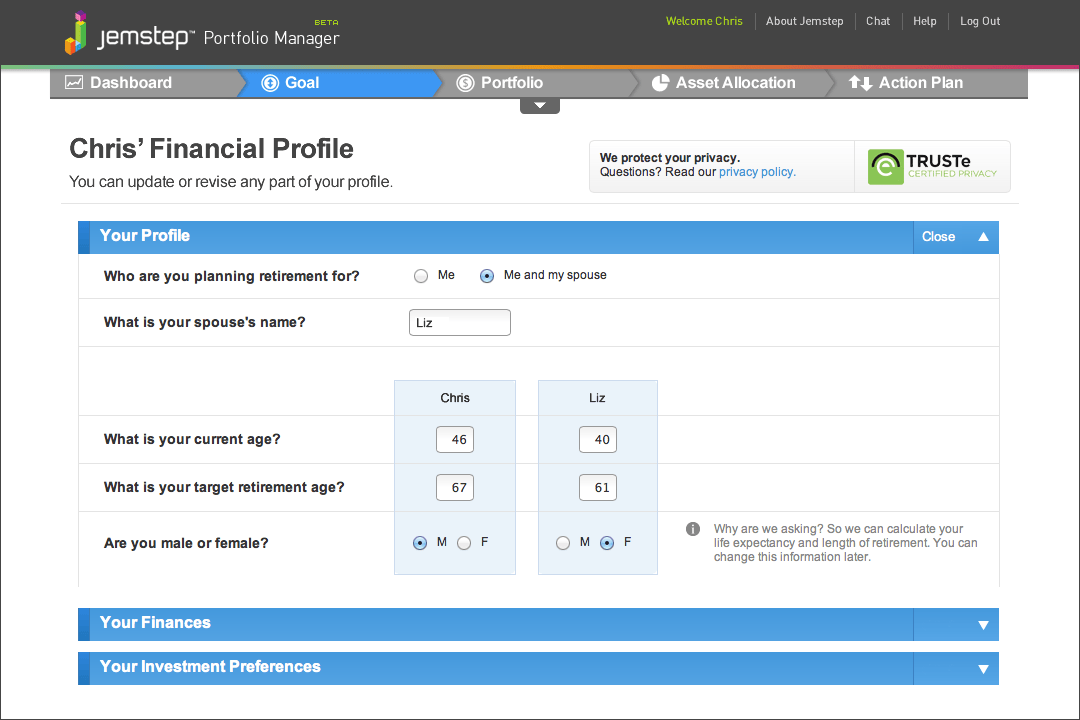
The Jemstep approach is consistent with that of an advisor. First, JemStep asks you questions about your goals. What do you need your portfolio to do? It asks questions about how far away the goal is, how much you may need to access at a time, and other relevant questions. I found this process fun. The interface is intuitive and the style of the website draws you in.

Jemstep Portfolio Manager Review at The Free Financial Advisor

Jemstep asks you for information about your retirement goal, among others. The interface is easy to use, and the blue lines below tell you just how far you still have to go: I have to still fill in information on my finances and investment preferences.

Once you’ve answered goal-related questions, you can upload your portfolio directly from your broker or add in funds manually. Finally, JemStep does it’s work and voila….gives you the correct asset allocation for your goal.

Jemstep Portfolio Manager basic recommendations

Here is the basic recommended portfolio. With these changes, I stand to gain over $9,000 per year in retirement. Yee-haw!

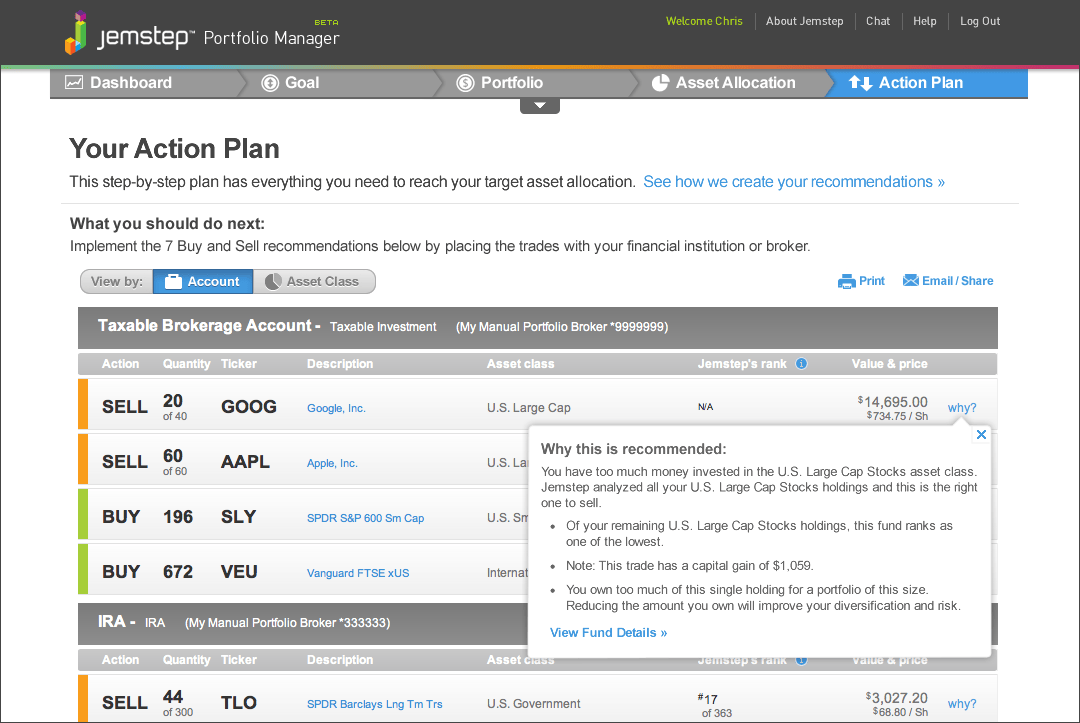
The premium version of Jemstep includes lists of what investments you should sell (in many cases only trim back), which investments you should accumulate, and new suggestions for your portfolio (often in asset classes that don’t exist in your portfolio). Here’s what that looks like:

jAction-Plan

Jemstep not only tells me which investments to sell, but alerts me to potential capital gains taxes. Every sell recommendation is accompanied by a detailed reason why this investment is on the chopping block. In this case: Apple is one of my worst performers and I have too much individual stock for a portfolio of this size.

The Cost

The Jemstep pricing model isn’t surprising. You can access basic advice for free (this includes the asset allocation you should be using, plus the differences between your portfolio and the suggested one). The premium model, which includes continuous tracking, rebalancing advice, a detailed breakdown of recommended sale quantities and investments, is also free for people just starting out. Pricing begins at $17.99 per month for portfolios over $25,000, and increases based on the amount of money Jemstep is helping you manage. While some who are looking for a freebie might be turned off by the price, this is less than the 1% fee often charged by a financial pro. Want professional advice in your corner without having to sit in an office with some team of people? Great. Jemstep won’t call you with hot stock tips and is there when you need it. In exchange, you’ll pay a model comparable to those used by seasoned investors for less than half the cost.

What I Like, What I Don’t

Here’s what I love: this asset allocation is a proven winner that points you toward the low cost, high return investments in a balanced portfolio. If you’ve ever wanted to have a well-managed portfolio but didn’t know where to start, Jemstep is a great place to begin. Different than some generic asset allocation models that I’ve used, JemStep points you toward specific investment options. For the person who wants to make sure they have low cost investments with a proven track record, Jemstep is for you.

Jemstep partnered with Windham Capital Management to create their recommendations. When back-tested against the S&P 500, Jemstep’s recommended portfolio was impressive: all five of their model portfolios outperformed the S&P 500 over the last 14 years with significantly less risk.

Here’s what I don’t like: results. Yes, JemStep provides impressive results, but will you use them? As I’ve stated before, financial advisors exist for one reason: to make sure that the job is finished. When people left my office, the portfolio moves were complete and people could go about their lives, knowing that the important decisions had been made. A JemStep rep was excited to tell me that 12% of JemStep users actually made changes to their portfolio “because it’s so hard to get people to take action.”

She’s right on.

While 12% usage is a great number for an often-free tool used by people on the internet, you should examine yourself. Are you going to follow through and actually take the advice on JemStep? If you don’t trust yourself to do the job, pay more and hire a human being who’ll give you a shove.

Overall Impression

If you’re managing your own money and aren’t sure how to do it well, give Jemstep a shot and follow the recommendations. If you don’t like your advisor or wonder if the recommendations you’re receiving are any good, take the time to use JemStep to give yourself a “second opinion.” The tool is robust enough that you’ll know immediately if your advisor isn’t diversifying your portfolio in a way that makes sense for your goals.

Jemstep can be found at Jemstep.com. I am not an affiliate of Jemstep and was not compensated for this review.

Enhanced by Zemanta
Photo of Joe Saul-Sehy
Joe Saul-Sehy

Joe is a former financial advisor and media representative for American Express and Ameriprise. He was the “Money Man” at Detroit television WXYZ-TV, appearing twice weekly. He’s also appeared in Bride, Best Life, and Child magazines, the Los Angeles Times, Chicago Sun-Times, Detroit News and Baltimore Sun newspapers and numerous other media outlets.  Joe holds B.A Degrees from The Citadel and Michigan State University.

joesaulsehy.com/

Filed Under: low cost investing, Planning Tagged With: Asset Allocation, diversification, Financial adviser, financial advisor, Investment, JemStep

Six Simple Tips for Beginner Investors

October 19, 2012 by Joe Saul-Sehy 17 Comments

My parents are in town! While I’m partying with my peeps, this guest article was written by our friend Julian over at Frugaal. Frugaal is a website that provides online stock and forex broker reviews, and it also contains a blog focusing on a broad range of financial and frugal-living topics. Enjoy!


You may think that investing is too complicated and difficult for you–especially if you have a very small amount that you’re able to invest. But over the past few years, the internet has made investing a possibility for anyone. Now, using online brokers, even if you only have a very small portfolio you can get all the benefits that the large investors do, just on a smaller scale. Of course, make sure you check out all the options available for you at the different brokerage companies but, in the meantime, take a look at these six simple investing tips for beginners.

Start small, and also don’t be deterred if you don’t have much cash to invest


In the past, it was impossible to start a portfolio with a very small investment. However, now you can get started with as little as $100. In fact, this it’s a good idea to start of small so you can learn the ropes before you start to take things seriously. So get your feet wet by buying a small portfolio containing mutual funds for example; this will give you an idea of how the stock market works and will mean you won’t risk more than you can afford to. However, by choosing wisely, you can find funds that are highly unlikely to ever lose major ground; they just may not have as high of a return as those that are more volatile. When purchasing stocks, beginners should also ideally go to discount online brokerages where, although the level of service will not stretch beyond deal-execution, you will avoid any expensive fees.


Do your homework


This tip doesn’t mean to say it’s a good idea to shell out a ton of money on books and even online or offline tutorials and courses. Instead, it means harnessing the wide range of readily available, free educational tools that are out there. So follow blogs that specifically focus on stock investing; read the financial papers to get an idea of what stocks you might like to purchase; join online forums (often found on the websites of online brokerages) to pitch your questions and ideas to others who have been in the game for longer and are more knowledgeable than you; and, as the very first starting point, be sure to understand some of the basic principles and rules of economics, accounting, and corporate finance. Ultimately, remember that a few Google searches and a few hours spent reading will get you a long way to begin with all this.


Monitor your investments


After you buy your first stocks, check up on them regularly. While you don’t want to become obsessed with checking them several times a day, this is your money that you’ve invested, so you should keep an eye on how things are going. Only by carefully monitoring the investments will you start understanding what makes them go up or down in value over time. A great way of monitoring your investments is by harnessing the capabilities of Google Finance. You can then also get yourself a Google Docs stock portfolio monitoring spreadsheet. The best thing is, both of these services are completely free.


Diversify


In some ways this should be on this list, but in other respects, it shouldn’t. If you have a diverse portfolio you’ll be mitigating against the risk of losses by spreading your investments across a diverse portfolio. Although in principle this is great, the reality is that it’s not possible to get your hands on a truly diverse portfolio with only a small amount of funds unless you buy into an index fund. So don’t be too hung about not being able to foster a diverse portfolio yourself if you don’t have the funds to do it.


Make investing a priority


If you want to add to your portfolio regularly, make investing a priority in your life. The old adage is that you should pay yourself first, meaning you should put aside money for savings before you pay your bills and buy things you need or want. This is excellent advice. Each paycheck, set aside a certain amount that you wish to invest, say 5% for example. It may not be much, but over time it will add up and your portfolio will grow. Investing is also a great thing to get into if you want to reel in your spending sprees and start to look towards the future, particularly if you’re a young adult. This is because unlike placing money into a savings account – a fairly passive and dull activity – investing can be exciting and it can become a new interest of yours, but one that will also allow you to build a healthy nest egg for later on in life too.


Have patience


Investing is not about getting rich overnight. Have patience with your chosen investments. There’s a very good chance they’ll grow and over time will begin to provide you with the financial return you were after. So if you’re after a quick return, investing won’t be the right method of savings for you; remember, investing is for those with time to wait for the market to dictate the rewards. Also, at the very basic level, make sure you’re not duped by any advert or website suggesting ‘get rich quick’ schemes through stock investing either. Put simply, there’s no magic bullet when it comes to stock investing, so don’t try and look for one.


Thanks for filling in, Julian! With the 4th quarter here, it’s time to cha-ching! on your investments. Okay, crew, your turn. Any tips to pile on top of Julian’s for your internet friends (or as my buddy Kathleen says, “the friends in your computer?”

Photo of Joe Saul-Sehy
Joe Saul-Sehy

Joe is a former financial advisor and media representative for American Express and Ameriprise. He was the “Money Man” at Detroit television WXYZ-TV, appearing twice weekly. He’s also appeared in Bride, Best Life, and Child magazines, the Los Angeles Times, Chicago Sun-Times, Detroit News and Baltimore Sun newspapers and numerous other media outlets.  Joe holds B.A Degrees from The Citadel and Michigan State University.

joesaulsehy.com/

Filed Under: Investing, investment types Tagged With: Asset Allocation, Individual Retirement Account, investing, Investment

So You Want to Manage Your Own Money?

September 4, 2012 by Joe Saul-Sehy 29 Comments

A friend texted me this morning.

“We should talk soon. Julie is coming around to the idea of us managing our own money.”

It seems easy, right? My initial reaction to my friend was, “That’s awesome!” because it is. There are few things more satisfying than achieving your financial dreams and knowing that you climbed the money management mountain yourself.

No “money-god” came down and did it for you.

You didn’t need the Powerball numbers.

You actually plotted a financial course and landed safely at your destination.

For my friend, and for you if you’re about to embark on this journey, there’s good news and bad news: the good news is that it isn’t difficult to manage your own money.

The bad news is that to effectively manage your own money you’ll need to be ready to face some fairly difficult tasks.


Two Types of People


When I was a professional advisor, I’d meet some smart people who wanted to jump into their own money management and wanted an expert with an opinion to look over their shoulder, hold them accountable, and make sure they didn’t miss any “I” dotting or “T” crossing.

…and then there were other, often equally-smart people who wanted to hand it over to me and have someone else take care of it for them.

Believe it or not, most advisors I knew preferred the latter type of client and loathed the first one. Someone questioning their motives? Someone asking “why are we doing it this way?” all the time? That’s preposterous!

But if you’re going to ever learn how to manage your own money, you’ll need to be the first type, not the latter.

The steps aren’t difficult:


The Steps to Managing Your Own Money


My kids are reading myths in school. In the story of Hercules, he faces a series of challenges to achieve is goal.

I look remarkably like the guy on top, but I’m a little paler and not quite as naked. And I have less hair.

You’ll have a series of gauntlets in your way too, if you want to manage your own money.

1) Write out your goals. I’m not talking about writing:

Retirement

College

New Boat

Fall Deeper in Love

Real goal writing has a specific time, dollar amount and vision attached.

I want to be able to live on $65,000 per year (in today’s dollars) by age 65 without having to work every day. With this money I’d like to: (here you write your bucket list, which should include visiting every NASCAR track in the country).

That’s a goal you can shoot for and be excited about (except for visiting the track at Pocono, which I thought was pretty overrated).

2) Next, you write out all the hurdles in your way.

– I have $25,000 in credit card debt (separate by interest rate, term, amount)

– I have to put two children through college

– I know nothing about money management

3) Then, you find one of the nearly bazillion financial calculators online (you can use our powerful little PlanWise calculator here on the site!) and figure out how much you need to save to reach your goal.

– I need to save $250 per month to reach my dream if I achieve an 8% return.

Armed with your money management return information, now you figure out how to come up with $250 per month.

– Tweak your budget

– Pay down debt

– Take on more work

4) Before investing, though, you have a big problem. You have to insure yourself against some of the huge “what if’s” out there for you and your family:

What if you die?

What if you are disabled?

What if you have a car accident?

You’ll need to create a will and evaluate insurances.

5) Finally, you begin the heavy task of research to find investments that have historically achieved 8%.


No Step is Difficult, You Just Shouldn’t Miss One


As you can see, when you take on the hard task and decide to manage your own money, getting it right will be difficult. Each area demands time and energy:

– Planning, milestones and tracking

– Budget, income advancement and debt reduction

– Insurance need projection and comparison analysis

– Estate planning

– Investment allocation, picking and monitoring

These are five basic money management steps, but each packs a punch!


I Don’t Mean To Imply You Can’t Do It


As soon as I finish this piece I’m calling my buddy and talking him through these points. Before he takes on the task, he should know how long the financial security road really is. Going in with your eyes wide open is half the battle if you plan to win the “manage your own money” game.

He can do it, and so can you!

Enhanced by Zemanta
Photo of Joe Saul-Sehy
Joe Saul-Sehy

Joe is a former financial advisor and media representative for American Express and Ameriprise. He was the “Money Man” at Detroit television WXYZ-TV, appearing twice weekly. He’s also appeared in Bride, Best Life, and Child magazines, the Los Angeles Times, Chicago Sun-Times, Detroit News and Baltimore Sun newspapers and numerous other media outlets.  Joe holds B.A Degrees from The Citadel and Michigan State University.

joesaulsehy.com/

Filed Under: money management, Planning, successful investing Tagged With: Budget, Debt, finance, Financial services, Insurance, Investment, manage your money, money management

  • « Previous Page
  • 1
  • …
  • 3
  • 4
  • 5

FOLLOW US

Search this site:

Recent Posts

  • Can My Savings Account Affect My Financial Aid? by Tamila McDonald
  • 12 Ways Gen X’s Views Clash with Millennials… by Tamila McDonald
  • What Advantages and Disadvantages Are There To… by Jacob Sensiba
  • 10 Tactics for Building an Emergency Fund from Scratch by Vanessa Bermudez
  • Call 911: Go To the Emergency Room Immediately If… by Stephen Kanaval
  • 7 Weird Things You Can Sell Online by Tamila McDonald
  • 10 Scary Facts About DriveTime by Tamila McDonald

Copyright © 2026 · News Pro Theme on Genesis Framework