• Home
  • About Us
  • Toolkit
  • Getting Finances Done
    • Hiring Advisors
    • Debt Management
    • Spending Plan
  • Insurance
    • Life Insurance
    • Health Insurance
    • Disability Insurance
    • Homeowners/Renters Insurance
  • Contact Us
  • Privacy Policy
  • Risk Tolerance Quiz

The Free Financial Advisor

You are here: Home / Archives for bonds

10 Portfolio Diversification Moves That Feel Like Cheating

June 1, 2025 by Travis Campbell Leave a Comment

diversification

Image Source: pexels.com

Building a strong investment portfolio can feel overwhelming, especially when you’re bombarded with advice about diversification. But what if there were ways to diversify that almost feel like you’re bending the rules—in a good way? The truth is, smart diversification isn’t about making things complicated. It’s about using clever, sometimes overlooked strategies that can boost your returns and lower your risk. Whether you’re a seasoned investor or just starting out, these portfolio diversification moves can make your financial life easier and more rewarding. Let’s dive into ten diversification tactics that might feel like cheating, but are actually just smart investing.

1. Target-Date Funds: Set It and (Almost) Forget It

Target-date funds are the ultimate “easy button” for portfolio diversification. These funds automatically adjust their asset allocation based on your expected retirement date, blending stocks, bonds, and sometimes alternative assets. You get instant diversification without having to rebalance or research individual investments. This feels almost too simple for busy investors, but it’s a proven way to keep your portfolio balanced over time.

2. Total Market Index Funds: One Fund, Hundreds of Stocks

Why pick individual stocks when you can own the whole market? Total market index funds give you exposure to hundreds or even thousands of companies in a single fund. This move instantly diversifies your portfolio across sectors, company sizes, and geographies. It’s a favorite among passive investors and is often recommended by financial experts for its simplicity and effectiveness. Vanguard’s research shows that broad diversification can help smooth out the bumps in your investment journey.

3. International ETFs: Go Global Without the Guesswork

Sticking to U.S. stocks is comfortable, but it leaves you exposed to domestic risks. International ETFs let you tap into growth in Europe, Asia, and emerging markets—all with a single purchase. This move can help protect your portfolio from U.S.-specific downturns and open the door to new opportunities. It’s a simple way to diversify globally without having to research foreign companies individually.

4. REITs: Real Estate Exposure Without the Headaches

Real Estate Investment Trusts (REITs) allow you to invest in real estate without becoming a landlord. REITs trade like stocks but own income-producing properties such as apartments, offices, and shopping centers. Adding REITs to your portfolio can provide steady income and diversification, since real estate often moves differently than stocks and bonds. It’s a hands-off way to get real estate exposure that feels almost too easy.

5. Bond Ladders: Smoothing Out Interest Rate Surprises

Bonds are a classic diversification tool, but building a bond ladder takes it up a notch. By buying bonds with different maturity dates, you can reduce the risk of interest rate swings and ensure a steady stream of income. This strategy can help you avoid the pitfalls of putting all your eggs in one bond basket, and it’s surprisingly simple to set up.

6. Sector ETFs: Bet on Trends Without Picking Winners

Want to invest in technology, healthcare, or clean energy but don’t want to pick individual stocks? Sector ETFs let you invest in entire industries with a single fund. This move gives you targeted exposure while still spreading your risk across multiple companies. It’s a great way to ride industry trends without the stress of choosing the next big winner.

7. Fractional Shares: Diversify on Any Budget

In the past, high share prices kept many investors from owning certain stocks. Now, fractional shares let you buy a piece of any company, no matter the price. This means you can diversify across more companies, even with a small investment. It’s a game-changer for new investors and anyone looking to spread their money further.

8. Robo-Advisors: Automated, Algorithm-Driven Diversification

Robo-advisors use algorithms to build and manage a diversified portfolio for you. They automatically rebalance your investments and adjust your asset allocation based on your goals and risk tolerance. This hands-off approach can feel like cheating, but it’s backed by solid financial theory and can help you avoid emotional investing mistakes. Morningstar’s analysis highlights how robo-advisors can deliver effective diversification at a low cost.

9. Alternative Assets: Spice Up Your Portfolio

Alternative assets like commodities, private equity, or even cryptocurrency can add a new layer of diversification. These assets often move independently of traditional stocks and bonds, helping to reduce overall portfolio risk. While they’re not for everyone, adding a small slice of alternatives can make your portfolio more resilient to market swings.

10. Dividend Growth Funds: Income and Stability in One

Dividend growth funds focus on companies with a history of increasing their dividends. These funds offer a blend of income and growth, and the companies they invest in tend to be stable and well-established. This move can add a layer of stability to your portfolio while providing long-term growth potential.

Diversification: The Secret Sauce to Smarter Investing

Portfolio diversification isn’t about making things complicated—it’s about making smart, strategic moves that protect your investments and help you grow wealth over time. By using these ten diversification strategies, you can build a portfolio that feels almost effortless but is actually working hard behind the scenes. Remember, the best portfolios aren’t built on luck but on smart diversification.

What’s your favorite diversification move? Share your thoughts or experiences in the comments below!

Read More

How to Slash Your Tax Bill – 2 Guys & Your Money

5 Ways to Improve Your Industrial Business Security

Travis Campbell
Travis Campbell

Travis Campbell is a digital marketer/developer with over 10 years of experience and a writer for over 6 years. He holds a degree in E-commerce and likes to share life advice he’s learned over the years. Travis loves spending time on the golf course or at the gym when he’s not working.

Filed Under: Investing Tagged With: Alternative Assets, bonds, etfs, Index Funds, investing, Personal Finance, Planning, portfolio diversification, REITs, robo-advisors

7 Financial Words You’re Using Every Day But Have No Idea What They Really Mean

February 10, 2025 by Latrice Perez Leave a Comment

Financial Words

Image Source: 123rf.com

In today’s world, financial terms often pop up in conversations, news, and advertisements. We use them all the time, but how many of us truly understand their full meaning? You may think you know what terms like “tariffs” or “liquidity” mean, but there’s often more to them than meets the eye. Here’s what 7 financial words that you probably use every day actually mean.

1. Tariffs

You’ve likely heard the word “tariffs” being used in the news, especially in discussions around trade wars and international commerce. But what does it really mean? A tariff is a tax or duty imposed by one country on goods or services imported from another. Governments use tariffs to protect local industries, raise revenue, or respond to trade imbalances. While tariffs are often discussed in terms of international trade, they can directly impact the prices of goods you buy, especially imported items like electronics, clothing, or even food. So when you pay more for imported products, those additional costs might be a result of tariffs.

2. Net Worth

When people talk about net worth, it often sounds like a concept reserved for the wealthy. But in reality, net worth is simply the difference between what you own (your assets) and what you owe (your liabilities). It’s an important indicator of your financial health.

To calculate your net worth, you add up all your assets—such as cash, investments, and property—and subtract any debts you have, like mortgages, loans, and credit card balances. Tracking your net worth over time can give you a clear picture of your financial progress and help you plan for the future.

3. Assets

Assets

Image Source: 123rf.com

When people talk about their assets, they typically mean valuable things like a house, car, or savings. But “assets” in the financial world is a broader term that refers to anything of value that you own. This could include cash, investments, real estate, or even intellectual property. The term is often used to determine an individual’s net worth, which is the value of all their assets minus their liabilities (debts). Understanding your assets—and how to protect and grow them—is crucial for making sound financial decisions and planning for the future.

4. Dividends

If you own stocks or shares, you might have heard the word “dividends” thrown around. A dividend is a payment made by a company to its shareholders, typically out of its profits. Companies often pay dividends to reward shareholders for investing in the company and to share the profits. While dividends are common in the world of investing, not every company pays them. Some choose to reinvest profits back into the business instead of distributing them to shareholders. When you invest in dividend-paying stocks, you’re essentially receiving a share of the company’s earnings.

5. Liquidity

When someone mentions “liquidity” in financial discussions, it can sound like a complicated concept. But it simply refers to how easily an asset can be converted into cash without affecting its price. For example, cash is the most liquid asset, because it’s already in the form you can spend. Stocks, bonds, or real estate are considered less liquid because it takes time to sell them and convert them into cash. Liquidity is an important consideration when assessing the health of your finances, as it determines how quickly you can access funds in an emergency or when an investment opportunity arises.

6. Inflation

You’ve probably heard about inflation, especially when prices on everyday goods and services seem to increase over time. Inflation refers to the rate at which the general level of prices for goods and services rises, eroding purchasing power. A little inflation is normal in a growing economy, but if inflation rises too quickly, it can lead to economic instability. For example, if inflation is high, the same amount of money buys fewer goods and services than it did before. It’s important to consider inflation when planning for long-term savings and retirement, as it can impact the value of your money over time.

7. Bonds

Bonds are often mentioned in financial news, but many people don’t fully understand what they are. A bond is essentially a loan that you give to a government or company, in exchange for periodic interest payments and the return of the principal at the bond’s maturity. Bonds are considered relatively low-risk investments compared to stocks, but they also typically offer lower returns. Investors often buy bonds as a way to balance their portfolios and reduce overall risk. Bonds come in various forms, including government bonds, corporate bonds, and municipal bonds, each with its own risk profile and benefits.

Understanding the Financial Lingo

Whether you’re navigating the stock market, looking to buy a home, or just trying to get your financial house in order, understanding these commonly used financial terms is crucial. Many of the words we use daily, like “tariffs,” ” net worth,” or “liquidity,” have deeper meanings and can influence your financial decisions. By learning what these terms truly mean, you’ll be better equipped to make informed decisions that impact your financial future.

Did you already have a good understanding of the terms in the article? If not, which terms did you already know the meanings of, and which ones did you learn today? Let’s talk about it in the comments below.

Read More:

15 English Tongue-Twisters: Words That Will Test Your Speaking Skills

12 Words and Phrases from the 1960’s That Need To Make a Comeback

Latrice Perez

Latrice is a dedicated professional with a rich background in social work, complemented by an Associate Degree in the field. Her journey has been uniquely shaped by the rewarding experience of being a stay-at-home mom to her two children, aged 13 and 5. This role has not only been a testament to her commitment to family but has also provided her with invaluable life lessons and insights.

As a mother, Latrice has embraced the opportunity to educate her children on essential life skills, with a special focus on financial literacy, the nuances of life, and the importance of inner peace.

Filed Under: Personal Finance Tagged With: assets, bonds, credit score, Dividends, financial literacy, financial terms, Inflation, liquidity, Personal Finance, tariffs

Managing High Inflation in Retirement

December 29, 2021 by Jacob Sensiba Leave a Comment


Managing High Inflation in Retirement

Inflation is high. We all know that. I’ve been writing about it for months and it appears that it’s here to stay. With all of that said, I saw a question the other day about how to manage the high inflation when you’re in retirement, and I thought it was a good topic to talk about today. So we’re going to discuss high inflation in retirement, how it’s impacting retirees, budgeting strategies, investment strategy changes, and if inflation will be an ongoing concern for retirees.

Inflation right now

It’s high…no surprise to anyone. In January it was 1.4%, in April it was 4.2%, in July it was 5.4%, in October it was 6.8%, and in December it was 5.9%. That’s historically high. The highest it’s been in 40 years. Will that stay, only time will tell and we’ll get into that later.

How is it impacting retirees?

Things are getting expensive, so when you set a budget at the beginning of your retirement you account for the current price of the things you need. You should also account for increased costs of items as time goes on because there can be big or small increases…either way, prices costs will go up.

Groceries and energy are two prime examples of things that have gotten more expensive recently. So when those things went up in price, it probably pinched people’s budgets, and/or pushed forward costs that probably weren’t expected for several years. Odds are, they’re spending more money now on food and energy than they anticipated. Hopefully, people have been able to make adjustments already.

Budgeting Strategies

There really aren’t a lot of tips I can give you. The best thing I can really say is to cut costs where it makes sense to account for things that are now more expensive. The other tip, though this is more of a gamble, is to not make any changes now and make changes in the future when inflation comes down.

Investment Strategies

With your investment, you’ll need to reallocate some assets. I wouldn’t take any money out of stocks. What I would do is take some money out of your bond investments and put it into precious metals. The FED said that they plan on hiking rates three times in 2022. Bond prices will go down when interest rates go up. Increasing your stock allocation or putting some money in precious metals could be a good way to combat inflation.

High inflation here to stay?

No, I do think it will be here until the FED hikes rates, but my reasoning for that has to do with what happened in 2018. If the FED can raise rates without putting a cork in the recovery, then I think there’s a possibility that inflation and the federal funds rate will stay elevated until the bubble pops.

Related reading:

Why Asset Allocation Matters

The Factors Causing Inflation

How to Beat Inflation with Investment

Disclaimer:

**Securities offered through Securities America, Inc., Member FINRA/SIPC. Advisory services offered through Securities America Advisors, Inc. Securities America and its representatives do not provide tax or legal advice; therefore, it is important to coordinate with your tax or legal advisor regarding your specific situation. Please see the website for full disclosures: www.crgfinancialservices.com

Jacob Sensiba
Jacob Sensiba

Jacob Sensible is a financial advisor with decades of experience in the financial planning industry.  His journey into finance began out of necessity, stepping up to support his grandfather during a health crisis. This period not only grounded him in the essentials of stock analysis, investment strategies, and the critical roles of insurance and trusts in asset preservation but also instilled a comprehensive understanding of financial markets and wealth management.  Jacob can be reached at: jake.sensiba@mygfpartner.com.

mygfpartner.com/jacob-sensiba-wisconsin-financial-advisor/

Filed Under: budget tips, Investing, money management, Personal Finance, Retirement, risk management Tagged With: bonds, Budget, Inflation, interest rates, investing, investment planning, precious metals, Retirement, retirement savings, savings, stocks

Why There is a Need for Investing in Renewable Energy Projects

January 13, 2021 by Susan Paige Leave a Comment

Renewable energies are sources of clean, inexhaustible, and increasingly competitive energy. They differ from fossil fuels principally in their diversity, abundance, and potential for use anywhere on the planet, but above all in that they produce neither greenhouse gases – which cause climate change – nor polluting emissions. Their costs are also falling and at a sustainable rate, whereas the general cost trend for fossil fuels is in the opposite direction despite their present volatility.

Clean Energy Is Increasing Popular

Growth in clean energies is unstoppable, as reflected in statistics produced in 2015 by the International Energy Agency (IEA): they represented nearly half of all new electricity generation capacity installed in 2014, when they constituted the second biggest source of electricity worldwide, behind coal.

Clean energy development is vital for combating climate change and limiting its most devastating effects. 2014 was the warmest year on record. The Earth’s temperature has risen by an average 0.85 °C since the end of the 19th Century, states National Geographic in its special November 2015 issue on climate change. Meanwhile, some 1.1 billion inhabitants (17% of the world population) do not have access to electricity. As such, one of the objectives established by the United Nations is to achieve to access to electricity for everyone by 2030, an ambitious target considering that, by then, according to the IEA’s estimates, 800 million people will have no access to an electricity supply if current trends continue.

The transition to an energy system based on renewable technologies will have very positive economic consequences. According to the International Renewable Energy Agency (IRENA), doubling the renewable energy share in the world energy mix, to 36% by 2030, will result in additional global growth of 1.1% by that year (equivalent to 1.3 trillion dollars), an increase in well being of 3.7% and in employment in the sector of up to more than 24 million people, compared to 9.2 million today. It will also significantly reduce air pollution.

Considering the importance of energy sustainability, the gravity of climate change and its impact on our planet, and the prospects for economic growth an increase in renewable energy can have, a transition to a system majorly operating on renewable energy is not only desirable but absolutely required.

RE Royalties and the Green Investing Revolution

That’s why Bernard Tan started RE Royalties. His goal was to help build renewable energy projects faster through innovative royalty financing, while leading the way for socially conscious investors. Many of RE Royalties’ clients have great project opportunities, but are too small to secure traditional financing to fund their growth plans. Typically, these projects need $1M – $20M in financing and want to maintain ownership of their assets.

While the royalty business model is well-proven and the renewable industry is not new, the combination of the two is very innovative. RE Royalties is the first royalty company to focus solely on the renewable energy sector. They provide capital in the form of a cash payment or loan, in exchange for a percentage of future revenues from operating projects. RE Royalties’ clients retain 100% control of their assets and businesses, and there are no restrictions on how the funds are used.

“The capital we provide can be considered an “advance” to our client, and the periodic percentage payments can be considered “royalties” to our investors, explains Bernard. We call it Renewable Energy Royalties.”

The idea for the business came when Bernard was working with a local clean technology company to help with their financing. The company had a promising technology that looked to harness the kinetic energy from tides and canals to generate clean electricity.

Not only did they have the technology to generate clean renewable electricity from an unlimited resource, but they also had an established development partner, the government was waiting to provide them with permits to install at various sites, and a long-term revenue contract to buy the electricity at a very high price. The only stumbling block was raising capital.

RE Royalties was started to create an alternative and an opportunity to make a difference for future generations. Bernard then contacted Peter Leighton, who was experienced in the renewable energy sector and joined the company as co-founder.

RE Royalties officially launched in January 2016. In March 2016, the company closed it’s first deal and acquired it’s first royalty in British Columbia, Canada.

Since then RE Royalties has built a portfolio of royalties in Canada, the United States and Europe. These long-term royalties are on over 400MW+ of solar, wind and hydro projects that are currently in operations or will be in the near-term. These projects play a significant role in combating climate change, as they will displace over 300,000+ tonnes of carbon per year from entering the atmosphere.

The company also announced a Green Bond offering, which allow participants to align their investments with their values while earning a fixed 6% return. Green Bonds are an exciting opportunity for socially and environmentally conscious investors who want to ensure their investments are helping fight climate change.

In contrast to buying shares and owning a piece of the company, RE Royalties Green Bonds are a loan from the investor to the company to be used exclusively for investing in renewable and sustainable energy projects.

Learn more about RE Royalties Green Bond offering here: https://www.reroyalties.com/green-bonds

Image source: Cafe Credit.

Filed Under: Investing Tagged With: bond, Bond Investing, bonds

High Yield vs. Other Investing Categories in Pretty Pictures

May 16, 2012 by Joe Saul-Sehy 14 Comments

When words don’t work, I’ll emulate my buddy PK at the DQYDJ blog and resort to graphics when explaining your investing options. Since I can’t personally be bothered to create any type of creative chart, I’ll instead use a graph that I  received from a friend.

Before we peruse this particular investing chart, I should introduce it, like a big star explains the movie clip:

People worry often about risk when investing. You should. It doesn’t make sense to risk your portfolio without knowing what type of return you’ll receive.

As an example, one of the riskiest investment classes is art. I know and you know that your dogs-playing-poker is probably a timeless classic, but beauty is definitely in the eye of the beholder on that one. Unfortunately, if you paid $10k for your Velvet-Elvis-and-the-Eagle rug, that’s probably considered a capital loss.

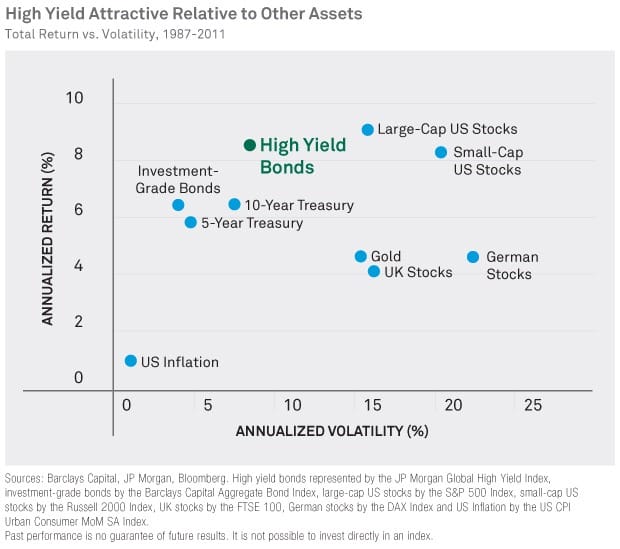
Here is the risk/reward profile of high yield vs. other asset classes:


Chart of Risk and Return


People are generally shocked when they see the risk/reward profile of high yield bonds. Is it true that JUNK BONDS are significantly less volatile than large-cap stocks?

Yup.

High yield bonds aren’t much more volatile than 10-year treasuries (which, ironically, have been more volatile than investment-grade bonds)?

Yup again. I knew people who came to this website are flippin’ brilliant.

Maybe now is a good time to review my posts last week on the topic of high yield bonds:

Off topic: Check out German stocks. Lots of volatility, plus those people wear black socks with sandals. I don’t know what those two points put together says, but it sure feels awkward.


How about you? Does this chart surprise you? Can you see my love affair with high yield? Make you laugh? Improve your outlook on life?

Enhanced by Zemanta
Photo of Joe Saul-Sehy
Joe Saul-Sehy

Joe is a former financial advisor and media representative for American Express and Ameriprise. He was the “Money Man” at Detroit television WXYZ-TV, appearing twice weekly. He’s also appeared in Bride, Best Life, and Child magazines, the Los Angeles Times, Chicago Sun-Times, Detroit News and Baltimore Sun newspapers and numerous other media outlets.  Joe holds B.A Degrees from The Citadel and Michigan State University.

joesaulsehy.com/

Filed Under: investment types, successful investing Tagged With: Asset, bonds, bonds vs. stock, Dogs Playing Poker, high yield, high yield risk reward, High-yield debt, Market capitalization, Velvet-Elvis

  • « Previous Page
  • 1
  • 2

FOLLOW US

Search this site:

Recent Posts

  • Can My Savings Account Affect My Financial Aid? by Tamila McDonald
  • 12 Ways Gen X’s Views Clash with Millennials… by Tamila McDonald
  • What Advantages and Disadvantages Are There To… by Jacob Sensiba
  • Call 911: Go To the Emergency Room Immediately If… by Stephen Kanaval
  • 10 Tactics for Building an Emergency Fund from Scratch by Vanessa Bermudez
  • 7 Weird Things You Can Sell Online by Tamila McDonald
  • 10 Scary Facts About DriveTime by Tamila McDonald

Copyright © 2026 · News Pro Theme on Genesis Framework