• Home
  • About Us
  • Toolkit
  • Getting Finances Done
    • Hiring Advisors
    • Debt Management
    • Spending Plan
  • Insurance
    • Life Insurance
    • Health Insurance
    • Disability Insurance
    • Homeowners/Renters Insurance
  • Contact Us
  • Privacy Policy
  • Risk Tolerance Quiz

The Free Financial Advisor

You are here: Home / Archives for Joe Saul-Sehy

Joe is a former financial advisor and media representative for American Express and Ameriprise. He was the “Money Man” at Detroit television WXYZ-TV, appearing twice weekly. He’s also appeared in Bride, Best Life, and Child magazines, the Los Angeles Times, Chicago Sun-Times, Detroit News and Baltimore Sun newspapers and numerous other media outlets.  Joe holds B.A Degrees from The Citadel and Michigan State University. 

High Yield vs. Other Investing Categories in Pretty Pictures

May 16, 2012 by Joe Saul-Sehy 14 Comments

When words don’t work, I’ll emulate my buddy PK at the DQYDJ blog and resort to graphics when explaining your investing options. Since I can’t personally be bothered to create any type of creative chart, I’ll instead use a graph that I  received from a friend.

Before we peruse this particular investing chart, I should introduce it, like a big star explains the movie clip:

People worry often about risk when investing. You should. It doesn’t make sense to risk your portfolio without knowing what type of return you’ll receive.

As an example, one of the riskiest investment classes is art. I know and you know that your dogs-playing-poker is probably a timeless classic, but beauty is definitely in the eye of the beholder on that one. Unfortunately, if you paid $10k for your Velvet-Elvis-and-the-Eagle rug, that’s probably considered a capital loss.

Here is the risk/reward profile of high yield vs. other asset classes:
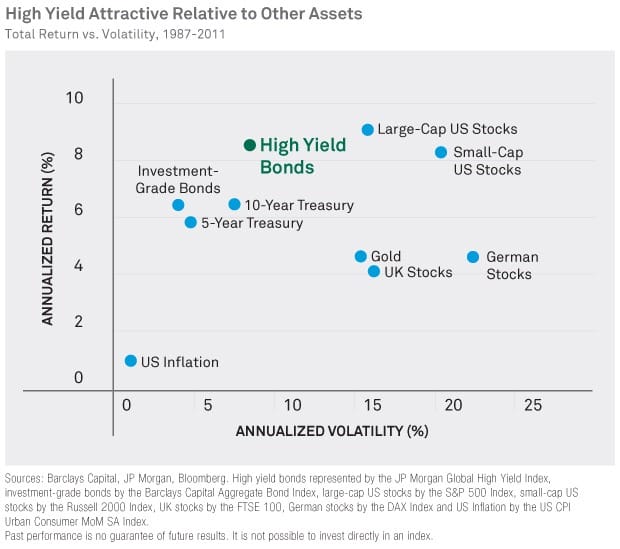
 

Chart of Risk and Return


People are generally shocked when they see the risk/reward profile of high yield bonds. Is it true that JUNK BONDS are significantly less volatile than large-cap stocks?

Yup.

High yield bonds aren’t much more volatile than 10-year treasuries (which, ironically, have been more volatile than investment-grade bonds)?

Yup again. I knew people who came to this website are flippin’ brilliant.

Maybe now is a good time to review my posts last week on the topic of high yield bonds:

Off topic: Check out German stocks. Lots of volatility, plus those people wear black socks with sandals. I don’t know what those two points put together says, but it sure feels awkward.


How about you? Does this chart surprise you? Can you see my love affair with high yield? Make you laugh? Improve your outlook on life?


Enhanced by Zemanta
Photo of Joe Saul-Sehy
Joe Saul-Sehy

Joe is a former financial advisor and media representative for American Express and Ameriprise. He was the “Money Man” at Detroit television WXYZ-TV, appearing twice weekly. He’s also appeared in Bride, Best Life, and Child magazines, the Los Angeles Times, Chicago Sun-Times, Detroit News and Baltimore Sun newspapers and numerous other media outlets.  Joe holds B.A Degrees from The Citadel and Michigan State University.
joesaulsehy.com/

Filed Under: investment types, successful investing Tagged With: Asset, bonds, bonds vs. stock, Dogs Playing Poker, high yield, high yield risk reward, High-yield debt, Market capitalization, Velvet-Elvis

JP Morgan: Opportunity or Trap for an Investor?

May 15, 2012 by Joe Saul-Sehy 15 Comments

While gold seekers in the stock market chase the Facebook IPO like NASCAR fans after a Dale Earnhardt Jr. autograph, my attention is leveled at JP Morgan Chase. I’m wondering if their recent stock hiccup is an isolated mistake or the beginning of a larger crisis.

This isn’t how most new investors act. Most hear bad news and run the other way.

You can profit from investing well-placed dollars into investments while others panic. In fact, I think it’s fun to prey on investors who throw logic out the window and panic.


In 2004, when investors panicked and sold investments around the Indian ocean after the tsunami, I snatched up iShare Singapore stock exchange shares (ticker: EWS). This was an easy decision: while many of their trading partners were hit hard, Singapore was not. There was bound to be a ton of shipping to rebuild the region, all to Singapore’s gain.


While not a homerun, the stock was an easy win. I’m not looking for huge gains….I’ll take good gains while minimizing my risk.


I didn’t want to prey on the awful event….I was very happy to prey on the morons who thought this was a good time to sell their investments in Singapore. Do your homework before panicking.

The market is usually a fairly efficient beast (I don’t want to have the “efficient market” argument in the comments, so please save them for another site), but during times of panic there’s money to make.

So, after JP Morgan Chase announced a $2 Billion dollar loss last week, hopefully you  also thought: “this looks like an opportunity.”

Not so fast, cowboy.

Before you invest money into ANY struggling company, you should understand the risks of this strategy. I do well because I pick my stock market spots carefully.

It looks so juicy, though!


Agreed.

On May 1, JPMorgan (JPM) was trading at $43.79. Yesterday JPM closed at $35.79. That’s a loss of over 18%.

If your thoughts immediately turn to “too big to fail,” you might be right (jokesters are out in droves with “too big to regulate” and others today).

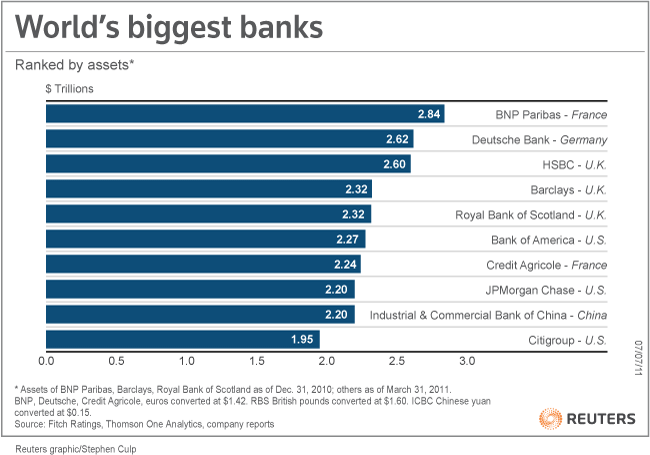
As of July of 2011, JP Morgan was the eighth largest bank in the world, according to Reuters:


World's Biggest Banks - Reuters


By many accounts, while $2 billion is large to you and I, JPM manages a stable of $2.2 trillion in assets and should be able to weather this storm.

Still, we need to do our homework before investing.


Follow These Steps


1) Understand the company, not just the situation. There will be news around JP Morgan in the next few weeks that I can almost guarantee will affect the stock price. Even if none occurs, it’s better to plan for news. Because you don’t know what the headlines will read tomorrow, have a solid a feel for the operation and scope of your target company to process how the news affects your position in the stock market.

Buying distressed companies isn’t about the initial purchase. You have to follow and respond to breaking news closely.

2) Evaluate the Risks

  • JPM could have severe penalties applied.
  • JPM may have broken the law.
  • Management may be forced to change (the Chief Investment Officer, Ina Drew, left yesterday).
  • Negative publicity could affect the performance of other divisions of the operation.

3) Sector analysis

You might find your dream company with an “oops” situation that’s easily fixable is in a nightmare sector where events are working against you. Any chance of a stock rebound is wiped out by prevailing conditions.

I thought this might be the case in early 2006. Ford pre-announced during their earnings report earlier in the week that they were going to unveil a major restructuring plan on January 23. Although layoffs aren’t a good sign over the long term, these quickly buoy the bottom line, giving hope to investors that the company will turn the corner. On the surface, this looked like a great event to invest in; a sure win.

There were significant downsides in the sector: at this time, the Detroit auto scene was in shambles. Auto supplier Delphi had declared bankruptcy only months earlier. Chrysler and GM were experiencing pain of their own. Did I really want to bet on a nice uptick in Ford stock over the short term when other auto news might sink my gains?

I explored the situation further. GM had already announced for the quarter a few days earlier. Chrysler had already experienced their blood letting, so I didn’t expect any short term news to disrupt what was looking like a quick trade.

In the final analysis, I made the trade, but because of the larger situation in the sector, I committed a much smaller portion of the portfolio than I’d originally intended. Plus, I became adamant that I’d set a quick turnaround on the stock. I’m usually a long term investor, but in this case, I was looking for a quick win.

I got it.

The morning of January 23, Ford announced a 30,000 job cut and the details of the restructuring. It was as large as expected. A stock that was trading at $7.90 the Monday before closed at $8.65 on the 25th. I was out, though, selling at $8.60. Nearly 10% in a few days was enough risk for me. This was one of only two or three times I’ve ever made a quick trade, and I don’t normally recommend it.

JP Morgan isn’t the same situation, but hopefully you understand my point: by analyzing other auto companies, I minimized the chances that news from them would work against me.

In the case of JPM, you’ll need to consider that state of banking. Is there any pending legislation that may affect performance? Is 2008 or a similar melt down in this sector or the wider stock market likely to occur?

4) Set defenses in place. Beginning investors should always work with a defensive strategy. I prefer a stop loss, but you may have other ways to reduce risk, such as the use of options. If you use a stop loss, you’ll want to give it a wide berth off the current price. Any stop loss placed within a few percentage points of the current trading level is bound to trigger due to the increased volatility of the stock.


magnifying glass II


Widen Your Lens


Because of a high credit rating, JP Morgan debt has been expensive, usually trading well above par value. If you feel JPM isn’t going to go bankrupt, then maybe looking for panic in the debt rather than the stock market is a better option. Here are some reasons I like trading debt instead of equity:

  • I know my end game (I’m guaranteed par value on the security at maturity as long as they don’t go belly up).
  • I can still sell on the open market.
  • I’ll receive dividends along the way, reducing my risk.

One such beast is a preferred stock. We’ll address preferreds in detail another day, but although they carry the name “stock,” a preferred acts much more like a bond.

A few questions to ask before investing in bonds or preferred stock:

  • What is par value. Many JP Morgan preferreds are trading at $25.50 or higher currently, while par value is $25 for preferreds (it’s $100 on most bonds).
  • What is the dividend? The stated dividend is based on the par value, so your dividend will vary from that stated on the preferred. If you’re using a website such as Bigcharts.com or Yahoo! Finance to evaluate the stock chart, the listed dividend is in fact the dividend you’ll receive at the current price.

Don’t just explore debt. Think further afield. Are there other companies that stand to win big because of JP Morgan’s stumble? Research these firms thoroughly before investing.


Final Thoughts


I’m not sure if I’m going to invest in JP Morgan. I’m more likely to buy here than in Facebook, a company with lots of hype and whose upside I don’t understand (most of my friends are tiring of Facebook, never a good sign for any product).

If you take anything from this discussion, I hope it’s the following:

– Think contrarian. When everyone else is running, ask “is this an opportunity?”

– Don’t buy immediately based on your contrarian “gut” reaction. Like buying a house or car, perform due diligence. Explore the company, the situation and the sector. Widen your lens to see if there are additional plays (such as debt or a competing company) that might make sense.

If this sounds like a lot of work, or individual stocks don’t fit your risk profile, stick with ETFs and mutual funds. Your chances of getting burned in your investment strategy is significantly reduced by staying diversified. Even if you do invest, don’t take large chances on “rebound” companies with significant portions of your portfolio.

Let’s pretend you were me: would you buy JP Morgan with a few “at risk” dollars? Are you jumping on this stock?


Enhanced by Zemanta
Photo of Joe Saul-Sehy
Joe Saul-Sehy

Joe is a former financial advisor and media representative for American Express and Ameriprise. He was the “Money Man” at Detroit television WXYZ-TV, appearing twice weekly. He’s also appeared in Bride, Best Life, and Child magazines, the Los Angeles Times, Chicago Sun-Times, Detroit News and Baltimore Sun newspapers and numerous other media outlets.  Joe holds B.A Degrees from The Citadel and Michigan State University.

joesaulsehy.com/

Filed Under: investing news, successful investing Tagged With: Chief investment officer, distressed investing, Ina Drew, Jamie Dimon, JPM, JPMorgan Chase, Singapore

The Worst of the Free Financial Advisor, Episode #8: Top 5 Ways to Cut Expenses

May 14, 2012 by Joe Saul-Sehy 6 Comments

Did you miss us?

The podcast comes roaring back after our week away as OG and I talk Ice, Ice, Baby, PK wins probability parlor games, and the roundtable ponders the question “Are We Too Dumb To Manage Our Retirement Money?”

Thanks to Greg McFarlane from Control Your Cash for sitting in with the roundtable gang this week!

<Open> Vanilla Ice on CNBC

<4:11> On the Blog: Cash Reserves

<7:59 >       Fractional Sense w/ PK from DQYDJ.NET

<15:57 >       Roundtable Question: Are we too stupid to manage our own money?

Control Your Cash article on The Simple Dollar and the oven light

– Washington Post Article: The 401k: Americans ‘Just Not Prepared’ To Manage Their Own Retirement Funds

– Vanguard Blog Piece: Retirement ready—or not?

– Singapore’s mandatory savings system: Forced Saving and Capital

Formation

Around the Blogosphere

– Dr. Dean discusses Talking About Ourselves: A Turn On? on the Millionaire Nurse Blog

– Greg McFarlane discusses retirement planning in Watch That Basket at Control Your Cash

– Len Penzo describes why You Should Be a Parent, Not a Best Friend at Len Penzo dot Com

– Carrie Smith feels the hurt of extra costs in Budgeting for Extra Costs When Moving To a New Apartment

<49:36 >       Top 5 Ways to Cut Expenses

Good Old Book: Saving on a Shoestring


All music in the show is from Incompetech.com

Photo of Joe Saul-Sehy
Joe Saul-Sehy

Joe is a former financial advisor and media representative for American Express and Ameriprise. He was the “Money Man” at Detroit television WXYZ-TV, appearing twice weekly. He’s also appeared in Bride, Best Life, and Child magazines, the Los Angeles Times, Chicago Sun-Times, Detroit News and Baltimore Sun newspapers and numerous other media outlets.  Joe holds B.A Degrees from The Citadel and Michigan State University.

joesaulsehy.com/

Filed Under: Podcast Tagged With: comedy financial podcast, free finance, free financial podcast

5 Fees I Hate More Than The New Spirit Airlines B.S. Bag Charge: Our Cuppa Joe Discussion

May 10, 2012 by Joe Saul-Sehy 22 Comments

It’s Thursday! That means we’re grabbin’ a cup of coffee and talking about my opinion on anything I find amusing that particular day (my favorite topic).

Spirit Airlines, who should really just change their name to “We Will Do Anything To Alienate Our Customers,” announced last week that they plan to charge $100 to give you the pleasure of placing a bag in the overhead bin.

If it’ll fit under your seat or on your body, you’re still good.

Now I’ll have to wear six layers of clothing on the plane instead of three.

Like cars, I feel an airplane ride is a way to get from point A to point B. That makes me a low-cost whore. If Spirit’s fees are still less than everyone else when you include the $100 bag fee, you’ll find me on the first flight out of Dodge. I’ll be the guy with the big, fat happy (and because of all the clothing…sweaty) grin on my face.

Spirit’s goal is to keep costs low. I understand that, so I’m taking this one in stride. As the above USA Today article states, other airlines are quietly following behind the Spirit-hatred shield. Other fees fill me with rage FAR more than this particular nuisance, because they make zero sense to me, except “this is an easy way for us to piss you off while we rip money out of your pocket.”

5) Credit card application or annual fees. There may be more on the way. On a recent Consumerism Commentary podcast, Flexo and Matt Schultz interview Jay Frosting of InvestingAnswers.com,about some alarming news around credit card application fees. The executive summary: Watch your credit card statements carefully. Fees might be rising soon.

4) Piled on mortgage fees. Origination charges? Appraisal fee of $350? Ouch. Ask for a complete list of mortgage expenses before signing on the dotted line.

3) Ticketmaster “convenience” charges. This one is awesome in a “you must be joking but you totally aren’t” kind of way. Ticketmaster charges me a CONVENIENCE FEE for printing tickets at my house. I made it more convenient for them (they don’t have to do anything at all) and they charge me more. There’s a bean counter at headquarters giggling to himself while I’m buying tickets.

2) Bank fees. Teller fees. Statement fees. ATM charges. I know. Enough already. We all know that banks don’t get it.

I love this series of Ally Bank commercials and their discussion of fees and bad customer service. These say it all:

Just one example of Ally’s campaign railing on bad customer service, fine print and baloney fees.


1) …and my most hated fee of all….hidden financial product fees, like 12b1 fees (mutual funds), mortality and expense charges (annuities), sales loads (funds and variable insurance products).

I know, I know. Mutual fund and insurance companies have to make money somehow. Just be brave like Spirit and tell me upfront how you’re going to skewer me to make a profit.


What are your least-favorite bullshit fees?

Photo of Joe Saul-Sehy
Joe Saul-Sehy

Joe is a former financial advisor and media representative for American Express and Ameriprise. He was the “Money Man” at Detroit television WXYZ-TV, appearing twice weekly. He’s also appeared in Bride, Best Life, and Child magazines, the Los Angeles Times, Chicago Sun-Times, Detroit News and Baltimore Sun newspapers and numerous other media outlets.  Joe holds B.A Degrees from The Citadel and Michigan State University.

joesaulsehy.com/

Filed Under: Cuppa Joe, Feature, money management, smack down!

The Waiting Is The Hardest Part

May 9, 2012 by Joe Saul-Sehy 17 Comments

I called my mother in law to check in yesterday.

I get worried about people after a loved one dies, but especially I’m concerned about her, right now. My in-laws were a close couple. She’d always yell, “Dave!” at him for one reason or another, but there was a camaraderie in her admonishments.

She enjoyed admonishing him and I could have swore he enjoyed being admonished.

There’s no way I can imagine what’s going on in someone’s head the day after their spouse passes away. It’s beyond imagination.

Still, my call to her was shocking.

I was surprised to find that she’d already called her financial advisor about moving money around and scheduled a meeting with the Medicare people about Papa Dave’s hospital bills.

Wow.

A piece of this I understand:

– The need to keep moving.

– The desire to run.

– The longing to make things feel better and to grab control.

I understand that, and it makes me want to give my mother-in-law a big fat hug today. All the running in the world won’t make the pain go away. There isn’t a hug big enough to swallow all those years of being together.

That’s why it’s a difficult pill to swallow when I tell you what I told her: Be still. Wait.

When any major life event occurs, the worst decision is to change your financial picture.

My best advice? Do nothing. Zip. Zero. Nada.

Too many times I’ve had clients come in after a spouse passes away and they want to make changes. Not little changes, mind you, but major, life changing moves. Let’s guarantee my money won’t run out. I want to take a trip around the world. It’s time to sell the house and move closer to my kids.

These are all valid thoughts, but not for today. Today’s a time to work on other areas.

– Go for a walk.

– Sign up for cooking classes.

– Learn a new language.

– Dive into a hobby.

All of these are positive life experiences that you can bow out of later without major repercussions. If you decide to sell your house and move, what if you don’t like the new place? If you change investments and the market tumbles, how will you respond?

Too many times I’ve witnessed people who’ve made life changing decisions without a clear head, only to regret all the moves later.

Often this regret, coupled with the sorrow of the original loss, is crippling.

How long do you wait?

I don’t know. 16 years of advising people who watched spouses, parents and children die still wasn’t enough for me to help you there. I can say this: Everyone was different. I will tell you that both my client and I knew when it was time to start moving. I’m sure you’ll know, too.

So, maybe Tom Petty was talking about a completely different topic, but he’s still right: The Waiting is the Hardest Part, but it’s the most important. Wait.

Photo of Joe Saul-Sehy
Joe Saul-Sehy

Joe is a former financial advisor and media representative for American Express and Ameriprise. He was the “Money Man” at Detroit television WXYZ-TV, appearing twice weekly. He’s also appeared in Bride, Best Life, and Child magazines, the Los Angeles Times, Chicago Sun-Times, Detroit News and Baltimore Sun newspapers and numerous other media outlets.  Joe holds B.A Degrees from The Citadel and Michigan State University.

joesaulsehy.com/

Filed Under: money management, successful investing

Emergency Fund? You’re Closer Than You Think

May 8, 2012 by Joe Saul-Sehy 20 Comments

Start a six month emergency fund? Are you crazy? How can I save that much money before I start investing? I’ll never make it! – most common reaction to my advice to create an emergency fund.

Personal finance is fun, but maybe the most boring part is creating an emergency fund. Yawn.

Building an emergency fund should be exciting. Sure, it’s the bland foundation of the house, but once this baby’s built, you’ll be able to rock ‘n roll on the fun stuff:

– Work without worry. You’ll know that even in an uncertain economy, you can focus on career instead of your next paycheck.

– Invest with confidence. We’re all worried about the market collapsing, but the best strategy is often to ride out downturns. With a reserve, you won’t have to decide whether to sell or not: you don’t need the money today.

– Weather financial storms. Is the muffler dragging behind your car? It’s covered! Did your dishwasher break down? You can fix it. Sure, you’ll have to slow your investing plan for a bit to rebuild the reserve, but you won’t be sweating the small personal finance stuff in life anymore.

In short, the reserve is the lynchpin of your personal finance plan. Doesn’t that fire you up?

Whether you’re excited or not, saving toward a reserve is a painful part of personal finance. That’s why gurus such as Dave Ramsey set the bar lower, like $1,000. Once you can weather the small storms, then you can focus on bigger fish.

At some point, you’ll need to adequately fund the reserve. There’s good news here. A six month cash reserve isn’t as large as you think it is.

First, people focus on three to six months of income, not expenses, when it should be the other way around. You don’t need six months worth of income. Your gross income from a job includes:

– federal taxes

– FICA taxes

– state taxes (in many places)

– savings

– insurance deductions (you’ll need to keep insurances in place, but the cost of workplace life or disability insurance will be removed). Unfortunately, you may have to self-purchase health insurance.

In a pinch, you don’t need to cover many of these costs. Instead, you’ll need only the basics: groceries, gasoline, clothing costs, utilities, and mortgage or rent payments. Add in any other debt payments you’ll have, and that’s your emergency fund amount.

This is a much, much smaller number than you may have realized.

Everyone wants to get their personal finance plan moving in the right direction. Building the foundation of your plan isn’t nearly as fun as what comes after. By focusing on the right number, you’ll have it built more quickly than you first imagined and be on your way to more entertaining goals.

(photo credit: martinak15, Flickr: frustrated; R Berteig, Flickr: foundation)

Photo of Joe Saul-Sehy
Joe Saul-Sehy

Joe is a former financial advisor and media representative for American Express and Ameriprise. He was the “Money Man” at Detroit television WXYZ-TV, appearing twice weekly. He’s also appeared in Bride, Best Life, and Child magazines, the Los Angeles Times, Chicago Sun-Times, Detroit News and Baltimore Sun newspapers and numerous other media outlets.  Joe holds B.A Degrees from The Citadel and Michigan State University.

joesaulsehy.com/

Filed Under: Cash Reserve, money management, risk management

You Can’t Make This Stuff Up

May 4, 2012 by Joe Saul-Sehy 13 Comments

Blog Post of the Week! will return next week.

I was riding the elevator this morning at Crittendon Hospital in Rochester, Michigan.

What was I doing there, you ask?

My daughter, who’d come to the Intensive Care Unit with us, wanted to get a drink. I could have used a strong one….but it was only a coffee shop and I wasn’t about to be the drunk guy at the hospital….

Autumn and I were sharing stories about my father-in-law, “Papa Dave,” as we have all week. He’s one my best friends. Last Saturday he fell while walking the dog and suffered a closed head injury. As I write this from the family waiting room, he’s expected to pass away any moment.

While we were talking, remembering, and thinking about Papa Dave’s last moments here, the elevator door opened to let more people onboard. A grandmother and three freckled kids, all between the ages of four and eight, piled into the elevator. One held flowers and another clutched a brand new teddy bear. They looked pensive and it appeared they’d been instructed to be on their best behavior.

I sickened. I’m sure Autumn had the same thought as me: they’re here to see a loved one die, too.

Autumn wiped away a tear and smiled. The grandmother couldn’t keep it in any longer. She spoke quickly.

“We’re getting a new baby brother this morning!” she beamed, nodding toward the girls.

The oldest one blushed.

I asked if they were excited. Each nodded.

When the elevator door opened, they piled out, rushing to see the new member of their family arrive while ours leaves.

There’s irony all around me today.

So, because I need a laugh, I’m going to provide one. Here’s one of my favorites….again, not suitable for little Jimmy or Julie, unless you want to show them what really goes on with Elmo Behind the Scenes.

Go hug somebody today.

j.

Photo of Joe Saul-Sehy
Joe Saul-Sehy

Joe is a former financial advisor and media representative for American Express and Ameriprise. He was the “Money Man” at Detroit television WXYZ-TV, appearing twice weekly. He’s also appeared in Bride, Best Life, and Child magazines, the Los Angeles Times, Chicago Sun-Times, Detroit News and Baltimore Sun newspapers and numerous other media outlets.  Joe holds B.A Degrees from The Citadel and Michigan State University.

joesaulsehy.com/

Filed Under: irrelevant stories, Meandering

How I Chose My High Yield Bond Fund

May 1, 2012 by Joe Saul-Sehy 16 Comments

Last week I described the ultra-thrilling process of how high yield bond funds work. The reason I penned that particular post was simple. I was in the process of buying one.

In today’s entry, lets look “over my shoulder” to see the method I used to pick my new fund. Many people don’t get to see how someone with 16 years of professional experience chooses an investment in their portfolio. Choosing a high yield mutual fund is a little like exploring through a wasteland of worthless investments (as you’ll soon see), and I think there’s a few crucial basics beginners can learn from my adventure.

Why? Like reading a map, you’re going to be surprised by how straightforward and simple the process is. Buying funds isn’t complicated and you too can find a good mutual fund within minutes while feeling comfortable that you performed adequate due diligence.

The key part of the process is spending some good time with the map first. If you know what you’re looking for, exploring for the fund is the easy part.

Leading up to choosing a fund, I determined the following:

  1. I knew my end goal. I wasn’t just throwing money in the general direction of my problems or praying for high returns. I didn’t use a “more is better” approach. That usually lands investors in an ugly spot, when their greed turns profits to huge losses. I was looking for retirement, and needed to maintain at least a 6 percent return to get there.
  2. I had already determined my asset mix to reach my goal. On our podcast and in previous posts, I’ve discussed finding the appropriate diversified asset mix for your goals. Mine included high yield bonds, mostly because they have a history of achieving my target return.
  3. I knew how much money I needed in high yield bonds to meet my goal. Normally, I’m not a fan of mutual funds. But, because it was a small amount and a manager can oversee the process of avoiding defaults, I decided one mutual fund would do the trick. For more sizable chunks, I’d hire multiple managers or switch from a mutual fund to individual bonds.

Why is it important to determine these three criteria first?

Like deciding which size ice cream cone you’re getting, it’s best to look at your current situation, or waistline, first. Plus, there’s another, overreaching reason:

I’m lazy.

Could you imagine the horror of searching through a gazillion mutual funds in a trillion different asset classes to find the one that fit my needs? Why would I spend countless hours oogling different investments I’ll never buy. I want to narrow the search as much as possible before investing. Why waste all that time I could be watching Cake Boss or Millionaire Matchmaker sorting through countless asset classes that I’ll never use?

I’m not going to waste time searching for investments. I’ll figure out the map first and then choose the right vehicle to get me to my goal.

…and that, class, is how we reached this point: choosing the vehicle.

Let’s begin.

My search began at TD Ameritrade. That’s because the IRA holding the cash I was going to use is housed there. If you’re not familiar with IRA custodians, you have a choice between many different places. Some decide on a bank, others a financial brokerage firm. I chose TD Ameritrade because I’m comfortable choosing investments alone but appreciate their stock and bond tools. They aren’t the cheapest provider, but I’m comfortable with the fee structure.

Fees


Just like a trip to the grocery store, every asset search begins with a discussion of “how much is this going to cost.” In many cases, I don’t want a mutual fund at all because they’re expensive, but in the high yield asset class, I want one. I don’t want to guess if one of the companies I own is going to go bankrupt. I also don’t want to do the homework necessary to avoid picking a loser (remember the lazy part above?).

Some mutual funds manage your cash for a reasonable fee, while others might as well be carrying a gun and wearing a mask.

But they’re not the only robbers.

It turns out that TD Ameritrade also is in on the “let’s gouge our customer” game. They’ve forged deals with some fund companies to offer their mutual funds at a lower cost. To tell you just how much lower, I was originally eyeing a Pioneer high yield offering. Imagine my surprise when I found out that I’d have to pay $49 when I bought AND AGAIN when I sold. Ouch.

As an aside, why not just round this ridiculous fee to $50? Wouldn’t anyone dumb enough to pay $49 shrug at a dollar more? If they want to play the psychological game make it $49.99. They’re leaving $10 on the table. I should work for TD Ameritrade…..


Screening: Expenses


So, armed with the list of funds that are available on my platform, I visit TD Ameritrade’s mutual fund screener site. There are many of these all over the web. The Wall Street Journal has a good one, as do Morningstar, Yahoo and MSN.

I used TD Ameritrade’s own screener for one reason. The first screen for me should be called “funds that avoid the ridiculous fee.” Because that’s too obvious, they named it, “No trading cost fund list.”

Screening: Manager


The second screen is for manager. If I have a manager at all, I want one who’s a little seasoned, but different than most investors, I also don’t want one who’s crusty. A fund manager nearing retirement might be milking her reputation at this point. Well-known managers such as Bill Gross at PIMCO are going to survive a couple down years with their portfolio if they decide to take a mental vacation at this point in the game. I don’t want that person.

I want them hungry.

There is no “avoid managers who have been around too long” screen, so I’m stuck using one based on minimum tenure. I don’t want one with less than three years in the saddle, personally, so I choose that screen.

Screening: Star Rating

Like I said, I’m lazy. I want Morningstar to do most of the heavy lifting for me. Although I’m smart enough to know that many lower-ranked funds could do well next year, I don’t have the time to search through them all.

In other areas, where I’m looking for more than a consistent dividend check and a fairly stable value, I might screen for more complex areas. In high yield, that’s it.

I press the “search” button.

Examining the List.

Now I feel like a kid in a candy store. Laid out in front of me is a shortened list of candidates for the title of “good enough to examine up-close.”

My attention now turns to fund evaluation company Morningstar, where I’m going to dig into each fund in detail.

I’m particularly interested in:

  • how each fund performed against it’s competitors,
  • what the dividend looks like, and
  • how the fund is managed.

I dig into these areas quickly. Simple internet searches lead me to mines of information. I’m too lazy to waste time flipping through funds, but when I’ve found my potential targets, I dig in like a rib-lover at the barbeque cook-off.

What Did I Choose?

Ultimately, the USAA High Income Fund won the day.

Why?

For an average fee of .90%, the dividend to me approaches 7% (6.93% as of this writing). The fund manager, R. Matthew Freund, has 21 years of experience (with USAA since 1994), so is mature yet not quite at retirement age. There’s been a co-manager named Julianne Bass since 2007, so there is younger blood overseeing day-to-day operations as well.

The fund has beaten the high yield sector over the past five years, but not by a ton. For the most part this fund’s performance has been slightly above or below the index. When it’s missed, it missed well above its asset category. It hasn’t had a major hiccup.

At this point, I like to guess what I’d rank the fund. I’d give it four stars out of five. It’s a winner, but not a thoroughbred. It won’t be the “hot thing” anytime soon. Perfect for this job.

Morningstar agrees, rating the fund four stars out of five. It’s an above average competitor with average fees and solid management.

Perfect. Often five star funds attract scads of assets, forcing me to look elsewhere as the management can’t invest all of the cash it’s attracted. I’m less concerned with the management of the fund over the past five years as I am over the next five. Because this fund isn’t meant to be the “go baby go” part of my portfolio, I’m fine with boring. In fact, I expect it and hope for it. Let’s get my 7% return so I can focus my energy elsewhere.

That’s how I picked the fund.

Complex? Nope.

I’d be willing to bet that this little 1000 word example is more homework than 95 percent of people complete when choosing investments. Even if a professional picks funds for you, there should be a list of screens you use to oversee picks.

It’s your portfolio. Take charge. It isn’t difficult.

(photo credit: Statue, Eusebius, Flickr;

Enhanced by Zemanta
Photo of Joe Saul-Sehy
Joe Saul-Sehy

Joe is a former financial advisor and media representative for American Express and Ameriprise. He was the “Money Man” at Detroit television WXYZ-TV, appearing twice weekly. He’s also appeared in Bride, Best Life, and Child magazines, the Los Angeles Times, Chicago Sun-Times, Detroit News and Baltimore Sun newspapers and numerous other media outlets.  Joe holds B.A Degrees from The Citadel and Michigan State University.

joesaulsehy.com/

Filed Under: investment types, investment websites, low cost investing, money management, Planning, successful investing Tagged With: High-yield debt, Investment management, Morningstar, Mutual fund, PIMCO, TD Ameritrade, USAA, Wall Street Journal

Worst of the Free Financial Advisor, Episode 7: Top 5 Annuity Traits

April 30, 2012 by Joe Saul-Sehy 9 Comments

This week we’re talking about annuities!  

Wait, don’t fall asleep yet, the episode hasn’t even started. Actually an annuity is an oft-misunderstood beast, so OG and I do our best to set the record straight.

Who knows, you might even enjoy learning a little about them!

PK from DQYDJ.net talks innumeracy. He calls his site “high on statistics and low on personality”….sure, PK. That’s what we have in common. No personality…. I still don’t know what innumeracy is…I think he’s swearing at us.

The roundtable team tackles an article by Sam from Financial Samurai on streams of income for retirement. How is your retirement vision? Is it close to Sam’s?

On the Sites (here are the articles mentioned in the segments):

Carrie Smith redesigned her site working with a friend at Careful Cents.

Dr. Dean talks coffee and tea at the Millionaire Nurse Blog.

Len Penzo made a list of 20 things he’s willing to spend more money for

Dominique Brown from Your Finances Simplified discusses how financial planning is like weight lifting

Show Notes:

<Open>  We begin the “I don’t want to say I told you so, but….” routine we often use when pretending we’re not bragging.

<14:30>  Fractional Cents with PK from DQYDJ.NET

<21:00>  Roundtable discusses Financial Samurai’s Achieving Financial Freedom One Income Slice at a Time

<51:50>  Top 5 Annuity Traits

The show continues, but as usual, if you’re still listening after the Top 5, you’re here for our general hilarity, not because you’re looking for more tips.

Thanks again to all of our contributers and listeners. I think you’re gonna love this show!


Enhanced by Zemanta
Photo of Joe Saul-Sehy
Joe Saul-Sehy

Joe is a former financial advisor and media representative for American Express and Ameriprise. He was the “Money Man” at Detroit television WXYZ-TV, appearing twice weekly. He’s also appeared in Bride, Best Life, and Child magazines, the Los Angeles Times, Chicago Sun-Times, Detroit News and Baltimore Sun newspapers and numerous other media outlets.  Joe holds B.A Degrees from The Citadel and Michigan State University.

joesaulsehy.com/

Filed Under: Podcast Tagged With: annuities, Financial Samurai, Life annuity, Personal Finance, Retirement

Being Okay With “I’m Not Okay” Financially: Our Cuppa Joe Discussion

April 26, 2012 by Joe Saul-Sehy 23 Comments

As I chronicled on Erin Shanendoah’s The Dog Ate My Wallet blog, I spent a year without much income (roughly $12,000). This lit a collection agency fire to the huge mound of debt I’d already wracked up, wrecked my credit rating and emptied my savings.

During this period I was renting a house in a nice neighborhood for far less money than I would have paid to own a home.

I hated the house.

It was a leaky, old 800 square foot bungalow and our young family of four was shoehorned in. I enjoy a small house, but this the double feature:  small and unattractive.

When my twins were in kindergarten a friend of my daughter’s came over and said, “I love your house. It reminds me of our cottage. It’s tiny!”

Kids say the cutest things. Yeah, right.

Once my income picked up, I wanted out of the house but I was trapped by those piles of debt. One day at lunch I was flipping through the newspaper and found another option: a house around the corner was up for rent at only $200 per month more than our current house! Better yet, it was 1,200 square feet and a bazillion years newer and more attractive.

I immediately imagined living there. In my mind, that felt like a palace compared to our house. I was motivated. I called the owner and talked it over. Things looked promising. Cheryl, initially worried, became excited too when we walked through the house. The kitchen was brand flippin’ new. There was a basement rec room where the kids could escape (or we could escape from them!) This was a dream come true. We could rent a nice place while we sorted out our debt troubles.

No more cottage. Hello real world.

I’ve been lucky to surround myself with people who aren’t like me. They think differently than I do. I suppose I’ve done this on purpose. I like a good discussion, and I don’t get angry when people disagree, as long as I understand the logic of the argument.

I told a close friend about this, very excitedly, and she didn’t seem as fired up. In fact, she didn’t get excited at all, even though I was flailing arms and explaining just how awesome this house was going to be for us.

I asked her what was going on in her head. Her answer changed my view then and still colors by lens when I approach financial situations today.

She said:

“Do you want to live in a nice place while you’re still buried in mountains of debt or do you want to come home to the reminder of why you need to change?”

She might have well punched me in the gut. I was desperate to change. I wanted to be free from the stomach-clenching thoughts of how long it was going to take to repay my lenders. She knew that the house would be pretend things are a-okay, and under all this enthusiasm, so did I.

Cheryl and I discussed the woman’s concerns. We decided to stay where we were.

Motivating Yourself to Change


Popular motivational speaker Anthony Robbins says that change happens because of desperation or perspiration. In most cases, people only change because they aren’t comfortable with their current reality.

That was the case for me. In other areas of my life, such as this blog, it’s still the case today. I’m not happy with where I am now. I need to motivate myself to continually improve and respond.

It may be the case for you now.

Are you living in reality or pretending things are okay?

Are you okay with “everything’s not okay?”


Case Studies: Confronting Change


When I was a financial advisor, if someone was single, they were coming to see me because they felt something wasn’t working correctly. Unfortunately, with many married couples, they would come in only because one of them wanted to change.

In essence, one saw the true picture and the other was in fantasyland.

You could tell when people didn’t want to change. They’d talk about “baby steps” and “getting comfortable” with one tiny recommendation I’d made before implementing the next one. When you dig to the root of this thinking, it’s easy to see what’s going on in their head:

Change is more scary and difficult than staying the way I am.

To bust through this wall of inactivity, it’s important to ask yourself a few questions. Here are the ones I’d use with myself and with clients:

1) If I stay where I am financially, where will I end up? What will the world look like down the road?

2) If I change, how will my world look down the road?

Often, when people actually analyzed their situation, change was less painful than staying the same. The future looked far, far brighter.

3) What systems can I put in place to automate the change and decrease the pain?

4) How long will the pain of change really last? Will it be hurtful for a long time?

5) If it does end up being more uncomfortable then I wish, can I come back to “the way I’m doing it now”?

Once people realized that they’re better off with the new strategy than the old, they became open to change. They still were understandably worried about the pain of change.

We’d discuss the actual immediate pain. There was never a time that change didn’t come with some pain. It was like ripping off the band-aid. Some hairs under that thing were going to die. We all feel better when we can identify exactly how it will hurt and for how long.

I still believe that if I’d actually moved into that house to dress up the present and pretend things were wonderful, my future wouldn’t have been as bright as it has been since.

I can’t say things aren’t perfect, but I’m glad I became okay with “things aren’t okay“ and faced the short term pain of achieving the freedom I was after.


Okay, that’s my story. Do you have a story about people who aren’t okay with “things aren’t okay?” Are you okay with “things aren’t okay?” or do you have some good coping mechanisms?

Photo of Joe Saul-Sehy
Joe Saul-Sehy

Joe is a former financial advisor and media representative for American Express and Ameriprise. He was the “Money Man” at Detroit television WXYZ-TV, appearing twice weekly. He’s also appeared in Bride, Best Life, and Child magazines, the Los Angeles Times, Chicago Sun-Times, Detroit News and Baltimore Sun newspapers and numerous other media outlets.  Joe holds B.A Degrees from The Citadel and Michigan State University.

joesaulsehy.com/

Filed Under: Cuppa Joe, Feature, Meandering

  • « Previous Page
  • 1
  • …
  • 26
  • 27
  • 28
  • 29
  • 30
  • …
  • 34
  • Next Page »

FOLLOW US

Search this site:

Recent Posts

  • Can My Savings Account Affect My Financial Aid? by Tamila McDonald
  • 12 Ways Gen X’s Views Clash with Millennials… by Tamila McDonald
  • What Advantages and Disadvantages Are There To… by Jacob Sensiba
  • Call 911: Go To the Emergency Room Immediately If… by Stephen Kanaval
  • 10 Tactics for Building an Emergency Fund from Scratch by Vanessa Bermudez
  • 7 Weird Things You Can Sell Online by Tamila McDonald
  • 10 Scary Facts About DriveTime by Tamila McDonald

Copyright © 2026 · News Pro Theme on Genesis Framework