• Home
  • About Us
  • Getting Finances Done
    • Hiring Advisors
    • Debt Management
    • Spending Plan
  • Insurance
    • Life Insurance
    • Health Insurance
    • Disability Insurance
    • Homeowners/Renters Insurance
  • Contact Us
  • Our Editorial Commitment

The Free Financial Advisor

You are here: Home / Archives for JPMorgan Chase

CFPB Investigates 9 Major Banks Over Alleged Discriminatory Account Closures

October 15, 2026 by Amanda Blankenship Leave a Comment

debanking investigation
Nine major U.S. banks face CFPB scrutiny after federal regulators identified policies that could restrict financial services based on customers’ beliefs or lawful business activities. Around the World Photos/Shutterstock

The Consumer Financial Protection Bureau (CFPB) announced on October 14, 2026, that it is investigating whether nine major U.S. banks violated federal consumer financial laws by restricting customers’ access to banking services based on political or religious beliefs or lawful business activities.

The announcement follows a report from the Office of the Comptroller of the Currency (OCC), which found that the nine largest national banks under its supervision maintained policies or engaged in practices that could restrict access to financial services for certain customers.

The banks identified in the report are JPMorgan Chase Bank, Bank of America, Citibank, Wells Fargo Bank, U.S. Bank, Capital One, PNC Bank, TD Bank, and BMO Bank.

The investigation focuses on a practice commonly known as debanking, which can involve closing accounts, denying banking services, or restricting access to financial products.

What Federal Regulators Found

The OCC’s report, titled Guaranteeing Fair Banking for All Americans, examined bank policies and practices between 2020 and September 2025.

According to the agency, all nine institutions maintained policies that could influence decisions about providing financial services based on customers’ beliefs, affiliations, or otherwise lawful business activities.

The review included approximately 50,000 documents totaling 420,000 pages, along with nearly 100,000 complaints submitted to OCC-regulated institutions.

Regulators identified restrictions affecting industries such as firearms, oil and gas, tobacco, coal mining, digital assets, and certain detention facilities.

The OCC also raised concerns about broad policies involving reputational risk, which it said sometimes lacked objective standards for determining whether a customer should receive banking services.

These findings do not establish that every account closure by the named banks was discriminatory or that the institutions have been found liable for violating federal consumer financial laws.

CFPB Will Examine Potential Consumer Protection Violations

In its October 14 announcement, the CFPB said it would examine whether the banks complied with federal consumer financial protections.

The agency identified several areas of potential scrutiny, including the Equal Credit Opportunity Act, the Fair Credit Reporting Act, and laws prohibiting unfair, deceptive, or abusive acts or practices.

These laws contain requirements governing certain lending decisions, consumer reporting practices, and financial services.

Acting CFPB Director Mark Paoletta said the bureau would investigate the institutions identified in the OCC report and consider appropriate action if violations are established.

The CFPB also said it has reviewed its own examination materials and regulatory guidance for concepts that could contribute to unlawful debanking.

The effort is connected to Executive Order 14331, Guaranteeing Fair Access to Banking for All Americans, which directs federal regulators to address politically motivated or otherwise unlawful restrictions on financial services.

Why Debanking Can Create Financial Problems

Losing access to a checking or savings account can create immediate financial challenges, particularly for households that depend on direct deposits or automatic bill payments.

For example, someone whose checking account is unexpectedly closed may need to update Social Security direct deposits, transfer funds, and establish new payment arrangements for rent, utilities, or insurance.

A small business could face additional complications if an account restriction interrupts payroll processing, vendor payments, or access to credit.

However, not every account closure is evidence of unlawful discrimination. Banks may restrict or close accounts for legitimate reasons, including fraud concerns, compliance requirements, or violations of account agreements.

The CFPB’s investigation is intended to determine whether particular practices crossed the line into violations of federal consumer financial laws.

What Consumers Can Do if Their Bank Closes an Account

Consumers who believe they were unfairly denied banking services should first contact their financial institution and request an explanation.

Keeping copies of account notices, correspondence, and other relevant documentation may help establish what happened and when.

The CFPB encourages people who believe they experienced improper debanking to submit complaints through its official website at consumerfinance.gov/complaint.

Consumers can explain the circumstances of an account closure or service denial and provide supporting information.

The agency’s announcement does not establish a new compensation program or guarantee that every complaint will result in a finding of wrongdoing.

For customers experiencing an unexpected account closure, taking prompt steps to protect deposits, redirect payments, and maintain access to essential banking services remains important while regulators continue their review.

What to Read Next

The Bank Calls to Verify a $10,000 Transfer: What Should You Never Tell the Caller?

A Scammer Knows Your Name, Bank and Account Balance — Would You Believe the Call?

You Don’t Need $7 Million in the Bank to Afford a $7 Million Life — Here’s What That Number Really Means

Headshot of Amanda Blankenship
Amanda Blankenship

Amanda Blankenship is the Chief Editor for District Media.  With a BA in journalism from Wingate University, she frequently writes for a handful of websites and loves to share her own personal finance story with others. When she isn’t typing away at her desk, she enjoys spending time with her daughter, son, husband, and dog. During her free time, you’re likely to find her with her nose in a book, hiking, or playing RPG video games.


Filed Under: news Tagged With: bank account closures, Bank of America, banking discrimination, banking regulations, CFPB, Consumer Protection, debanking, financial rights, JPMorgan Chase, OCC, Wells Fargo

Major Banks Continue Generating Billions From Overdraft Fees

February 15, 2026 by Brandon Marcus Leave a Comment

Major Banks Continue Generating Billions From Overdraft Fees
Image source: shutterstock.com

The overdraft fee refuses to die.

In an era of sleek banking apps, real-time alerts, and promises of financial empowerment, major banks still collect billions of dollars each year from customers who spend more than they have in their accounts. That number has fallen from its peak a decade ago, but it remains enormous, and it continues to raise serious questions about how the banking system treats everyday account holders.

If you assume overdraft fees faded into obscurity after years of public pressure and regulatory scrutiny, the numbers tell a very different story.

Millions In Fees

Overdraft fees once ranked among the most reliable revenue streams for large banks, and even after reforms and public backlash, they still deliver substantial income.

Institutions such as JPMorgan Chase, Bank of America, Wells Fargo, and Citibank still report hundreds of millions of dollars in overdraft-related revenue each year. Some have scaled back the practice by eliminating certain fees or reducing the number of times they charge customers per day. Others have introduced grace periods or low-balance alerts, which signal progress but do not erase the underlying business model.

Banks argue that overdraft services provide value. They frame the service as short-term liquidity that prevents declined payments, embarrassment at checkout counters, and late fees from merchants. That argument resonates with some customers, yet critics counter that the structure of overdraft fees often hits those with the least financial cushion the hardest. The tension between convenience and cost defines the debate, and it explains why the revenue persists even as public scrutiny intensifies.

Who Pays the Price

Overdraft fees do not spread evenly across all account holders. Research shows that a small percentage of customers account for a large share of overdraft revenue. Many of those customers carry lower account balances and experience volatile cash flow, which means they face a higher risk of dipping below zero.

Banks typically charge a flat fee, often around $30 to $35, for each overdraft transaction. When multiple transactions clear on the same day, those fees can stack quickly. Some banks once reordered transactions from largest to smallest, which increased the number of overdraft charges, but regulatory pressure and lawsuits pushed many institutions to abandon that practice.

Even with changes, the basic math still stings. A $15 purchase that triggers a $35 fee creates an effective short-term borrowing cost that dwarfs most credit card interest rates. Customers who incur repeated overdrafts can rack up hundreds of dollars in fees in a matter of weeks. That dynamic fuels criticism from consumer advocates who argue that overdraft programs function less like a safety net and more like a high-cost credit product attached to a checking account.

Major Banks Continue Generating Billions From Overdraft Fees
Image source: shutterstock.com

Regulatory Pressure and Public Backlash

Over the past several years, regulators have stepped up their focus on overdraft practices. The Consumer Financial Protection Bureau has scrutinized what it calls “junk fees” in banking, and it has urged institutions to rein in aggressive overdraft policies. Some lawmakers have proposed caps on overdraft fees or limits on how often banks can charge them.

Some recent changes by banks trimmed overall fee revenue across the industry, yet they did not eliminate overdraft programs. Banks still rely on them, and they still defend them as optional services that customers must opt into for debit card and ATM transactions. Federal rules require banks to obtain consent before enrolling customers in certain types of overdraft coverage, which means you can decline the service. Many people never revisit that decision after opening an account, even though it can shape their financial life in a very real way.

The Psychology Behind the Swipe

Overdraft fees persist not only because banks design them into account agreements, but also because human behavior makes them profitable. Most people do not track their checking account balance down to the dollar in real time. Life moves quickly, bills arrive unpredictably, and subscriptions renew quietly in the background.

Debit cards create a sense of immediacy without the visible friction of handing over cash. When a transaction goes through despite insufficient funds, the immediate relief can overshadow the fee that arrives later. Banks often notify customers after the fact, which means the decision has already occurred.

You can take back some control with a few deliberate steps. Set up low-balance alerts through your banking app and choose a threshold that reflects your real spending patterns, not a random number. Link your checking account to a savings account for overdraft protection if your bank offers it at low or no cost. Keep a small buffer in your checking account, even if it feels inefficient, because that cushion can save you from multiple $35 hits that wipe out any interest you might earn elsewhere.

A Business Model Under the Microscope

Critics argue that overdraft fees reveal a deeper issue within the banking system. Large banks market checking accounts as foundational financial tools, yet they attach fee structures that disproportionately affect customers with unstable incomes. When a relatively small group of account holders generates a large share of overdraft revenue, the optics raise uncomfortable questions about fairness.

Banks counter that customers choose these services and that fee income supports the cost of maintaining branch networks, digital infrastructure, and fraud protection. They point to competition from online banks and credit unions, many of which have reduced or eliminated overdraft fees altogether. The market, they argue, gives consumers options.

Both sides hold pieces of the truth. Consumers do have choices, but switching banks requires time, effort, and trust. Not everyone feels comfortable moving their direct deposit, automatic bill payments, and savings into a new institution. That inertia helps preserve the status quo, even when better alternatives exist.

The Real Cost of Convenience

Overdraft services promise convenience, and in certain moments, they deliver it. They can prevent a declined rent payment or a utility shutoff, which carries consequences that extend beyond a single fee. At the same time, convenience rarely comes free, and overdraft fees illustrate that tradeoff in stark numbers.

When major banks continue generating billions from overdraft fees, they signal that demand for short-term liquidity remains strong and that many households operate with thin margins. That reality reflects broader economic pressures, including rising living costs and income volatility.

If major banks still earn billions from overdraft fees each year, what steps will you take to make sure none of that money comes from your account? Tell us about it in the comments below.

You May Also Like…

Big Banks Are Still Collecting Billions in Overdraft and NSF Fees

How Can Small Banking Errors Snowball Into Huge Losses

6 Data-Scraping Features in Online Banking

10 Warning Signs Your Banking App Was Compromised

Credit Card Annual Fees Jumped in 2025 — Some Up to $200

Brandon Marcus
Brandon Marcus

Brandon Marcus is a writer who has been sharing the written word since a very young age. His interests include sports, history, pop culture, and so much more. When he isn’t writing, he spends his time jogging, drinking coffee, or attempting to read a long book he may never complete.

Filed Under: Banking Tagged With: Bank of America, bank regulations, banking industry, big banks, CFPB, checking accounts, Citibank, consumer finance, financial literacy, JPMorgan Chase, overdraft fees, personal finance tips, Wells Fargo

JP Morgan: Opportunity or Trap for an Investor?

May 15, 2012 by Joe Saul-Sehy 15 Comments

While gold seekers in the stock market chase the Facebook IPO like NASCAR fans after a Dale Earnhardt Jr. autograph, my attention is leveled at JP Morgan Chase. I’m wondering if their recent stock hiccup is an isolated mistake or the beginning of a larger crisis.

This isn’t how most new investors act. Most hear bad news and run the other way.

You can profit from investing well-placed dollars into investments while others panic. In fact, I think it’s fun to prey on investors who throw logic out the window and panic.


In 2004, when investors panicked and sold investments around the Indian ocean after the tsunami, I snatched up iShare Singapore stock exchange shares (ticker: EWS). This was an easy decision: while many of their trading partners were hit hard, Singapore was not. There was bound to be a ton of shipping to rebuild the region, all to Singapore’s gain.


While not a homerun, the stock was an easy win. I’m not looking for huge gains….I’ll take good gains while minimizing my risk.


I didn’t want to prey on the awful event….I was very happy to prey on the morons who thought this was a good time to sell their investments in Singapore. Do your homework before panicking.

The market is usually a fairly efficient beast (I don’t want to have the “efficient market” argument in the comments, so please save them for another site), but during times of panic there’s money to make.

So, after JP Morgan Chase announced a $2 Billion dollar loss last week, hopefully you  also thought: “this looks like an opportunity.”

Not so fast, cowboy.

Before you invest money into ANY struggling company, you should understand the risks of this strategy. I do well because I pick my stock market spots carefully.

It looks so juicy, though!


Agreed.

On May 1, JPMorgan (JPM) was trading at $43.79. Yesterday JPM closed at $35.79. That’s a loss of over 18%.

If your thoughts immediately turn to “too big to fail,” you might be right (jokesters are out in droves with “too big to regulate” and others today).

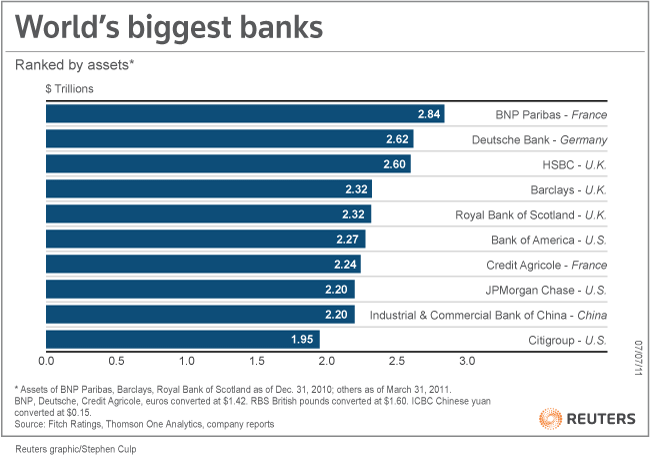
As of July of 2011, JP Morgan was the eighth largest bank in the world, according to Reuters:


World's Biggest Banks - Reuters


By many accounts, while $2 billion is large to you and I, JPM manages a stable of $2.2 trillion in assets and should be able to weather this storm.

Still, we need to do our homework before investing.


Follow These Steps


1) Understand the company, not just the situation. There will be news around JP Morgan in the next few weeks that I can almost guarantee will affect the stock price. Even if none occurs, it’s better to plan for news. Because you don’t know what the headlines will read tomorrow, have a solid a feel for the operation and scope of your target company to process how the news affects your position in the stock market.

Buying distressed companies isn’t about the initial purchase. You have to follow and respond to breaking news closely.

2) Evaluate the Risks

  • JPM could have severe penalties applied.
  • JPM may have broken the law.
  • Management may be forced to change (the Chief Investment Officer, Ina Drew, left yesterday).
  • Negative publicity could affect the performance of other divisions of the operation.

3) Sector analysis

You might find your dream company with an “oops” situation that’s easily fixable is in a nightmare sector where events are working against you. Any chance of a stock rebound is wiped out by prevailing conditions.

I thought this might be the case in early 2006. Ford pre-announced during their earnings report earlier in the week that they were going to unveil a major restructuring plan on January 23. Although layoffs aren’t a good sign over the long term, these quickly buoy the bottom line, giving hope to investors that the company will turn the corner. On the surface, this looked like a great event to invest in; a sure win.

There were significant downsides in the sector: at this time, the Detroit auto scene was in shambles. Auto supplier Delphi had declared bankruptcy only months earlier. Chrysler and GM were experiencing pain of their own. Did I really want to bet on a nice uptick in Ford stock over the short term when other auto news might sink my gains?

I explored the situation further. GM had already announced for the quarter a few days earlier. Chrysler had already experienced their blood letting, so I didn’t expect any short term news to disrupt what was looking like a quick trade.

In the final analysis, I made the trade, but because of the larger situation in the sector, I committed a much smaller portion of the portfolio than I’d originally intended. Plus, I became adamant that I’d set a quick turnaround on the stock. I’m usually a long term investor, but in this case, I was looking for a quick win.

I got it.

The morning of January 23, Ford announced a 30,000 job cut and the details of the restructuring. It was as large as expected. A stock that was trading at $7.90 the Monday before closed at $8.65 on the 25th. I was out, though, selling at $8.60. Nearly 10% in a few days was enough risk for me. This was one of only two or three times I’ve ever made a quick trade, and I don’t normally recommend it.

JP Morgan isn’t the same situation, but hopefully you understand my point: by analyzing other auto companies, I minimized the chances that news from them would work against me.

In the case of JPM, you’ll need to consider that state of banking. Is there any pending legislation that may affect performance? Is 2008 or a similar melt down in this sector or the wider stock market likely to occur?

4) Set defenses in place. Beginning investors should always work with a defensive strategy. I prefer a stop loss, but you may have other ways to reduce risk, such as the use of options. If you use a stop loss, you’ll want to give it a wide berth off the current price. Any stop loss placed within a few percentage points of the current trading level is bound to trigger due to the increased volatility of the stock.


magnifying glass II


Widen Your Lens


Because of a high credit rating, JP Morgan debt has been expensive, usually trading well above par value. If you feel JPM isn’t going to go bankrupt, then maybe looking for panic in the debt rather than the stock market is a better option. Here are some reasons I like trading debt instead of equity:

  • I know my end game (I’m guaranteed par value on the security at maturity as long as they don’t go belly up).
  • I can still sell on the open market.
  • I’ll receive dividends along the way, reducing my risk.

One such beast is a preferred stock. We’ll address preferreds in detail another day, but although they carry the name “stock,” a preferred acts much more like a bond.

A few questions to ask before investing in bonds or preferred stock:

  • What is par value. Many JP Morgan preferreds are trading at $25.50 or higher currently, while par value is $25 for preferreds (it’s $100 on most bonds).
  • What is the dividend? The stated dividend is based on the par value, so your dividend will vary from that stated on the preferred. If you’re using a website such as Bigcharts.com or Yahoo! Finance to evaluate the stock chart, the listed dividend is in fact the dividend you’ll receive at the current price.

Don’t just explore debt. Think further afield. Are there other companies that stand to win big because of JP Morgan’s stumble? Research these firms thoroughly before investing.


Final Thoughts


I’m not sure if I’m going to invest in JP Morgan. I’m more likely to buy here than in Facebook, a company with lots of hype and whose upside I don’t understand (most of my friends are tiring of Facebook, never a good sign for any product).

If you take anything from this discussion, I hope it’s the following:

– Think contrarian. When everyone else is running, ask “is this an opportunity?”

– Don’t buy immediately based on your contrarian “gut” reaction. Like buying a house or car, perform due diligence. Explore the company, the situation and the sector. Widen your lens to see if there are additional plays (such as debt or a competing company) that might make sense.

If this sounds like a lot of work, or individual stocks don’t fit your risk profile, stick with ETFs and mutual funds. Your chances of getting burned in your investment strategy is significantly reduced by staying diversified. Even if you do invest, don’t take large chances on “rebound” companies with significant portions of your portfolio.

Let’s pretend you were me: would you buy JP Morgan with a few “at risk” dollars? Are you jumping on this stock?


Enhanced by Zemanta
Photo of Joe Saul-Sehy
Joe Saul-Sehy

Joe is a former financial advisor and media representative for American Express and Ameriprise. He was the “Money Man” at Detroit television WXYZ-TV, appearing twice weekly. He’s also appeared in Bride, Best Life, and Child magazines, the Los Angeles Times, Chicago Sun-Times, Detroit News and Baltimore Sun newspapers and numerous other media outlets.  Joe holds B.A Degrees from The Citadel and Michigan State University.

joesaulsehy.com/

Filed Under: investing news, successful investing Tagged With: Chief investment officer, distressed investing, Ina Drew, Jamie Dimon, JPM, JPMorgan Chase, Singapore

Follow Us

Search this site:

Recent Posts

  • Can My Savings Account Affect My Financial Aid? by Tamila McDonald
  • 12 Ways Gen X’s Views Clash with Millennials… by Tamila McDonald
  • What Advantages and Disadvantages Are There To… by Jacob Sensiba
  • Call 911: Go To the Emergency Room Immediately If… by Stephen Kanaval
  • 7 Weird Things You Can Sell Online by Tamila McDonald
  • 10 Scary Facts About DriveTime by Tamila McDonald
  • How to Avoid NJ Exit Tax by Jacob Sensiba

Copyright © 2026 · News Pro Theme on Genesis Framework