• Home
  • About Us
  • Getting Finances Done
    • Hiring Advisors
    • Debt Management
    • Spending Plan
  • Insurance
    • Life Insurance
    • Health Insurance
    • Disability Insurance
    • Homeowners/Renters Insurance
  • Contact Us
  • Our Editorial Commitment

The Free Financial Advisor

You are here: Home / Archives for federal reserve

Bankrate Projects Credit Card Rates Will Only Drop to 19.1% by End of 2026

February 9, 2026 by Brandon Marcus Leave a Comment

Bankrate Projects Credit Card Rates Will Only Drop to 19.1% by End of 2026
Image source: shutterstock.com

Credit card interest rates have a way of grabbing your attention, especially when they’re hovering near historic highs and showing no signs of returning to the gentler levels of years past. Even with the Federal Reserve signaling a shift toward lower rates, the relief many consumers are hoping for simply isn’t on the horizon.

Bankrate’s latest projections show that average credit card APRs may only dip to around 19.1 percent by the end of 2026. That’s a decline, yes—but a tiny one, especially when compared to how dramatically rates climbed over the last few years. For anyone carrying a balance, this forecast is a wake‑up call: waiting for interest rates to save you isn’t a sound strategy.

The Drop That Barely Feels Like a Drop

When Bankrate released its forecast showing credit card APRs falling only to about 19.1 percent by late 2026, it underscored a reality that many consumers already feel: credit card debt is still expensive, and it’s going to stay that way.

Even after several Federal Reserve rate cuts in 2025, average credit card rates barely budged, ending the year around 19.7 percent. That’s only about a percentage point below the record highs set in 2024. The reason for this stubbornness is simple—credit card rates are tied closely to the prime rate, but they also reflect lenders’ appetite for risk.

With consumer debt levels elevated and delinquencies rising, lenders aren’t eager to slash APRs. So while the Fed may continue trimming rates, credit card companies are likely to move slowly, keeping APRs high enough to offset risk and maintain profitability. For consumers, that means the cost of carrying a balance will remain steep for the foreseeable future.

Why Credit Card Rates Stay High Even When the Fed Cuts

It’s easy to assume that when the Federal Reserve cuts interest rates, credit card APRs should fall in lockstep. But the reality is far more complicated. Credit cards are unsecured debt, which means lenders have no collateral to seize if a borrower defaults. That makes them inherently risky, and lenders price that risk into the APR. Even when the Fed lowers short‑term rates, credit card companies may choose to keep margins wide to protect themselves from rising delinquencies or economic uncertainty.

In recent years, inflation, higher household expenses, and increased borrowing have all contributed to a more cautious lending environment. As a result, credit card rates have remained elevated even as other borrowing costs—like personal loans or auto loans—have shown more movement. This disconnect explains why Bankrate’s projection of 19.1 percent isn’t surprising. It reflects a market where lenders are prioritizing stability over generosity.

What This Means for the Average Cardholder

For the millions of Americans carrying credit card balances, a 19.1 percent APR still represents a significant financial burden. High interest rates make it harder to pay down debt, especially when only minimum payments are made. Even small balances can balloon over time, turning manageable debt into a long‑term financial obstacle. This is why understanding the implications of Bankrate’s forecast is so important.

If rates are going to remain high, consumers need to adjust their strategies accordingly. That might mean prioritizing debt repayment more aggressively, exploring balance transfer offers, or consolidating debt into lower‑interest products. It also means being more intentional about how credit cards are used—reserving them for planned purchases rather than relying on them to fill budget gaps.

Bankrate Projects Credit Card Rates Will Only Drop to 19.1% by End of 2026
Image source: shutterstock.com

Strategies to Stay Ahead of High APRs

The good news is that consumers aren’t powerless in the face of stubbornly high credit card rates. One of the most effective strategies is to focus on paying down the highest‑interest balances first, a method often called the avalanche approach. This reduces the amount of interest paid over time and accelerates debt elimination. Another option is to take advantage of 0 percent APR balance transfer offers, which can provide a window of relief if used strategically.

For those with strong credit, personal loans may offer lower fixed rates and a clear payoff timeline. It’s also worth contacting your credit card issuer directly—some lenders are willing to reduce APRs for long‑time customers with good payment histories. Beyond these tactics, building a stronger emergency fund can help reduce reliance on credit cards during unexpected expenses. The key is to stay proactive rather than waiting for the rate environment to improve on its own.

A New Era of Expensive Credit

Bankrate’s projection isn’t just a number—it’s a signal that the era of cheap credit is firmly behind us. For years, consumers enjoyed historically low interest rates across many financial products, but that landscape has shifted. Credit card APRs are now among the highest of any mainstream borrowing option, and they’re likely to stay elevated even as other rates decline.

This new reality requires a mindset shift. Instead of viewing credit cards as a flexible financial tool, consumers may need to treat them more cautiously, recognizing the long‑term cost of carrying balances.  The more informed consumers are about how credit card rates work and why they remain high, the better equipped they’ll be to navigate this challenging environment.

High Rates Demand High Awareness

Credit card rates may inch downward over the next couple of years, but Bankrate’s projection makes one thing clear: meaningful relief isn’t coming anytime soon. With APRs expected to remain around 19.1 percent, consumers need to approach credit card use with more strategy, more caution, and more awareness than ever before. The cost of borrowing is still high, and the best defense is a proactive plan to manage or eliminate debt. The financial landscape may be shifting, but your ability to adapt can make all the difference.

What steps are you taking to manage credit card debt in today’s high‑rate environment? Talk about your plans in the comments section below.

You May Also Like…

Credit Card Delinquencies Expected to Remain Flat in 2026 Says TransUnion

The Credit Score Range That Gets You 17%–21% APR on Credit Cards Right Now

The Single Late Payment That Raises APR to 29.99% Permanently at Discover

Retail Store Credit Cards Now Charging 30% APR on Average

Why Credit Card APRs Only Dropped 0.35% Even After Three Fed Rate Cuts in 2025

Brandon Marcus
Brandon Marcus

Brandon Marcus is a writer who has been sharing the written word since a very young age. His interests include sports, history, pop culture, and so much more. When he isn’t writing, he spends his time jogging, drinking coffee, or attempting to read a long book he may never complete.

Filed Under: credit cards Tagged With: APR trends, Bankrate forecast, consumer spending, Credit card debt, credit cards, Debt Management, federal reserve, interest rates, money tips, Personal Finance, Planning

The Federal Reserve Rate Cut That Did Nothing for Credit Card Holders

February 5, 2026 by Brandon Marcus Leave a Comment

The Federal Reserve Rate Cut That Did Nothing for Credit Card Holders
Image source: shutterstock.com

The Federal Reserve made headlines with its long‑awaited rate cut, and for a brief, shining moment, millions of credit card holders dared to hope. Maybe—just maybe—their sky‑high APRs would finally ease up. Perhaps carrying a balance wouldn’t feel like dragging a boulder uphill. And maybe this was the break everyone had been waiting for.

And then… nothing happened. Credit card interest rates barely blinked, balances didn’t get cheaper, and consumers were left wondering why the Fed’s big move felt like a firework that fizzled before it left the ground. If you’ve been staring at your statement wondering why your APR still looks like a bad joke, you’re not imagining it. There’s a very real reason the Fed’s rate cut didn’t help—and understanding it can save you money in ways the Fed never will.

Why Credit Card APRs Don’t Drop Just Because the Fed Says So

When the Federal Reserve cuts rates, it affects a lot of things—mortgages, auto loans, personal loans, and even savings account yields. But credit cards live in their own universe, one where interest rates are tied to the prime rate and to whatever margin your card issuer decides to tack on.

Yes, your APR is technically variable, but that doesn’t mean it moves in lockstep with the Fed. Even when the prime rate drops, issuers can keep their margins high, which means your APR barely budges. And because credit card rates are already at historic highs, many issuers simply choose not to pass along the full benefit of a rate cut. It’s not illegal, it’s not hidden—it’s just how the system works.

The Credit Card Industry Has Zero Incentive to Lower Your Rate

Credit card companies make money from interest, and right now, they’re making a lot of it. With average APRs sitting well above 20%, issuers have little motivation to reduce rates unless they absolutely have to. A Fed rate cut gives them the option to lower rates, but not the requirement. And because consumer demand for credit remains strong, issuers know they can maintain high APRs without losing customers.

Even when the prime rate shifts, the margin they add on top can stay exactly the same. This is why your APR might drop by a fraction of a percent—just enough to technically reflect the Fed’s move—but not enough to make any meaningful difference on your monthly bill. It’s a system designed to benefit lenders first and borrowers last.

The Federal Reserve Rate Cut That Did Nothing for Credit Card Holders
Image source: shutterstock.com

Variable APRs Move Slowly—And Sometimes Not at All

Many credit cards come with variable APRs, which means they’re supposed to adjust when benchmark rates change. But “adjust” doesn’t mean “drop dramatically.” In reality, variable APRs often move in tiny increments, and issuers can delay adjustments depending on their internal policies.

Some cards only update APRs quarterly, while others adjust monthly. And even when they do adjust, the change is usually small—think tenths of a percentage point, not whole numbers. For someone carrying a balance, that tiny shift barely makes a dent. So while the Fed’s rate cut may technically ripple through the system, it’s more like a gentle ripple in a bathtub than a wave strong enough to lower your debt burden.

Record‑High Consumer Debt Keeps APRs Elevated

Another reason credit card rates remain stubbornly high is the sheer amount of consumer debt in circulation. Americans are carrying record levels of credit card balances, and delinquency rates have been rising. When lenders see increased risk, they raise margins to protect themselves. Even if the Fed lowers rates, issuers may keep APRs high to offset the risk of borrowers falling behind.

This means your interest rate is influenced not just by economic policy, but by the behavior of millions of other cardholders. It’s a collective effect that keeps APRs elevated even when the broader financial environment becomes more favorable.

Why Your Minimum Payment Didn’t Shrink Either

Even if your APR technically dropped a little, your minimum payment probably didn’t. That’s because minimum payments are calculated using formulas that prioritize fees, interest, and a small percentage of your principal. A tiny APR reduction doesn’t change the math enough to lower your minimum.

And if your balance has grown due to everyday spending, inflation, or unexpected expenses, your minimum payment may actually increase despite the Fed’s rate cut. It’s a frustrating reality, but it’s also a reminder that relying on minimum payments is one of the most expensive ways to manage credit card debt.

What You Can Do When the Fed Won’t Save You

The good news is that you’re not powerless. Even if the Fed’s rate cut didn’t help, there are strategies that can. One of the most effective is calling your credit card issuer and asking for a lower APR. Many companies will reduce your rate if you have a strong payment history or if you mention that you’re considering transferring your balance elsewhere.

Speaking of balance transfers, 0% APR offers can be a game‑changer if you qualify and can pay off the balance before the promotional period ends. You can also explore debt‑consolidation loans, which often have lower rates than credit cards, especially after a Fed rate cut. And if you’re feeling overwhelmed, nonprofit credit counseling agencies can help you create a plan that reduces interest and simplifies payments.

Rate Cuts Don’t Fix Credit Card Debt—You Do

The Federal Reserve can influence a lot of things, but it can’t force credit card companies to lower your APR in a meaningful way. That power still lies with you. Whether it’s negotiating your rate, switching to a better card, consolidating your debt, or adjusting your spending habits, the most effective changes come from your own actions. The Fed may set the stage, but you’re the one who gets to rewrite the script. And the more you understand how credit card interest really works, the easier it becomes to take control of your financial story.

What’s the most surprising thing you’ve learned about credit card interest rates lately? Give us your thoughts in the comments.

You May Also Like…

Retail Store Credit Cards Now Charging 30% APR on Average

Why Credit Card APRs Only Dropped 0.35% Even After Three Fed Rate Cuts in 2025

7 Ways Credit Card Debt Builds Faster Than Expected

The Quiet Credit Score Rule Change That’s Raising Borrowing Costs for Older Americans

10 Reasons Your Credit Card Fraud Claim Was Denied—and What You Can Do About It

Brandon Marcus
Brandon Marcus

Brandon Marcus is a writer who has been sharing the written word since a very young age. His interests include sports, history, pop culture, and so much more. When he isn’t writing, he spends his time jogging, drinking coffee, or attempting to read a long book he may never complete.

Filed Under: credit cards Tagged With: APR, banking, consumer debt, credit cards, credit credit card problems, Debt, Fed rate cut, federal reserve, financial literacy, interest rates, money tips, Personal Finance

Why Credit Card APRs Only Dropped 0.35% Even After Three Fed Rate Cuts in 2025

February 2, 2026 by Brandon Marcus Leave a Comment

Why Credit Card APRs Only Dropped 0.35% Even After Three Fed Rate Cuts in 2025
Image source: shutterstock.com

If you watched the Federal Reserve cut rates three times in 2025 and thought, “Finally, some breathing room,” you weren’t alone. Millions of cardholders expected lower balances, cheaper interest, and at least a noticeable dip in those brutal APR numbers.

Instead, many people saw their credit card rates barely move, dropping by only a fraction of a percent, which felt less like relief and more like a financial prank. The frustration makes sense, but credit card APRs play by a very different set of rules, and those rules are not designed with everyday consumers in mind.

The Fed Doesn’t Control Credit Card APRs The Way People Think

The Federal Reserve controls the federal funds rate, not the rates lenders charge you directly. Credit card APRs are tied loosely to benchmarks like the prime rate, but banks layer their own margins, risk pricing, and profit targets on top of that base. Even when the Fed cuts rates, lenders decide how much of that benefit they actually pass on to customers.

For credit cards, which are considered high-risk, unsecured debt, banks protect their margins aggressively. That means small Fed cuts often translate into tiny APR changes, if any, especially compared to mortgages or auto loans. If you’re waiting for Fed policy alone to rescue your credit card balance, you’re waiting on the wrong lever of the financial system.

Banks Price Risk, Not Just Interest Rates

Credit card lending isn’t treated like home loans or business financing because there’s no collateral backing it. If someone stops paying a mortgage, the lender has a house; if someone defaults on a card, the bank has nothing but a loss. That risk gets baked into APRs through higher pricing, regardless of what the Fed does.

In uncertain economic conditions, lenders often tighten standards and keep rates elevated to offset potential defaults. Even small signs of economic instability make banks defensive, not generous. That’s why APRs stay stubbornly high even when broader rates move downward.

Profit Margins Matter More Than Consumer Relief

Credit cards are one of the most profitable products that banks offer. Interest revenue, late fees, balance transfer fees, and interchange fees create massive income streams that shareholders expect to keep growing. When the Fed cuts rates, banks don’t feel pressure to sacrifice profits unless competition forces them to. Because most major issuers move together, there’s little incentive to slash APRs aggressively.

The result is a slow, symbolic drop that looks good in headlines but barely helps cardholders. The system rewards stability and profits, not consumer relief.

Variable APRs Move Slowly By Design

Most credit cards use variable APR formulas tied to benchmark rates plus a fixed margin. When rates rise, increases hit fast; when rates fall, decreases move like molasses. That asymmetry isn’t accidental—it’s structural. Lenders update rates based on internal schedules, billing cycles, and risk assessments, not real-time Fed announcements.

Even multiple cuts can get absorbed into those systems gradually. So while headlines talk about rate changes, your statement tells a much slower story.

Inflation Still Shapes Lending Behavior

Even with rate cuts, inflation expectations continue influencing how lenders price credit. If banks believe costs will rise or economic pressure will persist, they protect their interest income. Lower rates don’t erase operational costs, fraud losses, or charge-offs from defaults.

Credit card APRs reflect long-term risk outlooks, not short-term monetary policy shifts. Until inflation feels truly under control at a structural level, lenders will keep pricing defensively. That caution shows up directly in your APR.

What You Can Actually Do Instead Of Waiting

Waiting for macroeconomic policy to fix personal finance problems rarely works. If high APRs and interest rates are hurting your budget, proactive moves matter more than headlines. Balance transfer offers with 0% introductory rates can create breathing room if used strategically. Credit unions often offer lower APRs than major banks and are worth exploring.

Negotiating directly with your card issuer sometimes works, especially if your payment history is strong. And paying more than the minimum, even in small extra amounts, dramatically reduces long-term interest costs.

Why The 0.35% Drop Feels Like An Insult

A tiny APR drop feels offensive because it highlights how disconnected consumer debt is from economic optimism. People hear “rate cuts” and expect relief, not symbolic gestures. That emotional disconnect fuels frustration and financial fatigue. But the system isn’t broken—it’s operating exactly as designed. Understanding that design gives you power instead of confusion.

Why Credit Card APRs Only Dropped 0.35% Even After Three Fed Rate Cuts in 2025
Image source: shutterstock.com

Why Financial Control Beats Financial Hope

Hope feels good, but control works better. Fed policy will always move more slowly than personal financial needs. Small APR drops won’t fix big balances. Real progress comes from strategy, not headlines. The people who win financially focus on leverage, not luck.

If credit card APRs barely budged after three Fed rate cuts, what does that say about how much control consumers actually have over their financial lives—and what’s the next move you’re willing to make to change yours?

You May Also Like…

8 Times “0% Interest” Credit Cards Turn Into Financial Traps

8 Hidden Risks People Overlook When Financing a Car at High APR

6 Foolish Mistakes That Can Lead to High APRs When Buying a Used Car

Why Closing an Old, Unused Credit Card Can Wreck Your Credit Score

Why Does Interest Rate Talk Suddenly Affect Everyday Spending

Brandon Marcus
Brandon Marcus

Brandon Marcus is a writer who has been sharing the written word since a very young age. His interests include sports, history, pop culture, and so much more. When he isn’t writing, he spends his time jogging, drinking coffee, or attempting to read a long book he may never complete.

Filed Under: credit cards Tagged With: APR, budgeting, consumer finance, credit cards, Debt Management, federal reserve, financial literacy, Inflation, interest rates, money tips, Personal Finance

Investment Risks in the World Today

March 16, 2022 by Jacob Sensiba Leave a Comment

investment-risks

The world is crazy right now. The war with Russia and Ukraine has created investment risks and opportunities with commodities, specifically. Inflation is also an issue. What do you do with all of these moving parts in the global economy?

Gold

Gold has only gone up since the war began, up over $2,000 for the first time since 2020. The reason being is that gold is a store of value and is often seen as a safe asset during times of uncertainty, like war, inflation, or a pandemic.

Gold isn’t the only asset that’s used in times of uncertainty. Cash, bonds, and other precious metals have also seen a massive inflow lately.

Crypto

Cryptocurrencies have also seen a run-up in recent weeks, for two reasons. One, some people do see cryptocurrencies as a store of value like gold. And two, cryptocurrencies have played a role in this war. Because Russia has been cut off, financially, from the rest of the world, they’ve used crypto to finance operations. Ukraine has done the same, but for the reason of being able to raise money from different channels.

Oil

The price of oil has been on a roller coaster since the war began. Russia supplies a lot of energy to the world. It supplies the U.S. with just 3% of oil, but it supplies Europe with most of what they use. That said, the price of oil went up very fast to about $125/barrel because the US and other countries blocked them off to further disrupt their finances.

It’s come back down since then thanks to OPEC+. They pledged to increase production to make up for the loss in supply.

Inflation

Inflation is off the charts right now. The most recent reading came in at 7.9%. There are quite a few things that are seeing the effects of it. Food is getting more expensive. Gas, obviously, due to supply constraints and inflation is getting more expensive. Property is also getting more expensive. Interest rates are going up as well. My wife and I refinanced late last year and locked our rate in at 3%. The most recent reading came in at 4.5%.

The FED is going to make some moves as well. Because of the war with Russia and Ukraine, they will take a more measured and conservative approach, so it’s possible that inflation is a problem for longer because the FED won’t hike rates as quickly as they may have previously intended.

Commodities

There are some other commodities, besides gold and other precious metals, that are feeling a pinch due to the war between Russia and Ukraine. Wheat is the biggest example of this because between Russia and Ukraine, they produce and ship a third of the world’s wheat.

Unintended consequences

Even though the war is between two countries, it’s affecting everything (though differently than how it’s affecting Russia and Ukraine). There are logistical problems that are delaying shipments of things. The air space above the scuffle is off-limits, so flights around the area are taking longer than they previously would have. Longer flights = more fuel and reduced volume on flights = increased costs.

There are a lot of investment risks and opportunities due to the moving parts in the world right now and the market will continue to be volatile until things settle down. If you have time to ride out some ugly markets, stick to your plan. If you’re in retirement or close to retirement, reducing your risk might not be a bad idea.

Related reading:

How to Invest in Gold: 5 Ways to Get Started

How Inflation is Changing Our Lives and Not for the Better

Weekly Wrap: Crypto Aids Ukraine Putin Aids Inflation and Russian Investments Tank

Safeguarding Your Future: A Comprehensive Review Of Augusta Precious Metals

Disclaimer:

**Securities offered through Securities America, Inc., Member FINRA/SIPC. Advisory services offered through Securities America Advisors, Inc. Securities America and its representatives do not provide tax or legal advice; therefore, it is important to coordinate with your tax or legal advisor regarding your specific situation. Please see the website for full disclosures: www.crgfinancialservices.com

Jacob Sensiba
Jacob Sensiba

Jacob Sensible is a financial advisor with decades of experience in the financial planning industry.  His journey into finance began out of necessity, stepping up to support his grandfather during a health crisis. This period not only grounded him in the essentials of stock analysis, investment strategies, and the critical roles of insurance and trusts in asset preservation but also instilled a comprehensive understanding of financial markets and wealth management.  Jacob can be reached at: jake.sensiba@mygfpartner.com.

mygfpartner.com/jacob-sensiba-wisconsin-financial-advisor/

Filed Under: International News, Investing, investing news, money management, Personal Finance, risk management Tagged With: ', choosing investments, commodities, conservative investments, crypto, defensive investing, federal reserve, gold, Inflation, invest, investing, investing news, Investment, Investment management, Risk management, wheat

What Currently Present a Risk to Markets?

September 22, 2021 by Jacob Sensiba Leave a Comment


Where is the market going? What kind of risks do we need to be aware of? There are three or four things to pay attention to right now. The FED, interest rates, inflation, Covid, China, the government, and geopolitics. Do any of these present a risk to markets?

Okay, more than three or four things, but the first three can all be lumped together. Interest rate policy is enacted by the FED and what happens with interest rates has a direct impact on inflation. Furthermore, the government also has a chance to impact inflation.

And I apologize if we bounce around a little from topic to topic.

The FED, Interest Rates, Inflation

The government and the FED have a lot of control over what inflation is going to do. We had a lot of liquidity injected into the market because of the pandemic, and there’s a very good chance we’ll see more of that in the near future.

A $3.5 trillion bill is circulating through Congress right now. If this bill gets passed, we’ll have a lot more liquidity injected into the market. That’s likely to be a large tailwind for inflation (which is already running much hotter than expected). If the FED continues to provide an accommodative monetary policy, we’ll see inflation get out of control, and they’ll have to increase interest rates much sooner than they had planned.

Covid

Covid is still hanging around. 75% of the country has received at least one shot and now the administration is pushing booster shots. This is even after the CDC and the WHO have insisted on holding off on a third shot until less fortunate countries have a chance to get more of their first poke. The numbers need to level off soon or I fear lockdowns may rear their ugly head, and we all know how much the economy liked that the first time around.

China

China is a new story. Specifically, Evergrande. The ginormous real estate company is on the brink of bankruptcy. Comparisons have been made to the collapse of Lehman Brothers during the GFC (great financial crisis). We’ll see what happens and if the Chinese government decides to step in. Ripple effects through the global monetary system are possible.

Geopolitics

The last story is geopolitics. This has to do with the deal the US and Australia struck to help the Australian government build nuclear-capable submarines. It angered France because they already had a deal with Australia to help them build submarines (not nuclear-capable though). Britain feels pretty good because they helped broker the US/Aussie deal. Most likely, this will end up being only noise but could present a risk to markets. Something to keep your eye on.

Related reading:

What does an increase in yields look like?

The resurgence of Covid and what it means

Investment concerns and opportunities

Disclaimer:

**Securities offered through Securities America, Inc., Member FINRA/SIPC. Advisory services offered through Securities America Advisors, Inc. Securities America and its representatives do not provide tax or legal advice; therefore, it is important to coordinate with your tax or legal advisor regarding your specific situation. Please see the website for full disclosures: www.crgfinancialservices.com

Jacob Sensiba
Jacob Sensiba

Jacob Sensible is a financial advisor with decades of experience in the financial planning industry.  His journey into finance began out of necessity, stepping up to support his grandfather during a health crisis. This period not only grounded him in the essentials of stock analysis, investment strategies, and the critical roles of insurance and trusts in asset preservation but also instilled a comprehensive understanding of financial markets and wealth management.  Jacob can be reached at: jake.sensiba@mygfpartner.com.

mygfpartner.com/jacob-sensiba-wisconsin-financial-advisor/

Filed Under: International News, Investing, investing news, Personal Finance Tagged With: chine, covid, federal reserve, geopolitics, Inflation, interest rates, investing, risk

The FED, The Dollar, and Opportunities

January 13, 2021 by Jacob Sensiba Leave a Comment

My post for today was supposed to be a personal reflection, but in lieu of that, I’m going to lay out my thoughts on the market and the economy. Which includes the FED, the dollar, and inflation. In addition to that, I want to explain where I see risks and opportunities right now.

The dollar

We can expect the Federal Reserve to continue an accommodative monetary policy. They will invest in the fixed income market and they’ll resume the low-interest-rate stance.

If they continue this response to the Covid crisis, the dollar should go down in value. There are some risks and opportunities that arise if that happens.

Gold and cryptocurrencies should increase in value. A devaluing in the dollar is, normally, the right landscape for “alternative currencies” to do well.

International securities, especially emerging markets, do well when the value is priced lower. A large majority of international transactions take place using the USD. The value of their home currency goes up in relation to the USD.

The technology sector also has a negative correlation to a falling dollar. When the dollar goes down, that sector tends to outperform.

If the dollar, indeed, goes down look at these areas for possible investment opportunities.

The FED

As I mentioned earlier, the FED will continue to create an accommodative environment for the economy…until they don’t.

At some point, the recovery will gain momentum. GDP will go up and the population will gain confidence in that recovery. At this juncture, inflation will pop onto people’s radars.

If inflation runs too hot, the FED could possibly stop, or reduce, QE. They could halt the bond-buying program and they could raise rates. If that happens, keep your eyes out for a pullback.

We saw this happen at the end of 2018. The FED started raising rates until they went too far, and we had a 20%-25% decline in Q4. Then they reversed course and began easing again. We had a run-up in the market until March of 2020 when Covid hit.

Long term

I believe tech and healthcare will be the two sectors to watch over the next decade or more. With technology getting more advanced every day, investment opportunities will present themselves in these two areas.

Green energy, especially with the incoming administration, is also an industry with big potential. Technology will play a large role in the advancement of renewable energy.

My biggest concern

And I’ll preface this by saying I’m concerned because I truly don’t know the implications of it. MMT looks as likely as ever at this point.

The favorable stance by the FED plus the democratic party holding the House, the Senate, and the Presidency leads me to believe printing money is going to pop off.

An aggressive agenda to provide relief for Americans struggling because of Covid, a push for expanded Medicare/Medicaid benefits, possible student debt relief, as well as other initiatives.

It appears that reducing the national debt is not a concern. To be fair, it wasn’t a concern for the Trump administration either.

The bill comes due for everyone, and if other countries (namely China) are no longer buying US Treasuries like they were, I do not know how we can fund policies, branches, or even service the existing debt. Only time will tell.

Conclusion

I will close by saying that these are my opinions. Granted, I do a lot of research to come to these conclusions, but what I said above are still my thoughts and not foregone conclusions. Do your own research.

Related reading:

How to Beat Inflation with Investment

What Makes Gold so Valuable


**Securities offered through Securities America, Inc., Member FINRA/SIPC. Advisory services offered through Securities America Advisors, Inc. Securities America and its representatives do not provide tax or legal advice; therefore, it is important to coordinate with your tax or legal advisor regarding your specific situation. Please see the website for full disclosures: www.crgfinancialservices.com

Jacob Sensiba
Jacob Sensiba

Jacob Sensible is a financial advisor with decades of experience in the financial planning industry.  His journey into finance began out of necessity, stepping up to support his grandfather during a health crisis. This period not only grounded him in the essentials of stock analysis, investment strategies, and the critical roles of insurance and trusts in asset preservation but also instilled a comprehensive understanding of financial markets and wealth management.  Jacob can be reached at: jake.sensiba@mygfpartner.com.

mygfpartner.com/jacob-sensiba-wisconsin-financial-advisor/

Filed Under: Investing, money management, Personal Finance, risk management, successful investing Tagged With: bitcoin, dollar, Emerging markets, FED, federal reserve, gold, Investment, investment opportunities, USD

Federal Reserve Report: Hang On For Rough Ride…

September 26, 2011 by The Other Guy 1 Comment

Here’s a depressing recent headline. Today the Federal Reserve Bank of San Francisco released a report predicting that the financial markets are unlikely to be strong for the next…drum roll please…16 years!

Can this be accurate?

The report, titled “Boomer Retirement: Headwind for U.S. Equity Markets?” illustrates long-range, historical data which suggests that as the boomer generation moves into retirement, they’ll pull an increasing amount of money out of equity funds.  This can only mean increased pressure on stocks for years to come.

This is classic ‘supply & demand’ economics at work here, folks. 

Roughly 10,000 baby-boomers turn 60 EVERY DAY, a trend that will continue for the foreseeable future.  As each of these 10,000 individuals leaves the workforce, they need money to spend in retirement.  Where will their meals come from?  That’s right.  Their spending money will come, in part, from investment portfolios.

As the report points out “…to finance retirement, they are likely to sell off acquired assets, especially risky assets.  A looming concern is that this massive sell-off might depress equity values.”

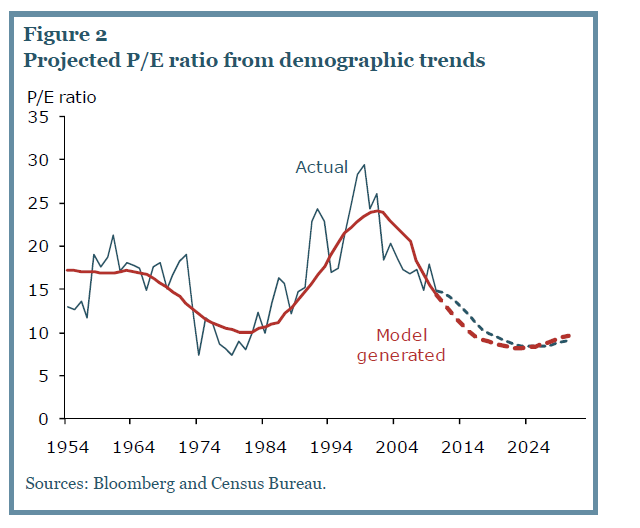
Take a look at this projection:

According to the research in this report, P/E ratios, an indicator of potential stock prices, is slated to continue downward through the early 2020s before rebounding in the latter half of that decade.

“Figure 2 shows that P/E should decline persistently from about 15 in 2010 to about 8.4 in 2025, before recovering to 9.14 in 2030.”

The report continues: “The model-generated path for real stock prices implied by demographic trends is quite bearish.  Real stock prices follow a downward trend until 2021, cumulatively declining 13% relative to 2010…real stock prices are not expected to return to their 2010 levels until 2027.”

Ouch.  That could sting a little.

So what does this data imply?

Should we all be in bonds until 2030?  Quite the contrary.  There will likely still be bullish trends throughout the upcoming cycle, so it pays to be vigilant. 

Instead, I believe this heralds the end of “buy and hold and you’ll be fine” investing.

This mean you’ll need to be cognizant of market trends and invest accordingly.  What does your advisor think about this report?  In all likelihood, he’s never heard of it, and will probably say something like “Just invest and stick with the plan, and you’ll be OK.”

You can do better.  If you just pay attention to the signs, you can profit from both sides of the market, both the ups and downs.  You just have to pay attention.

If you’d like to read this report for yourself, it’s available here or type in http://www.frbsf.org/publications/economics/letter/2011/el2011-26.html to read for yourself.

I’m interested in your thoughts…post your comments below.

Filed Under: investing news, successful investing Tagged With: federal reserve, investing, investing news, market report, San Francisco reserve, stock market, stocks, trends

  • « Previous Page
  • 1
  • 2
  • 3

Follow Us

Search this site:

Recent Posts

  • Can My Savings Account Affect My Financial Aid? by Tamila McDonald
  • 12 Ways Gen X’s Views Clash with Millennials… by Tamila McDonald
  • What Advantages and Disadvantages Are There To… by Jacob Sensiba
  • 10 Tactics for Building an Emergency Fund from Scratch by Vanessa Bermudez
  • Call 911: Go To the Emergency Room Immediately If… by Stephen Kanaval
  • 7 Weird Things You Can Sell Online by Tamila McDonald
  • 10 Scary Facts About DriveTime by Tamila McDonald

Copyright © 2026 · News Pro Theme on Genesis Framework