• Home
  • About Us
  • Getting Finances Done
    • Hiring Advisors
    • Debt Management
    • Spending Plan
  • Insurance
    • Life Insurance
    • Health Insurance
    • Disability Insurance
    • Homeowners/Renters Insurance
  • Contact Us
  • Our Editorial Commitment

The Free Financial Advisor

You are here: Home / Archives for investing news

SEC Approves ICE Clear Credit Rule Change on Operational Risk Management Framework

July 20, 2026 by Amanda Blankenship Leave a Comment

ICE Clear Credit Operational Risk Management Framework
ICE Clear Credit LLC has received SEC approval to update its Operational Risk Management Framework, a change intended to support the resilience and reliability of the financial market infrastructure that clears credit-related derivatives. g0d4ather/Shutterstock

The U.S. Securities and Exchange Commission has formally approved a proposed rule change submitted by ICE Clear Credit LLC concerning updates to the company’s Operational Risk Management Framework. The approval was published in the Federal Register on July 20, 2026, under SEC Release No. 34‑105918 and docket number SR‑ICC‑2026‑004.

The notice appears at 91 FR 45306 and spans three pages. ICE Clear Credit LLC operates as a registered clearing agency responsible for clearing credit default swaps and other credit‑related derivatives. As a central counterparty, its risk‑management practices directly affect market participants who rely on its clearing services for trade execution, settlement, and systemic protection.

Background on the Rule Change Process

The SEC initially published the proposed rule change on June 8, 2026, opening a public comment window and allowing stakeholders to review the submission. Roughly six weeks later, the Commission issued its approval order. This timeline reflects the standard review process under the Securities Exchange Act, which requires clearing agencies to submit rule changes for regulatory oversight before implementation.

Although the approval order confirms that ICE Clear Credit updated its Operational Risk Management Framework, the Federal Register summary does not describe the specific revisions. Operational risk frameworks typically address how a clearinghouse identifies, measures, and mitigates risks related to technology, internal processes, staffing, and external disruptions. Any changes to such a framework can influence how the clearinghouse responds to incidents that may affect clearing operations.

Why the Update Matters for Market Participants

For broker‑dealers, asset managers, and other financial professionals who interact with ICE Clear Credit, updates to operational risk protocols can affect daily workflows and compliance obligations. Enhancements to risk identification or monitoring procedures may change reporting expectations, incident‑response timelines, or technology‑related requirements.

Operational risk failures — such as system outages, data‑processing errors, or procedural breakdowns — can disrupt trade clearing and settlement. Because clearinghouses play a critical role in maintaining market stability, the SEC closely monitors changes to their risk‑management frameworks to ensure they meet regulatory standards for resilience and reliability.

Readers seeking authoritative guidance should review the official Federal Register publication or contact the SEC or ICE Clear Credit directly. These sources can clarify how the approved changes may affect specific clearing arrangements or regulatory responsibilities.

What to Read Next

SEC Grants CME Conditional Exemption for Certain Cash-Settled Security Futures

New York AG Charges Long Island Man With Fraudulently Collecting Over $100,000 in Social Security Disability Benefits

The SEC Just Formed a Retail Fraud Working Group: What Everyday Investors Should Watch

Amanda Blankenship

Amanda Blankenship is the Chief Editor for District Media.  With a BA in journalism from Wingate University, she frequently writes for a handful of websites and loves to share her own personal finance story with others. When she isn’t typing away at her desk, she enjoys spending time with her daughter, son, husband, and dog. During her free time, you’re likely to find her with her nose in a book, hiking, or playing RPG video games.

Filed Under: news Tagged With: clearinghouse, compliance, credit default swaps, derivatives, Federal Register, financial markets, financial regulation, ICE Clear Credit, investing news, market infrastructure, operational risk, Risk management, SEC, SEC approval, Securities and Exchange Commission

SEC Grants CME Conditional Exemption for Certain Cash-Settled Security Futures

July 16, 2026 by Amanda Blankenship Leave a Comment

SEC CME exemption
The SEC has granted the Chicago Mercantile Exchange (CME) a conditional exemption from certain opening price settlement requirements for select cash-settled security futures contracts, marking a targeted regulatory change that affects how those products may be settled under specific conditions. Mark Van Scyoc/Shutterstock

The U.S. Securities and Exchange Commission has issued an official order granting the Chicago Mercantile Exchange Inc. (CME) conditional exemptive relief from specific settlement requirements that apply to certain cash-settled security futures contracts, according to an official announcement published in the Federal Register on July 15, 2026.

The order, identified as Release No. 34-105882 and published at 91 FR 43410, was issued under Section 36 of the Securities Exchange Act of 1934 and Rule 6h-1(d) thereunder. It exempts CME, on a conditional basis, from the opening price settlement requirements set out in Rule 6h-1(b) of the Exchange Act for the specific category of cash-settled security futures covered by the relief.

The action follows a formal application process. According to the Federal Register filing, CME submitted an application for the exemption in February 2026, and the SEC published a notice of that application along with a request for public comment at that time. The July 2026 order represents the SEC’s final determination granting the requested relief, subject to conditions.

Rule 6h-1 generally governs how certain security futures products must be settled, including requirements tied to opening prices. The conditional exemption means CME is not required to comply with those particular opening price settlement rules for the covered contracts, provided it meets whatever conditions the SEC has attached to the relief. The full text of those conditions spans five pages in the official Federal Register document.

The order is categorized as a Notice by the SEC and carries docket file number S7-2026-04. It applies specifically to CME and to the cash-settled security futures contracts identified within the order, rather than to the broader futures or securities markets.

For market participants, broker-dealers, or investors involved in security futures products traded on CME, this regulatory change may affect how certain contracts are settled. Those with questions about how this exemption applies to their specific situation should consult the official Federal Register document or contact the SEC directly, as the full conditions and scope of the relief are detailed in the official filing. Readers are encouraged to verify any specifics relevant to their circumstances with the SEC or a qualified financial or legal professional.

What to Read Next

New York AG Charges Long Island Man With Fraudulently Collecting Over $100,000 in Social Security Disability Benefits

Hospital Service Costs Rose in May CPI—A Retirement Healthcare Planning Reminder

RentGrow to Pay $2.25 Million to Settle FTC Allegations of Fair Credit Reporting Act and FTC Act Violations

Amanda Blankenship

Amanda Blankenship is the Chief Editor for District Media.  With a BA in journalism from Wingate University, she frequently writes for a handful of websites and loves to share her own personal finance story with others. When she isn’t typing away at her desk, she enjoys spending time with her daughter, son, husband, and dog. During her free time, you’re likely to find her with her nose in a book, hiking, or playing RPG video games.

Filed Under: news Tagged With: broker-dealers, cash-settled security futures, Chicago Mercantile Exchange, CME, derivatives, Exchange Act, Federal Register, financial regulation, futures trading, investing news, Rule 6h-1, SEC, Securities and Exchange Commission, security futures, settlement rules

Market Turn: 4 Signals That the Next Bull Cycle Could Look Different

December 24, 2025 by Brandon Marcus Leave a Comment

Market Turn: 4 Signals That the Next Bull Cycle Could Look Different
Image Source: Shutterstock.com

The stock market has always been a stage for drama, spectacle, and surprises, but right now, the excitement is dialed up to eleven. Investors are buzzing with curiosity, strategists are sharpening their pencils, and the financial world is bracing itself for the next big bull cycle. Unlike past rallies that followed predictable patterns, this one seems poised to rewrite the rulebook. From tech innovations reshaping industries to global economic shifts challenging old assumptions, the next surge could feel completely unfamiliar.

For anyone with skin in the game, knowing the signs early might mean the difference between riding the wave and getting caught in the undertow.

1. Tech Disruption Is Accelerating Market Dynamics

Technology has always been a market mover, but today it’s almost like the rules themselves are being rewritten in real-time. Artificial intelligence, blockchain applications, and quantum computing aren’t just buzzwords—they’re becoming integral drivers of market behavior. Companies that adapt quickly are seeing unprecedented growth, while laggards face rapid obsolescence. This acceleration makes predicting traditional market cycles trickier, as old patterns may no longer hold. Investors need to pay attention to innovation pipelines, not just quarterly earnings, to spot where real momentum is forming.

2. Global Capital Flows Are Shifting

Money doesn’t stay put for long, and the paths it takes are signaling change. Emerging markets are attracting attention in sectors that were previously dominated by developed economies. Sovereign wealth funds and institutional investors are diversifying aggressively, spreading capital in ways that challenge historical norms. Currency fluctuations, geopolitical tensions, and trade realignments all create unexpected ripples that affect stock valuations. Understanding where money is moving, and why, will be critical for anticipating which sectors will lead the next bull cycle.

3. Retail Investors Are Changing the Game

Forget the old image of Wall Street as a closed club; retail investors now wield more influence than ever. Social media platforms, trading apps, and real-time analytics have given everyday traders access to information that used to be reserved for professionals. This democratization of market participation creates volatility, but also opportunity, as coordinated moves by retail investors can send formerly overlooked stocks soaring. Analysts now have to factor in behavior patterns and sentiment indicators alongside traditional fundamentals. Ignoring the impact of retail energy could leave investors flat-footed in the next rally.

Market Turn: 4 Signals That the Next Bull Cycle Could Look Different
Image Source: Shutterstock.com

4. ESG and Sustainability Are Driving Investment Decisions

Environmental, social, and governance considerations aren’t just ethical talking points—they’re shaping real investment flows. Corporations that excel in ESG metrics are attracting long-term capital, while those lagging behind are facing higher scrutiny and risk premiums. The rise of green finance, sustainable bonds, and socially responsible ETFs is creating new winners and losers in unexpected places. Investors who factor ESG into their strategies are likely to see advantages in sectors that previously wouldn’t have been in focus. The next bull market could be as much about values-driven performance as it is about profits and earnings growth.

What This Means For Investors

The next bull cycle is likely to look different from what many are used to, blending technology, global capital movements, retail influence, and ESG factors in ways that make old playbooks less reliable. For savvy investors, that means staying agile, curious, and ready to adapt at a moment’s notice. Market signals are subtle but powerful, offering clues for those willing to read between the lines. Everyone’s experience and approach will vary, and your insights could provide valuable perspective for others navigating this evolving landscape.

Leave your thoughts, experiences, or perspectives in the comments section below—we’d love to hear how you’re preparing for the next wave.

You May Also Like…

Asset Migration: 5 Emerging Market Trends Retirees Should Know Before January

Why Young People Should Invest In The Stock Market

These 5 Stocks Only Perform Well When The Entire Stock Market Does

4 Bold Predictions Regarding the Future of the Stock Market

7 Stock Market Myths That Cost Beginner Investors Their Life Savings


Brandon Marcus
Brandon Marcus

Brandon Marcus is a writer who has been sharing the written word since a very young age. His interests include sports, history, pop culture, and so much more. When he isn’t writing, he spends his time jogging, drinking coffee, or attempting to read a long book he may never complete.

Filed Under: Investing Tagged With: bull market, capital flows, invest, investing, investing news, Investing Tips, retail, retail industry, retail investing, stock market, stock market strategy, stock market traps

Investment Risks in the World Today

March 16, 2022 by Jacob Sensiba Leave a Comment

investment-risks

The world is crazy right now. The war with Russia and Ukraine has created investment risks and opportunities with commodities, specifically. Inflation is also an issue. What do you do with all of these moving parts in the global economy?

Gold

Gold has only gone up since the war began, up over $2,000 for the first time since 2020. The reason being is that gold is a store of value and is often seen as a safe asset during times of uncertainty, like war, inflation, or a pandemic.

Gold isn’t the only asset that’s used in times of uncertainty. Cash, bonds, and other precious metals have also seen a massive inflow lately.

Crypto

Cryptocurrencies have also seen a run-up in recent weeks, for two reasons. One, some people do see cryptocurrencies as a store of value like gold. And two, cryptocurrencies have played a role in this war. Because Russia has been cut off, financially, from the rest of the world, they’ve used crypto to finance operations. Ukraine has done the same, but for the reason of being able to raise money from different channels.

Oil

The price of oil has been on a roller coaster since the war began. Russia supplies a lot of energy to the world. It supplies the U.S. with just 3% of oil, but it supplies Europe with most of what they use. That said, the price of oil went up very fast to about $125/barrel because the US and other countries blocked them off to further disrupt their finances.

It’s come back down since then thanks to OPEC+. They pledged to increase production to make up for the loss in supply.

Inflation

Inflation is off the charts right now. The most recent reading came in at 7.9%. There are quite a few things that are seeing the effects of it. Food is getting more expensive. Gas, obviously, due to supply constraints and inflation is getting more expensive. Property is also getting more expensive. Interest rates are going up as well. My wife and I refinanced late last year and locked our rate in at 3%. The most recent reading came in at 4.5%.

The FED is going to make some moves as well. Because of the war with Russia and Ukraine, they will take a more measured and conservative approach, so it’s possible that inflation is a problem for longer because the FED won’t hike rates as quickly as they may have previously intended.

Commodities

There are some other commodities, besides gold and other precious metals, that are feeling a pinch due to the war between Russia and Ukraine. Wheat is the biggest example of this because between Russia and Ukraine, they produce and ship a third of the world’s wheat.

Unintended consequences

Even though the war is between two countries, it’s affecting everything (though differently than how it’s affecting Russia and Ukraine). There are logistical problems that are delaying shipments of things. The air space above the scuffle is off-limits, so flights around the area are taking longer than they previously would have. Longer flights = more fuel and reduced volume on flights = increased costs.

There are a lot of investment risks and opportunities due to the moving parts in the world right now and the market will continue to be volatile until things settle down. If you have time to ride out some ugly markets, stick to your plan. If you’re in retirement or close to retirement, reducing your risk might not be a bad idea.

Related reading:

How to Invest in Gold: 5 Ways to Get Started

How Inflation is Changing Our Lives and Not for the Better

Weekly Wrap: Crypto Aids Ukraine Putin Aids Inflation and Russian Investments Tank

Safeguarding Your Future: A Comprehensive Review Of Augusta Precious Metals

Disclaimer:

**Securities offered through Securities America, Inc., Member FINRA/SIPC. Advisory services offered through Securities America Advisors, Inc. Securities America and its representatives do not provide tax or legal advice; therefore, it is important to coordinate with your tax or legal advisor regarding your specific situation. Please see the website for full disclosures: www.crgfinancialservices.com

Jacob Sensiba
Jacob Sensiba

Jacob Sensible is a financial advisor with decades of experience in the financial planning industry.  His journey into finance began out of necessity, stepping up to support his grandfather during a health crisis. This period not only grounded him in the essentials of stock analysis, investment strategies, and the critical roles of insurance and trusts in asset preservation but also instilled a comprehensive understanding of financial markets and wealth management.  Jacob can be reached at: jake.sensiba@mygfpartner.com.

mygfpartner.com/jacob-sensiba-wisconsin-financial-advisor/

Filed Under: International News, Investing, investing news, money management, Personal Finance, risk management Tagged With: ', choosing investments, commodities, conservative investments, crypto, defensive investing, federal reserve, gold, Inflation, invest, investing, investing news, Investment, Investment management, Risk management, wheat

Federal Reserve Report: Hang On For Rough Ride…

September 26, 2011 by The Other Guy 1 Comment

Here’s a depressing recent headline. Today the Federal Reserve Bank of San Francisco released a report predicting that the financial markets are unlikely to be strong for the next…drum roll please…16 years!

Can this be accurate?

The report, titled “Boomer Retirement: Headwind for U.S. Equity Markets?” illustrates long-range, historical data which suggests that as the boomer generation moves into retirement, they’ll pull an increasing amount of money out of equity funds.  This can only mean increased pressure on stocks for years to come.

This is classic ‘supply & demand’ economics at work here, folks. 

Roughly 10,000 baby-boomers turn 60 EVERY DAY, a trend that will continue for the foreseeable future.  As each of these 10,000 individuals leaves the workforce, they need money to spend in retirement.  Where will their meals come from?  That’s right.  Their spending money will come, in part, from investment portfolios.

As the report points out “…to finance retirement, they are likely to sell off acquired assets, especially risky assets.  A looming concern is that this massive sell-off might depress equity values.”

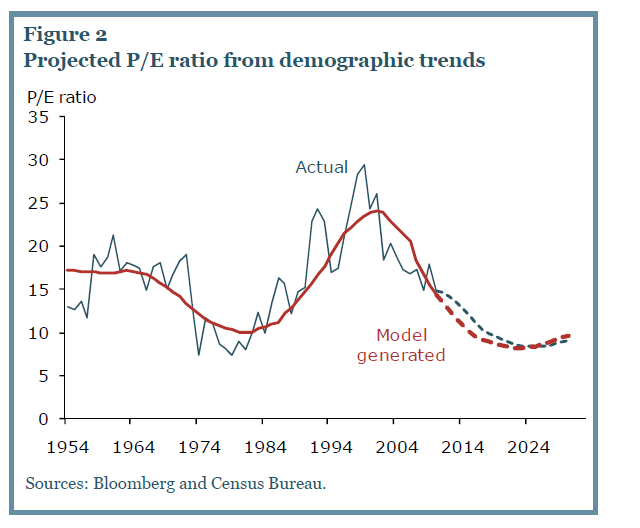
Take a look at this projection:

According to the research in this report, P/E ratios, an indicator of potential stock prices, is slated to continue downward through the early 2020s before rebounding in the latter half of that decade.

“Figure 2 shows that P/E should decline persistently from about 15 in 2010 to about 8.4 in 2025, before recovering to 9.14 in 2030.”

The report continues: “The model-generated path for real stock prices implied by demographic trends is quite bearish.  Real stock prices follow a downward trend until 2021, cumulatively declining 13% relative to 2010…real stock prices are not expected to return to their 2010 levels until 2027.”

Ouch.  That could sting a little.

So what does this data imply?

Should we all be in bonds until 2030?  Quite the contrary.  There will likely still be bullish trends throughout the upcoming cycle, so it pays to be vigilant. 

Instead, I believe this heralds the end of “buy and hold and you’ll be fine” investing.

This mean you’ll need to be cognizant of market trends and invest accordingly.  What does your advisor think about this report?  In all likelihood, he’s never heard of it, and will probably say something like “Just invest and stick with the plan, and you’ll be OK.”

You can do better.  If you just pay attention to the signs, you can profit from both sides of the market, both the ups and downs.  You just have to pay attention.

If you’d like to read this report for yourself, it’s available here or type in http://www.frbsf.org/publications/economics/letter/2011/el2011-26.html to read for yourself.

I’m interested in your thoughts…post your comments below.

Filed Under: investing news, successful investing Tagged With: federal reserve, investing, investing news, market report, San Francisco reserve, stock market, stocks, trends

Follow Us

Search this site:

Recent Posts

  • Can My Savings Account Affect My Financial Aid? by Tamila McDonald
  • 12 Ways Gen X’s Views Clash with Millennials… by Tamila McDonald
  • What Advantages and Disadvantages Are There To… by Jacob Sensiba
  • 10 Tactics for Building an Emergency Fund from Scratch by Vanessa Bermudez
  • Call 911: Go To the Emergency Room Immediately If… by Stephen Kanaval
  • 7 Weird Things You Can Sell Online by Tamila McDonald
  • 10 Scary Facts About DriveTime by Tamila McDonald

Copyright © 2026 · News Pro Theme on Genesis Framework