• Home
  • About Us
  • Toolkit
  • Getting Finances Done
    • Hiring Advisors
    • Debt Management
    • Spending Plan
  • Insurance
    • Life Insurance
    • Health Insurance
    • Disability Insurance
    • Homeowners/Renters Insurance
  • Contact Us
  • Privacy Policy
  • Risk Tolerance Quiz

The Free Financial Advisor

You are here: Home / Archives for Joe Saul-Sehy

Joe is a former financial advisor and media representative for American Express and Ameriprise. He was the “Money Man” at Detroit television WXYZ-TV, appearing twice weekly. He’s also appeared in Bride, Best Life, and Child magazines, the Los Angeles Times, Chicago Sun-Times, Detroit News and Baltimore Sun newspapers and numerous other media outlets.  Joe holds B.A Degrees from The Citadel and Michigan State University. 

Two Guys and Your Money #13: How Wall Street Became the Capital of Capital

October 8, 2012 by Joe Saul-Sehy Leave a Comment

This week Dr. Brian Murphy visits the basement. He’s curator of the exhibit The Capital of Capital, the story of how New York became the world’s financial center. We discuss the creation of Wall Street, Alexander Hamilton, Andrew Jackson, Occupy Wall Street and Bloomberg terminals, among many others. The exhibit appears at the Museum of the City of New York until October 21st. Whether you can make it or not, Dr. Murphy winds a fun history lesson about New York and its role on the financial stage.


Show Notes


<> Open: Asset Allocation – What is it?

<> The Capital of Capital – Interview with Dr. Brian Murphy, curator of an exhibit running through October 21st at the Museum of the City of New York.

<32:29> PK’s Fractional Cents – Why Apple is King in the Tech World

<> Let’s Give Something Away

Our September Sound was Dr. Dean Burke, and our random winner is Steve Stewart from the MoneyPlan SOS podcast! Congrats on winning the hit board game Settlers of Catan, Steve!


Click Here For Our October Giveaway Page!


You don’t need to know the voice….still enter if you Tweet about the giveaway or like us on Facebook. Lots of ways to enter and win the classic book The E Myth, Why Most Small Businesses Fail and What To Do About It.

<> The Shortwave – I fire up my Dad’s shortwave radio in the basement and talk to bloggers from all across the United States! Carrie Smith, Dominique Brown and Dr. Dean Burke join me for for a rousing discussion of their favorite investments, ones that have worked so far this year, and their investing strategy overall.

<> End Show – Films:

Joe – The Master (thumb sideways)

Photo of Joe Saul-Sehy
Joe Saul-Sehy

Joe is a former financial advisor and media representative for American Express and Ameriprise. He was the “Money Man” at Detroit television WXYZ-TV, appearing twice weekly. He’s also appeared in Bride, Best Life, and Child magazines, the Los Angeles Times, Chicago Sun-Times, Detroit News and Baltimore Sun newspapers and numerous other media outlets.  Joe holds B.A Degrees from The Citadel and Michigan State University.

joesaulsehy.com/

Filed Under: Podcast

Mortgages for a Young Borrower

October 6, 2012 by Joe Saul-Sehy 8 Comments

Thanks to RefinanceMortgageRates.org for the guest post!

For a young adult, purchasing a home has many advantages. Home owners can quickly establish good credit, accumulate equity, build net worth, and create a sense of stability for themselves. Also, going through the process of buying property at a young age allows buyers to become familiar with a good long term asset class: real estate.
However, before a young adult decides to embark on home ownership, there are a few important points they absolutely must understand. By understanding the steps involved in the mortgage process and accurately planning your budget, you will have more success in keeping and maintaining your loan.


How Do I Establish Credit to Qualify For A Loan?

To secure a good mortgage interest rate, you will need to have an established credit record and at least two years on the job at the same company at a consistent pay rate.
Establish your credit by finding and using a secured credit card. This type of credit requires you to place a deposit against the card which equals your credit limit. Don’t be confused between a secured credit card and debit card; only the former will ensure that the company reports your good standing to the credit bureaus.

As you begin making timely payments on your new card, look to establish other lines of credit. Do not, however, create too many lines. Mortgage companies worry about a metric called your debt to income ratio. Too much debt will show you with an unbalanced credit health, and will make it difficult for you to secure good mortgage interest rates. A good rule of thumb is to never exceed 50 percent of your credit limit in charges on your credit clines and cards. This will help you achieve the highest credit score possible without a mortgage.

After two years on the job and a credit history of 18 at least months, it’s time to begin shopping for a mortgage!


What Are The Down Payment Requirements?

Place at least 20% of the purchase price down on the home you’re purchasing to receive the best mortgage rates from a commercial lender. I know what you’re thinking: this could be a significant amount of money for a young up-and-coming borrower. If you have the ability to save this sum in a short time…do it. This will secure low interest rates and create instant equity in your new property.

If you’re unable to save such a large amount in a short period of time, check out something called “mortgage insurance.” This type of insurance is offered by agencies such as the Federal Housing Authority (FHA), Veterans Administration (VA), Department of Agriculture (Farm Home), and occasionally even from private insurers.
Mortgage insurance allows you to place as little as 3.5% down on your home. Here’s why: the insurance policy states that the mortgage will be paid even if you default. Banks feel much more comfortable with this in place. However, there’s more good news about these programs. They allow for lower credit score qualifications, enabling more people to purchase homes.

As a last resort, you may also wish to consider borrowing money from family or friends for the large down payment. It should be noted that many banks now frown on this method for down payments. You will need to speak with your preferred lender to glean whether they’ll allow you to borrow money for a down payment.


How Much Loan You Can Afford? (Income Guidelines)


This is perhaps the most important thing a young borrower should understand. Your monthly mortgage payment should never exceed 33% of your monthly bring home pay. For example, if you bring home $3000 a month after taxes and insurance premiums, your mortgage payment should not exceed $990 per month. By keeping to this guideline, you should have enough budget room to easily afford your loan.

Many lenders will provide mortgages that are up to 40% of bring home pay. This creates risk for both the borrower and the lender. The average person needs at least 67% of their income to pay for living expenses and saving for their future. Once you pass this threshold, other areas of your life are certainly going to feel the weight of the mortgage.

The best thing you can do for your credit and lifestyle is to only purchase a home you can afford on your current salary. As your life develops, your career blossoms, and your need for a larger home increases, you can sell your current home and purchase one based on your new income and desires.

This information was provided by RefinanceMortgageRates.org. Click here for more information on mortgage, refinancing and housing.

Photo Credit: Kimubert

Photo of Joe Saul-Sehy
Joe Saul-Sehy

Joe is a former financial advisor and media representative for American Express and Ameriprise. He was the “Money Man” at Detroit television WXYZ-TV, appearing twice weekly. He’s also appeared in Bride, Best Life, and Child magazines, the Los Angeles Times, Chicago Sun-Times, Detroit News and Baltimore Sun newspapers and numerous other media outlets.  Joe holds B.A Degrees from The Citadel and Michigan State University.

joesaulsehy.com/

Filed Under: Banking, Real Estate Tagged With: how mortgages work, mortgage, Real estate, young borrower

Five Money-Saving Tasks That’ll Help You Cha-Ching! in the 4th Quarter

October 4, 2012 by Joe Saul-Sehy 28 Comments

I love the sound of the cash register ringing, don’t you?

If you’re going to be successful in your financial life, treat it as if it’s a business and you’re trying to hear that awesome cash register sound. If you don’t, you’ll always prioritize yourself behind more “important” activities like your job (nevermind that the job is there to help your net worth…that’s probably the subject of another post).

Every business has a mandatory list of activities that can’t be ignored. So does your financial life.

Here are five items that MUST be on that list this quarter:

1) Mutual fund capital gains. Even if you don’t have mutual funds outside of an IRA now, you should learn how these rules work. When the manager (or system, for an index fund) trades stocks or bonds inside of the fund a capital gain is generated. Someone has to pay it, and there’s no real fair method, so the mutual fund company declares a date and divides the gain among shareholders of record. Even if you didn’t sell the fund, you’re responsible for your portion of the manager’s buying and selling.

With results so far in 2012 looking up, there’s a good chance you might get hit with a tax bill this year. Avoiding this tax is legal and easy. Find the dates the fund declares capital gains and transfer your money to a different fund in the same family. This avoids fees for switching and the manager’s capital gains tax.

Grab a calculator before you move any money. You’ll still be on the hook for capital gains taxes you generate by selling as well. The cost of switching might outweigh the savings you’ll realize from avoiding any taxes created by the fund manager.

2) The lemon drop. Hoping to skim off some of that skyrocketing Apple stock? Cover a portion of your capital gain by also selling your brother in law’s “can’t lose” loser. There’s no time like now to weed your portfolio of positions that aren’t going anywhere. Although you’re only allowed to show $3k in net capital losses each year, leftovers can be carried over to deduct in future years.

3) Charitable giving. Hopefully you’ve given to your favorite community non-profits throughout the year, but if not (and especially if you itemize), you’ll want to make cash and in-kind donations in before December 31. Keep receipts for your gifts. The IRS has tightened charitable giving laws in recent years.

4) Estimate your taxes and decide when to pay property taxes. If you own a home winter taxes are deductible either in December or January, your choice. Did you receive a big bonus this year? Take the extra deduction now to help lower your tax due. If you make too much, it might be a better idea to wait until next year. High income earners aren’t allowed to claim all of their itemized deductions (ask your accountant about whether you’re subject to phaseouts).

5) Goal evaluation and setting. The 4th quarter is the perfect time to begin thinking about your short and long term goals. Did you hit your benchmark in 2012? If not, what are you going to change in 2013?

While people generally talk a good game about benchmarking, most of my clients were surprised when I pulled the actual number out of their plan to see if they’d hit the mark during a year. By sticking with actual data and avoiding the “Yeah, it feels like I had a good year” you’ll be able to make the necessary course corrections to save the right amount of money in the upcoming year.

I’ll be addressing each of these areas in more detail during the course of the quarter, but do yourself a favor and schedule these tasks now. These are five activities that you don’t want to miss!

What other events are on your 4th quarter financial calendar?

Enhanced by Zemanta
Photo of Joe Saul-Sehy
Joe Saul-Sehy

Joe is a former financial advisor and media representative for American Express and Ameriprise. He was the “Money Man” at Detroit television WXYZ-TV, appearing twice weekly. He’s also appeared in Bride, Best Life, and Child magazines, the Los Angeles Times, Chicago Sun-Times, Detroit News and Baltimore Sun newspapers and numerous other media outlets.  Joe holds B.A Degrees from The Citadel and Michigan State University.

joesaulsehy.com/

Filed Under: money management, Planning, Retirement, successful investing, Tax Planning, tax tips Tagged With: Business, Capital gain, Internal Revenue Service, investing, IRS, Mutual fund, mutual fund capital gains, Tax

5 Methods I’m Contemplating to Avoid American Airlines this Fall

October 2, 2012 by Joe Saul-Sehy 24 Comments

Just my luck.

Reliable news organizations such as the Wall Street Journal and CBS News are asking an important question: Is American Airlines a trusted travel source this holiday season? According to the CBS piece, American Airlines cancelled over 300 flights two weeks ago, purportedly due to disgruntled employees. Yesterday’s news about loose seats makes me even more nervous. Whether this is caused by staff sabotage or oversights due to overworked and unhappy employees is irrelevant to me; I think I’ll look elsewhere.

That’s where my trouble begins.

Each November and December we make the trek twice (Thanksgiving and the December holiday season) halfway across the country to visit family in the Midwest.

For many, this is a no-brainer: take another airline. However, in our quest to live in small town America, we moved to Texarkana nearly four years ago. Guess how many airlines service our town?

You’ve got it: exactly one….American Airlines.

So, now I’ve created a list of (hopefully) inexpensive ways to avoid American Airlines. Here are our choices the way I see it:

1) While Shreveport (75 minutes away) offers me nothing exciting unless I’m headed to Vegas or Orlando, Little Rock (two hours) and Dallas (three hours) might give me some interesting options. Experts always recommend checking neighboring cities. In my case, Southwest flies into Little Rock. However, the Little Rock – Detroit trip has never been an inexpensive proposition for some reason. Dallas gives me plenty of possibilities, but between gas, parking and the six hours of combined travel time there-and-back, I’m almost a third of the way to my destination if I’d driven it.

2) So…I’ve scheduled alerts on Hotwire and Expedia to tell me if prices decline in Little Rock or Dallas. I’m not hopeful, but I like the fact that I can electronically monitor rates without having to flip through several websites each day.

3) I’ve also begun the search for discount options. I could try to sell our AA miles and buy miles in other programs, but this is fraught with risk (and I’d still have to drive to Shreveport, Little Rock or Dallas to catch a flight). The last thing I want is to end up with no ticket because I violated the airline’s terms of service. It isn’t against the TOS to swap miles with family (I transfer my AA miles to them while they give me an equivalent on another airline). While there have been times where giving miles in an unstable airline sounded like fun, I can’t do this in good faith to my family.

4) We could drive or take the train. Hold on. I just wrote, “Take the train!” Just a minute while I catch my breath…man, that was funny. I COULD take Amtrak if I wanted to pay a bundle AND arrive just after my retirement date.

Seriously, though, in the past we’ve driven, but that kills two days from the trip, instead of a few hours to fly. The first day we arrive and the initial day back home I’m still tired from all that time in the car. As in the past, if we stick with hotel deals (like on Hotels.com, use gasoline smartphone apps and the awesome Wasi social driving app, we can make it there in 15 hours.

5) For now, I’ve set an alert in Google for “American Airlines” news to follow the situation closely. I have maybe two weeks before I need to pull the trigger on this decision. Hopefully conditions improve and I can just schedule a flight out of Texarkana.

Which would you choose? Any ideas I’ve forgotten?

Photo of Joe Saul-Sehy
Joe Saul-Sehy

Joe is a former financial advisor and media representative for American Express and Ameriprise. He was the “Money Man” at Detroit television WXYZ-TV, appearing twice weekly. He’s also appeared in Bride, Best Life, and Child magazines, the Los Angeles Times, Chicago Sun-Times, Detroit News and Baltimore Sun newspapers and numerous other media outlets.  Joe holds B.A Degrees from The Citadel and Michigan State University.

joesaulsehy.com/

Filed Under: budget tips Tagged With: avoid American Airlines, Dallas travel, Texarkana travel, travel, travel choices

Two Guys and Your Money #12: Top 5 Ways to Increase Your Cash Flow, Real Risk in the Market, Preparing for Baby & Nerdwallet Reality Show Update

October 1, 2012 by Joe Saul-Sehy 7 Comments

Never listened to a podcast before? Either listen by hitting the speaker above OR subscribe through iTunes. Here’s a great link on what podcasts are all about.

Do you prefer to listen on your smartphone? Some listeners plug in their smartphone to their car aux and listen through their speakers. If so, add the Stitcher app to either your Droid or iPhone.


How’s that for a long title? …AND we couldn’t pack in all the goodness we discuss on this week’s show.

Special thanks to Dave Hilton of Financial Conflict Coach and Debt Black Hole fame for all the new announcer drops.

Also special thanks to MMD from My Money Design, who gives us new bumper music between our segments!

Both of these guys show how multi-talented they are by running quality financial sites AND showing off other talents here.

AND NOW…Your SHOW NOTES!


Thanks to our sponsor ING – open an ING account and receive a $50 bonus.

<> Open – Recent real estate numbers…time to buy?

<9:46> PK from DQYDJ.NET – What risk is greater than the stock market?

The article PK discusses in this piece can be found here: Get Over Your Irrational Fear of Risk

<12:20> Let’s give something away.

For the month of October we’re giving away The E-Myth Revisited by Michael Gerber.

YOU DON’T HAVE TO LISTEN TO THE SHOW TO ENTER!

Click here for the contest page to enter our October giveaway.

<19:26> Roundtable: Prepping for baby. When’s the right time to have a child? What should you do to prepare?

The Parent Rap Video

Thanks to Sandy from Yes, I Am Cheap for joining us this week!

Here’s the link to Sandy’s article about having children: Don’t Have Kids If You Can’t Afford Them

<41:27> Top 5 Ways to Increase Your Cash Flow

<> End Show

OG – Wilfred: The Complete First Season’>Wilfred TV Show

Joe – Ruby Sparks’>Ruby Sparks

<> NerdWallet Interview: So You Think You Can Finance Update

Related articles
  • NerdWallet’s Top 7 Ways to Save Money and Earn Rewards This Valentine’s Day
Enhanced by Zemanta
Photo of Joe Saul-Sehy
Joe Saul-Sehy

Joe is a former financial advisor and media representative for American Express and Ameriprise. He was the “Money Man” at Detroit television WXYZ-TV, appearing twice weekly. He’s also appeared in Bride, Best Life, and Child magazines, the Los Angeles Times, Chicago Sun-Times, Detroit News and Baltimore Sun newspapers and numerous other media outlets.  Joe holds B.A Degrees from The Citadel and Michigan State University.
joesaulsehy.com/

Filed Under: Podcast

How to Fix Your Rotten “Get Out of Debt” Plan

September 25, 2012 by Joe Saul-Sehy 30 Comments

If my title intrigued you, I’ll assume your debt payoff strategy is in shambles.

I’m not surprised if it is. Many people struggle with debt:

  • The average person carries $7,800 in consumer debt.
  • 33% of this is revolving debt. The rest are loans.
  • $51 billion of fast food was charged to credit cards
  • Over 2 million households in the U.S. have more than $20k in credit card debt

It seems that many of us are in a never-ending spiral that we can’t escape.

Yet, successful businesses manage debt effectively every day.

Why is it that the same people who make these business decisions so effortlessly during the day come home and make emotionally fueled decisions at night?

That’s easy. They separate their working thoughts about money from their home life thoughts about money.

For some reason, when we reach home, we go from pragmatic individuals who can easily make objective, fact-based decisions for a company, to people who are emotional about their credit card debt and student loans.

I watched it happen for 16 years, but this behavior doesn’t make any sense!

You deserve success in your life. You deserve to have a debt payoff plan that actually works. All that you really need? Change the way you look at debt and your own financial picture.

Think of your own situation as if you were controlling a company.

Here are three crucial differences:

1) Companies manage interest rates and terms effectively, while most people don’t.

The average person says “I want a 15 year mortgage because my house will be paid off earlier than it will with a 30 year loan.” Really? Why is that? You can’t pay off the loan on a different schedule than the bank approves? Companies don’t begin negotiations by asking “when is the loan due” and then try to weasel the term to a shorter duration. Successful companies ask the bank for the longest, most flexible term available and then have their intelligent accountants create and maintain a repayment plan that works best for their goals.

Why do businesses do this? It makes financial sense to find a low interest rate and flexibility.

Why don’t we do it at home? We can’t trust ourselves to stick to the plan. We’ve messed it up so often in the past that we know we’re more likely to be successful if we have someone else do the thinking.

– How would you rearrange your debt if you focused on flexibility and interest rates?

2) Corporations focus on the big financial “game changer” moves while individuals worry about the latte factor and whether they should brown bag their lunch or eat at a restaurant.

Companies will focus time and attention toward negotiating salaries and health care costs to save millions of dollars. An employee stealing a few pencils and some toilet paper are a blip on the bottom line. Yet, the same people who focus on whether to raise the price of goods sold to increase profits $10 million will go home and waste all their time cutting a few coupons to save $4.73. What if they used this time to negotiate a raise or find better employment? That could mean $10k more to the bottom line instead of $4.73!

– What would happen if you focused your energy on major financial decisions instead of the line-by-line budget items?

3) A company makes decisions based on building financial muscle, not based on “feeling good.”

Companies weigh the financial impact of decision “A” against decision “B” and most often choose the more profitable path.

I’ve had clients who are vice presidents of major companies tell me, “I’m going to pay down a 3% loan before I tackle raising my 401k savings.” Why? “I hate having that hanging over me.”

While I appreciate the sentiment, I think this is where you modify the Nike slogan “Feel the fear and do it anyway” into “Feel the hanging over me feeling and do the right thing anyway.” It almost works.

  • Why do businesses analyze financial data and growth projections before making decisions? They have shareholders to hold them accountable.
  • Why don’t we make growth decisions more often at home? Would your financial picture be better if you thought of your family as shareholders? What would change about your focus?

Imagine a “shareholder” meeting to discuss what you’re doing well and where your “company” needs improvement

  • What charts would you show at this meeting? Would you produce information about your projected future? Are these accurate?
  • What changes could you make that you don’t make now if you had these?

If you were a shareholder for your company, what would you say about your stock? Going up? Struggling? Why?

Photo of Joe Saul-Sehy
Joe Saul-Sehy

Joe is a former financial advisor and media representative for American Express and Ameriprise. He was the “Money Man” at Detroit television WXYZ-TV, appearing twice weekly. He’s also appeared in Bride, Best Life, and Child magazines, the Los Angeles Times, Chicago Sun-Times, Detroit News and Baltimore Sun newspapers and numerous other media outlets.  Joe holds B.A Degrees from The Citadel and Michigan State University.

joesaulsehy.com/

Filed Under: Banking, Debt Management, money management Tagged With: a better debt relief strategy, debt relief, thinking about your money like you're a company, why your debt strategy sucks

2 Guys and Your Money, Episode 11: Why Aren’t We Saving More? Luke Landes interview, BillGuard, PlanWise Gets an Update

September 24, 2012 by Joe Saul-Sehy 9 Comments

Never listened to a podcast before? Either listen by hitting the speaker above OR subscribe through iTunes. Here’s a great link on what podcasts are all about.

Do you prefer to listen on your smartphone? Some listeners plug in their smartphone to their car aux and listen through their speakers. If so, add the Stitcher app to either your Droid or iPhone.

We interview Luke Landes of Consumerism Commentary fame about why he started blogging about money and about his favorite Consumerism Commentary episodes. You’re going to love the stories he shares.

Congratulations to Len Penzo on his Plutus Award! We can’t forget a big shout out to Carrie Smith on becoming the new social media maven for Payoff.com, either. Our roundtable team (including Len and Carrie) are certainly busy these days. They’re back “on air” and fired up about saving. Why are we saving so little money? We review some Fidelity statistics that don’t appear very good on the surface.

We catch up with Vincent Turner who has PlanWise updates on our site. He’ll tell you why the PlanWise tool is going from a valuable tool to an indespensable one.

Mary Anne Keegan from BillGuard tells us about a cool new FREE tool that people can use to stop those annoying credit card recurring charges that you can’t seem to get rid of (like old gym memberships or magazine subscriptions).

Click here for more on our Roundtable gang and other show contributors.

Photo of Joe Saul-Sehy
Joe Saul-Sehy

Joe is a former financial advisor and media representative for American Express and Ameriprise. He was the “Money Man” at Detroit television WXYZ-TV, appearing twice weekly. He’s also appeared in Bride, Best Life, and Child magazines, the Los Angeles Times, Chicago Sun-Times, Detroit News and Baltimore Sun newspapers and numerous other media outlets.  Joe holds B.A Degrees from The Citadel and Michigan State University.

joesaulsehy.com/

Filed Under: Podcast Tagged With: BillGuard, Consumerism Commentary Podcast interview, Flexo, Luke Landes, PlanWise

Why You Shouldn’t Invest Like President Obama

September 18, 2012 by Joe Saul-Sehy 25 Comments

Imagine my surprise over the weekend when I discovered President Obama’s portfolio holdings. Although I’m crafty, I didn’t sneak into the West Wing; the President is required to file tax returns and investment documentation. Most investment strategies show up on these forms.

The biggest surprise?

The President can pick fights with Wall Street because he largely doesn’t rely on them for investment returns. Less than 10% of his portfolio is in equity investments, far less than is recommended for most people his age.

After fighting in the trenches as a financial advisor for well over a decade, I can see the method behind his madness. Don’t try to invest like he does. It probably won’t improve your retirement.

Let’s review:

The President’s Portfolio

– Around $500k in cash

– Between $50k and $100k in Vanguard S&P 500 Fund

– Over $1M in Treasury Bills and Notes

– 529 College Savings Plans


Here are the top five take aways:

1) His version of “safety” and yours probably aren’t the same. The President’s massive investment in Treasury Bills suggests that he’s looking to preserve capital, not grow his nest egg. Treasuries are among the lowest risk/lowest reward investments available.

Why he’s different than you:

You probably can’t afford to keep such a large percentage of your portfolio in low-earning investments. A President stands to make millions in the future on book deals, speaking engagements and consulting. His future investment plan can easily include some HUGE assumptions for future cash infusions.

If you’ve calculated your personal returns based on future income, are you sure that your numbers are realistic? I often see plans showing individuals working well into their 70s. Even if you’re healthy enough to work that late in life, do you want to include it in your plan? My clients working in their 70s largely did so because they enjoyed it, not because they needed some benjamins to pay the electric bill.

2) You can tweak your returns without adding much risk. He helps his anemic rate of return by moving some of his huge government bond exposure to Treasury Notes. The difference between treasury bill and treasury note gives him an extra 0.5% in this climate because of the longer duration.

How this applies to you:

For you and I, an extra 0.5% doesn’t help, but we can take similar steps. I wrote this spring about how adding high yield bonds can boost returns while not appreciably increasing risk. Look for investments where the perceived risk is higher than the actual risk and find greater returns. (I’d also put GNMA bonds in this category. They garner a much higher return than Treasuries and the actual risk, while greater than Treasuries, isn’t appreciably higher for the average investor).

3) Watch your fees. The President bets on the US economy by investing in the S&P 500. Instead of relying on investment managers for a return, he uses the Vanguard S&P 500 Index mutual fund.

Here’s a better method than the President uses:

In some cases, an exchange traded fund can lower fees even further. The iShares ETF version of the S&P 500, IVV, features an incredibly low 0.09% cost ratio, while the Vanguard fund the President uses has a still-low internal expense of 0.17%. The only difference? You’ll probably pay trading costs to buy the iShares ETF, while the Vanguard fund is free to purchase in most brokerage accounts. If you’re buying over only a few trades and plan to hold the fund for a long period of time, IVV might be a more cost-effective option.

4) He keeps a large cash reserve. $500k in cash is clearly too large for the average person, but that would be nice, wouldn’t it? Conservative investors should keep enough money to endure a long layoff in money market accounts.

Check out Don’t Be the Emperor With No Emergency Fund for more details on why this is important.

5) Invest in what you know. The President is betting big on future income streams, not on investment returns. As it sits, his portfolio isn’t huge for a man of his office, but I’m sure he knows that it will be in the future. Speaking engagements, consulting and book deals should allow him access to plenty of money without risking his investments in the stock, real estate, or commodities markets.

An example that might be closer to home:

I had clients once who herded cattle. They earned a 10% return year-over-year on their herd, without a ton of variation. We kept that the centerpiece of their portfolio, while creating a diverse mix of other investments to round out their returns. They were surprised I wanted them to continue buying cows. “Investment advisors want you to only use stocks,” Bryan said. I agreed with him. “I’m a fee-based advisor. You paid me money to give you the right direction. I don’t need to make money on convincing you to invest through my firm. If I were you, I’d stick with cattle because it earns a great return and it’s what you know.”

My last takeaway (and I won’t number this one):

The President appears to need a good investment advisor. He either isn’t comfortable with a suitably well-rounded portfolio or just doesn’t have the time. Either way, he’s lost considerable money to either not being educated in investments or to being too busy to care. The right advisor can help him boost returns, tweak his tax strategy and still focus on his “day job” so he doesn’t feel like a Wall Street trader. Investment advisors aren’t for everyone, but in this case, I think it’s warranted and a great idea.

Mr. President, although I’m no longer practicing, I’m ready if you need help. I’m sure the Secret Service can figure out my phone number.


That’s my story, now it’s your turn: What investments could you improve in your portfolio?

Photo of Joe Saul-Sehy
Joe Saul-Sehy

Joe is a former financial advisor and media representative for American Express and Ameriprise. He was the “Money Man” at Detroit television WXYZ-TV, appearing twice weekly. He’s also appeared in Bride, Best Life, and Child magazines, the Los Angeles Times, Chicago Sun-Times, Detroit News and Baltimore Sun newspapers and numerous other media outlets.  Joe holds B.A Degrees from The Citadel and Michigan State University.

joesaulsehy.com/

Filed Under: successful investing Tagged With: diversification, obama investments, president uses treasuries, treasury bills, treasury notes

Two Guys & Your Money #10–Financial Blogger Conference Part 1: Adam Baker Film, College Planning Game and New Financial Podcasts

September 17, 2012 by Joe Saul-Sehy 5 Comments

Never listened to a podcast before? Either listen by hitting the speaker above OR subscribe through iTunes. Here’s a great link on what podcasts are all about.

Do you prefer to listen on your smartphone? Some listeners plug in their smartphone to their car aux and listen through their speakers. If so, add the Stitcher app to either your Droid or iPhone.

Now that we have electricity, let’s get you a show:

Show Notes: (more detailed notes will follow. Stop back periodically for updates)

<> JD Roth

<> Open

<> Michelle from SeeDebtRun

<> Phillip Taylor from PT Money, Conference Organizer

<> Eric Rosenberg from NarrowBridge Finance

<> Adam Baker from Man vs. Debt discusses his new film: I’m Fine, Thanks

<> Let’s Give Something Away – email joe (at) the free financial advisor (dot) com to win a copy of the board game Settlers of Catan

<> Kraig Mathais from Young Cheap Living

<> Stuart Ritter from T.Rowe Price: The Great Piggybank Adventure

<> J Money from Budgets Are Sexy

<> Shannyn Allan talks about the FrugalPreneur Podcast (iTunes link here)

<> Sean Bryant from One Smart Dollar

<> LaTisha Styles & Paula Pant from the Wealth Fast Podcast (iTunes link here)

<> End show: OG saw Invictus, Joe saw Premium Rush, discuss the Smurfs Movie

Photo of Joe Saul-Sehy
Joe Saul-Sehy

Joe is a former financial advisor and media representative for American Express and Ameriprise. He was the “Money Man” at Detroit television WXYZ-TV, appearing twice weekly. He’s also appeared in Bride, Best Life, and Child magazines, the Los Angeles Times, Chicago Sun-Times, Detroit News and Baltimore Sun newspapers and numerous other media outlets.  Joe holds B.A Degrees from The Citadel and Michigan State University.

joesaulsehy.com/

Filed Under: Podcast Tagged With: 2 guys and your money, documentary, fincon organizer, Frugalpreneur podcast, I'm fine thanks, man vs debt, podcast, PT Money, Wealthfast podcast

5 Must-Know Privacy Lessons I Learned From 9-11

September 11, 2012 by Joe Saul-Sehy 18 Comments

I was late to work and sneaking up the stairwell to my office. A passing friend said, “A second plane just hit the World Trade Center.”

There’d been a first plane? The World Trade Center? It must be a little Cessna.

The entire office huddled around televisions. I wasn’t prepared for what they were watching. The heroism of everyday people that day still amazes me.

Later in the week, among the flurry of stories echoing the disaster, one personal finance problem emerged: private financial documents with personal client information littered the streets of Manhattan. Many of the firms in the World Trade Center were financial companies (in fact, one firm owned by a cousin of a client, Alger Mutual Funds, lost David Alger and 35 other staffers that day). I began helping the media complete stories about “How to Protect Your Privacy.”

Although we can’t prevent another 9-11, we can make sure that our financial documents are the last thing we worry about when far more important concerns (such as people) should dominate our thoughts. Here are five lessons I took far more seriously after that day than I had previously:


5 Steps To Protect Your Identity


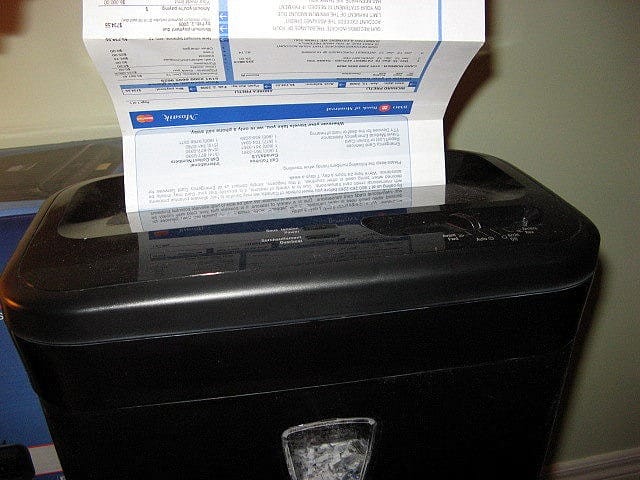
shredder1) Shred unnecessary documents. A good shredder pays for itself immediately. If you’re using it for household bills, this Amazon shredder will only set you back $29.99. Businesses should invest in a more robust tool.

2) Don’t give out your social security number, telephone number, or other unnecessary information on documents. I hand over wrong numbers like a hot woman at the bar. Create a separate email address reserved for email forms and correspondence with companies.

3) Check your credit report regularly. You’ll want to keep a tight watch over predators trying to access your credit. Companies with free credit tools like Quizzle or CreditKarma are great places to monitor lender activity. On episode #2 of our Two Guys & Your Money podcast, Len Penzo reported that he turns off his credit with each credit company until he needs it. Look for other mistakes while you’re there: a recent ABC news story reported that over 90% of all credit reports have inaccurate information.

4) Review every credit card statement. Ever wonder why Mr. Monopoly looks shocked when you draw the “Bank Error in Your Favor….Collect $40” card in the popular board game? It’s because errors happen all the time and they’re rarely in your favor. More importantly, you may see early signs of thieves trying to gain access to your credit.

5) Back up your documents – I’ve recently begun transferring my paper documents into digital form. Keep these in two places in case you lose access to the first or thieves steal the data.

Foremost in my mind today is the tragic and unnecessary loss of life on 9-11. I learned far greater lessons than the five I pointed out above. However, I also learned a little about taking care of my financial life so that if tragedy strikes, the threat to my identity is minimized.


What steps do you still need to take to better protect your financial privacy?

Enhanced by Zemanta
Photo of Joe Saul-Sehy
Joe Saul-Sehy

Joe is a former financial advisor and media representative for American Express and Ameriprise. He was the “Money Man” at Detroit television WXYZ-TV, appearing twice weekly. He’s also appeared in Bride, Best Life, and Child magazines, the Los Angeles Times, Chicago Sun-Times, Detroit News and Baltimore Sun newspapers and numerous other media outlets.  Joe holds B.A Degrees from The Citadel and Michigan State University.

joesaulsehy.com/

Filed Under: credit score, Debt Management, money management, risk management Tagged With: credit monitoring, credit thief, CreditKarma, identity theft, protect identity, Quizzle

  • « Previous Page
  • 1
  • …
  • 21
  • 22
  • 23
  • 24
  • 25
  • …
  • 34
  • Next Page »

FOLLOW US

Search this site:

Recent Posts

  • Can My Savings Account Affect My Financial Aid? by Tamila McDonald
  • 12 Ways Gen X’s Views Clash with Millennials… by Tamila McDonald
  • What Advantages and Disadvantages Are There To… by Jacob Sensiba
  • Call 911: Go To the Emergency Room Immediately If… by Stephen Kanaval
  • 10 Tactics for Building an Emergency Fund from Scratch by Vanessa Bermudez
  • 7 Weird Things You Can Sell Online by Tamila McDonald
  • 10 Scary Facts About DriveTime by Tamila McDonald

Copyright © 2026 · News Pro Theme on Genesis Framework