• Home
  • About Us
  • Toolkit
  • Getting Finances Done
    • Hiring Advisors
    • Debt Management
    • Spending Plan
  • Insurance
    • Life Insurance
    • Health Insurance
    • Disability Insurance
    • Homeowners/Renters Insurance
  • Contact Us
  • Privacy Policy
  • Risk Tolerance Quiz

The Free Financial Advisor

You are here: Home / Archives for Joe Saul-Sehy

Joe is a former financial advisor and media representative for American Express and Ameriprise. He was the “Money Man” at Detroit television WXYZ-TV, appearing twice weekly. He’s also appeared in Bride, Best Life, and Child magazines, the Los Angeles Times, Chicago Sun-Times, Detroit News and Baltimore Sun newspapers and numerous other media outlets.  Joe holds B.A Degrees from The Citadel and Michigan State University. 

Two Guys and Your Money #16: Ghostly Tales of Financial Horror and Asset Allocation

October 29, 2012 by Joe Saul-Sehy 3 Comments

Have shows come automatically to your iPod! Use the 2 Guys iTunes page here.

Listen to shows on your smartphone! Try the Stitcher app here.


Be afraid.

Be very afraid.

Our Halloween special episode is a unique potion we dreamed up just for you.

Listen.

Go ahead. I dare you.


Our show is now sponsored by Fidelity Investments! (Thank you, Fidelity)


Show Notes

<> Open

<4:00> Joe & OG: Things that go “bump” in your portfolio

<8:40> PK: What you should REALLY fear this Halloween

<13:58> Let’s Give Something Away: The E-Myth (contest ends Wednesday!)


Head to our giveaway page here (No Show Listen Required!)


<17:32> Dad’s Shortwave Radio: Dom, Len & (special guest!) Nina Penzo, and Carrie weigh in on their scariest financial moments

<24:48> How do you pick the right investments? Interview with Simon Roy of JemStep

<45:00> Show End: Favorite horror film/tv shows (OG: Treehouse of Horror, Joe: The Changeling)


Thanks to all of our show contributors! You can find out more about our lovable cast of characters on our podcast team page.



Photo of Joe Saul-Sehy
Joe Saul-Sehy

Joe is a former financial advisor and media representative for American Express and Ameriprise. He was the “Money Man” at Detroit television WXYZ-TV, appearing twice weekly. He’s also appeared in Bride, Best Life, and Child magazines, the Los Angeles Times, Chicago Sun-Times, Detroit News and Baltimore Sun newspapers and numerous other media outlets.  Joe holds B.A Degrees from The Citadel and Michigan State University.
joesaulsehy.com/

Filed Under: Podcast Tagged With: finance podcast, financial podcast, money podcast

Investors Beware: What the 3 Biggest Brokerages Really Do With Investor Money

October 28, 2012 by Joe Saul-Sehy 17 Comments

Today’s guest post comes from Susan Lyon, financial analyst with NerdWallet. Thanks, Susan!

What do E-trade, Schwab, and TD Ameritrade all have in common?  Aside from being the three largest online brokerages and some of the biggest brand names in investing, they also all charge investors upwards of $7.99 or more on the typical stock trade.


Think this doesn’t sound so bad?  Think again.  A recent study by NerdWallet found that over 17 million investors are overpaying $1.8 billion every year on unnecessary (and sometimes very complicated or hidden) fees with the largest brokerages.


In light of the ongoing ETF price wars, you’d think a little of this competitive spirit would trickle down into the trading sphere – but this remains to be seen.


Where Is My Money Really Going?

Brokerages all make money by charging commission: that much is plain and simple.  But how much is too much, and is the peace of mind that comes from trading with a brand name broker worth it, NerdWallet asks?  The data says otherwise.


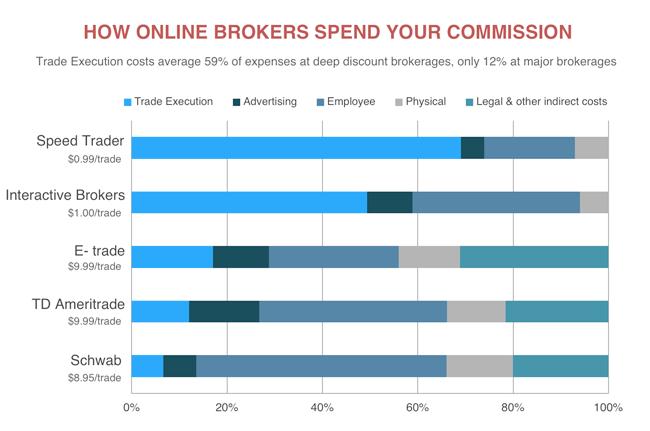
It’s easy to assume that a brand name brokerage is giving you top-notch treatment and the best money can buy, but NerdWallet’s study breaks down the top 3 brokerages’ financial statements to question this assumption.  The key findings:


  • The big 3 online brokers spend a smaller percentage of their money on trade execution – what benefits the investor – compared to the little guys.
  • The big 3 spend far more on advertising and overhead expenses.


This data breaks down expenses at major brokerages by trade execution (what matters to the investor the most) versus advertising, employees, physical, legal and indirect costs:


Lesson learned: active traders can meet their needs just as well by bringing their business to a new firm.  The average investor doesn’t need most of the “extras” offered by the big 3 anyways.  Why pay for something you aren’t even using?


Investors Can Avoid Fees By Shopping Around

The typical investor with these companies makes between 1 and 2 trades per month, so while a one off expense might not seem like a lot, we did the math and it really adds up.  If the typical investor makes only one stock trade per month, of approximately 100 shares, their annual fees at the largest 3 brokers come out to be:


  • E-trade $119.88
  • TD Ameritrade $119.88
  • Schwab $107.40


To make shopping around for better deals quicker and easier, NerdWallet’s new brokerage comparison tool allows investors to compare their many options side-by-side to find the right fit for them.


How Do I Decide on the Best Fit for Me?

NerdWallet’s new tool allows users to do their research before they invest, so they are made aware of all hidden and unpublished fees upfront to avoid unpleasant surprises later on.  Investors can search among the 74 brokerage accounts in the search tool by price, research, or data tools – whichever matters most to them personally.


The takeaway: just like in all personal finance situations, make sure to explore all your options before transferring your money.

Photo credit: Joybot

Enhanced by Zemanta
Photo of Joe Saul-Sehy
Joe Saul-Sehy

Joe is a former financial advisor and media representative for American Express and Ameriprise. He was the “Money Man” at Detroit television WXYZ-TV, appearing twice weekly. He’s also appeared in Bride, Best Life, and Child magazines, the Los Angeles Times, Chicago Sun-Times, Detroit News and Baltimore Sun newspapers and numerous other media outlets.  Joe holds B.A Degrees from The Citadel and Michigan State University.

joesaulsehy.com/

Filed Under: investing news, investment websites, low cost investing Tagged With: Exchange-traded fund, Fee (remuneration), Financial analyst, Investor, NerdWallet, Stock broker, TD Ameritrade

Paying Student Loans: Learn Why to Pay Federal and Private Student Loans Faster

October 27, 2012 by Joe Saul-Sehy 5 Comments

The Truth about Paying Student Loans

If you are borrowing for your college education with Federal or private student loans, you have many options to handle their pay off. When applying for your loan, speak with your financial aid advisor or loan servicer for help choosing from different terms, payment schedules, deferment periods and more.

While payment plans that place a lighter load on you financially may be beneficial to you during different times in your life; there is also a huge benefit to putting in the effort and paying student loans off earlier.

3 Reasons to pay off your private and federal student loans faster

If you are debating whether to pocket your extra cash or apply it to your student loan payments, here are three reasons to go beyond your minimum payments and apply your money to the principal on student loans.


1.       You will pay less for school in the long run.

When you make a monthly loan payment, your money is allocated first towards student loan interest rates and fees and then towards the principal. But when you pay over the minimum amount, you can specify that the excess is applied directly to the principal balance – the total amount due for you to pay off the loan. As this number decreases, so does the amount of interest you pay on the loan. So, when you make the effort to take a larger dent out of your principal, you are significantly reducing the amount of interest you owe overall and the amount of time it will take you to pay off federal or private student loans.


2.       Earn interest rather than pay it on student loan interest rates

The reward for your college education is ideally the ability to secure a job and get on the road to financial stability. That being said, in the early years of employment after college, your overall personal financial obligations will likely be at their lowest level. If you make the smart decision and funnel extra income into paying student loans, you can get them paid down before things like a wedding, house and kids become the financial focus. Plus, once your debts are paid off, you can start putting your money into interest-bearing savings accounts  – helping you meet your savings goals faster. Just remember, because the student loan interest rates are often better on Federal student loans, if you have private student loans as well, you will want to pay those down first.


3.       There is no prepayment penalty

Thanks to the Higher Education Act of 1956, student loan lenders are unable to charge you anything at all for paying your student loans off as fast as you can. So, keep that in mind. If you can make payments now, even small ones, you’ll set yourself up for a better financial future.


The sooner the better when it comes to paying student loans
Getting out of debt can open you up to a world of possibility. Paying more on student loans, or even starting to pay them before graduation, gives you a head start on a secure financial future. Plus, the earlier you start showing a history of making consistent payments, the earlier you start building a positive credit history. It’s a win-win all around.


Sponsored content was created and provided by RBS Citizens Financial Group.


Photo credit: College Degrees 360


Photo of Joe Saul-Sehy
Joe Saul-Sehy

Joe is a former financial advisor and media representative for American Express and Ameriprise. He was the “Money Man” at Detroit television WXYZ-TV, appearing twice weekly. He’s also appeared in Bride, Best Life, and Child magazines, the Los Angeles Times, Chicago Sun-Times, Detroit News and Baltimore Sun newspapers and numerous other media outlets.  Joe holds B.A Degrees from The Citadel and Michigan State University.

joesaulsehy.com/

Filed Under: Debt Management

2 Guys & Your Money Episode #15: Top 5 Ways to Increase Your Investment Returns

October 22, 2012 by Joe Saul-Sehy 3 Comments

Have shows come automatically to your iPod! Use the 2 Guys iTunes page here.

Listen to shows on your smartphone! Try the Stitcher app here.


My favorite number: 15…that is, until we reach episode #16. Someone asked me which podcast episode I like best so far….it will ALWAYS be the one that I did last. They’re all my babies…but this one is the best yet.

On this exciting installment of our podcast, OG is back from the House of Mouse and helps us show you some thrilling ways to tweak those investment returns.

I know, I can’t believe it either. Why are you still reading this? Start listening!


Show Notes

<> Open – Side Hustle. Great idea or waste of energy?

<> PK: Consistency in your investment portfolio.

<> Let’s Give Something Away: This month we’re GIVING AWAY a copy of classic business book The E-Myth (maybe the best business book of all time). Interested in getting better results at work? Read this book!

What do you have to do to win? Tweet about the giveaway, like us on Facebook or guess the voice on the show. Three easy ways to enter. Already liked us on Facebook?


CLICK HERE FOR OUR OCTOBER GIVEAWAY PAGE


<> Shortwave: Len is back and joins Carrie and Dom in a great discussion on fees in every area of your financial life.

Interested in our contributors? Visit our Podcast Team page

<> Top 5: Our best five ways to increase your investment results

<> End Show:

OG – What he liked at Disney

Joe – Frankenweenie film (Thumb up!)

Enhanced by Zemanta
Photo of Joe Saul-Sehy
Joe Saul-Sehy

Joe is a former financial advisor and media representative for American Express and Ameriprise. He was the “Money Man” at Detroit television WXYZ-TV, appearing twice weekly. He’s also appeared in Bride, Best Life, and Child magazines, the Los Angeles Times, Chicago Sun-Times, Detroit News and Baltimore Sun newspapers and numerous other media outlets.  Joe holds B.A Degrees from The Citadel and Michigan State University.

joesaulsehy.com/

Filed Under: Podcast Tagged With: E-Myth, giveaway, podcast, Small business

How To Start Your Own Business

October 20, 2012 by Joe Saul-Sehy 18 Comments

It doesn’t matter why you start: whether you’ve become part of the unemployed, need to supplement your income to pay for a child’s college education, or simply have a passion to “strike out on your own,” starting your business is a worthwhile goal.

More Americans are entering the world of entrepreneurship than ever before. In a July 2012 interview with Forbes magazine, Jack Sunderlage, Executive Vice President of National Sales for Grow America, reported that more than 11.5 million new U.S. businesses have emerged since March 2011.

What does it take to start your own business?

1. Decide what type of business you want to start.

You may not have a clever, new idea that the world will find fascinating and jump at the chance to buy from. However, there are many businesses of the “same old type” that you might be able to run better than those around you.

For instance, the salon you frequent is close to home, yet you have to sign in and wait for up to an hour for service and it lacks a certain “atmosphere.” You just want to get in and out as quickly as possible. But the salon on the far side of town has a more relaxing air about it, and they take appointments. If it were closer to home, you’d probably go there instead. There are many businesses you have an opinion about, yet can’t avoid because you need their services. If it were your business, you would know what changes you would make.

Think about what you would want out of a business as a consumer. Now is your opportunity.

2. Create a business plan.

Don’t worry about writing a lengthy business plan with 5- and 10-year projections. You can start out small and keep it to one or two pages. Include what your business will be, to whom you’ll be selling services or products to (your target customer), how much you’ll charge, and how you plan to do it. This includes what resources you’ll need, including location, staff, furniture, supplies, equipment, telephone, utilities, internet connection, POS (point of sale) system — and what your estimated start-up costs will be.  Research and comparison shopping can help to reduce your operation costs.  For example, investing into a MegaPath internet service can help reduce your total online costs.   Also note how you’ll pay back your start-up loan, if necessary, and how long it will take.

3. Determine how much to charge.

Besides researching what similar businesses charge, ask yourself what kind of income you need to earn. Don’t expect to get rich the first year; be realistic about the growth of your company. List your expenses, such as rent, payroll, taxes, insurance, utilities, consumables, and other monthly costs.

4. Establish how you’ll receive payment from customers.

Getting paid in cash is nice, but most people don’t pay in cash these days, nor write checks. You’ll want to establish a merchant account so you can receive payments by debit and credit card. This is otherwise known as “payment processing.” Payment processing services work with a bank to securely handle debit and credit card transactions. These services will also help to reconcile your accounting to ensure all payments were made to your account. There are many different plans and services offered, so be sure to research several to determine the most quality with the best rates that suits your needs. For help comparing rates from different payment processing companies click here.

5. Get help.

Seek some advice from a new business resource, such as the Small Business Administration and Entrepreneur Magazine. Both of these sites have excellent resources and tools to help steer you in the right direction.

Don’t let fear of the unknown get in the way of starting your own business. It’s an exciting, challenging, yet rewarding opportunity!

Photo of Joe Saul-Sehy
Joe Saul-Sehy

Joe is a former financial advisor and media representative for American Express and Ameriprise. He was the “Money Man” at Detroit television WXYZ-TV, appearing twice weekly. He’s also appeared in Bride, Best Life, and Child magazines, the Los Angeles Times, Chicago Sun-Times, Detroit News and Baltimore Sun newspapers and numerous other media outlets.  Joe holds B.A Degrees from The Citadel and Michigan State University.

joesaulsehy.com/

Filed Under: business planning

Six Simple Tips for Beginner Investors

October 19, 2012 by Joe Saul-Sehy 17 Comments

My parents are in town! While I’m partying with my peeps, this guest article was written by our friend Julian over at Frugaal. Frugaal is a website that provides online stock and forex broker reviews, and it also contains a blog focusing on a broad range of financial and frugal-living topics. Enjoy!


You may think that investing is too complicated and difficult for you–especially if you have a very small amount that you’re able to invest. But over the past few years, the internet has made investing a possibility for anyone. Now, using online brokers, even if you only have a very small portfolio you can get all the benefits that the large investors do, just on a smaller scale. Of course, make sure you check out all the options available for you at the different brokerage companies but, in the meantime, take a look at these six simple investing tips for beginners.

Start small, and also don’t be deterred if you don’t have much cash to invest


In the past, it was impossible to start a portfolio with a very small investment. However, now you can get started with as little as $100. In fact, this it’s a good idea to start of small so you can learn the ropes before you start to take things seriously. So get your feet wet by buying a small portfolio containing mutual funds for example; this will give you an idea of how the stock market works and will mean you won’t risk more than you can afford to. However, by choosing wisely, you can find funds that are highly unlikely to ever lose major ground; they just may not have as high of a return as those that are more volatile. When purchasing stocks, beginners should also ideally go to discount online brokerages where, although the level of service will not stretch beyond deal-execution, you will avoid any expensive fees.


Do your homework


This tip doesn’t mean to say it’s a good idea to shell out a ton of money on books and even online or offline tutorials and courses. Instead, it means harnessing the wide range of readily available, free educational tools that are out there. So follow blogs that specifically focus on stock investing; read the financial papers to get an idea of what stocks you might like to purchase; join online forums (often found on the websites of online brokerages) to pitch your questions and ideas to others who have been in the game for longer and are more knowledgeable than you; and, as the very first starting point, be sure to understand some of the basic principles and rules of economics, accounting, and corporate finance. Ultimately, remember that a few Google searches and a few hours spent reading will get you a long way to begin with all this.


Monitor your investments


After you buy your first stocks, check up on them regularly. While you don’t want to become obsessed with checking them several times a day, this is your money that you’ve invested, so you should keep an eye on how things are going. Only by carefully monitoring the investments will you start understanding what makes them go up or down in value over time. A great way of monitoring your investments is by harnessing the capabilities of Google Finance. You can then also get yourself a Google Docs stock portfolio monitoring spreadsheet. The best thing is, both of these services are completely free.


Diversify


In some ways this should be on this list, but in other respects, it shouldn’t. If you have a diverse portfolio you’ll be mitigating against the risk of losses by spreading your investments across a diverse portfolio. Although in principle this is great, the reality is that it’s not possible to get your hands on a truly diverse portfolio with only a small amount of funds unless you buy into an index fund. So don’t be too hung about not being able to foster a diverse portfolio yourself if you don’t have the funds to do it.


Make investing a priority


If you want to add to your portfolio regularly, make investing a priority in your life. The old adage is that you should pay yourself first, meaning you should put aside money for savings before you pay your bills and buy things you need or want. This is excellent advice. Each paycheck, set aside a certain amount that you wish to invest, say 5% for example. It may not be much, but over time it will add up and your portfolio will grow. Investing is also a great thing to get into if you want to reel in your spending sprees and start to look towards the future, particularly if you’re a young adult. This is because unlike placing money into a savings account – a fairly passive and dull activity – investing can be exciting and it can become a new interest of yours, but one that will also allow you to build a healthy nest egg for later on in life too.


Have patience


Investing is not about getting rich overnight. Have patience with your chosen investments. There’s a very good chance they’ll grow and over time will begin to provide you with the financial return you were after. So if you’re after a quick return, investing won’t be the right method of savings for you; remember, investing is for those with time to wait for the market to dictate the rewards. Also, at the very basic level, make sure you’re not duped by any advert or website suggesting ‘get rich quick’ schemes through stock investing either. Put simply, there’s no magic bullet when it comes to stock investing, so don’t try and look for one.


Thanks for filling in, Julian! With the 4th quarter here, it’s time to cha-ching! on your investments. Okay, crew, your turn. Any tips to pile on top of Julian’s for your internet friends (or as my buddy Kathleen says, “the friends in your computer?”

Photo of Joe Saul-Sehy
Joe Saul-Sehy

Joe is a former financial advisor and media representative for American Express and Ameriprise. He was the “Money Man” at Detroit television WXYZ-TV, appearing twice weekly. He’s also appeared in Bride, Best Life, and Child magazines, the Los Angeles Times, Chicago Sun-Times, Detroit News and Baltimore Sun newspapers and numerous other media outlets.  Joe holds B.A Degrees from The Citadel and Michigan State University.

joesaulsehy.com/

Filed Under: Investing, investment types Tagged With: Asset Allocation, Individual Retirement Account, investing, Investment

What Do You Want To Be?

October 18, 2012 by Joe Saul-Sehy 19 Comments

Having a hard time sticking with your goals lately? How long has it been since you’ve re-evaluated your path?

There’s a place for money, but you might need to re-think your priorities.

Are you chasing the right goals?


What do you REALLY want to do?

Photo of Joe Saul-Sehy
Joe Saul-Sehy

Joe is a former financial advisor and media representative for American Express and Ameriprise. He was the “Money Man” at Detroit television WXYZ-TV, appearing twice weekly. He’s also appeared in Bride, Best Life, and Child magazines, the Los Angeles Times, Chicago Sun-Times, Detroit News and Baltimore Sun newspapers and numerous other media outlets.  Joe holds B.A Degrees from The Citadel and Michigan State University.

joesaulsehy.com/

Filed Under: Meandering, Productivity

Two Guys & Your Money #14 – The Worst 5 Ways to Hire a Financial Advisor

October 15, 2012 by Joe Saul-Sehy 7 Comments

Have shows come automatically to your iPod! Use the 2 Guys iTunes page here.

Listen to shows on your smartphone! Try the Stitcher app here.


“Top 5” is SO last week….this time we took a different approach.

With OG at Mickey’s house, my mom’s neighbor Doug co-hosts (even though he THINKS he’s just coming to the basement to help with the furnace….).

PK tells us how your vote ISN’T wasted, even if you live in an overwhelmingly blue or red state.

The roundtable gives us their best advice from the past month.

We’re giving away the classic The E-Myth, Why Most Small Businesses Fail and What To Do About It

(You have several ways to win: 5 entries to tweet about the show, 5 to like us on Facebook and 25 if you guess the voice on the podcast.)

Click Here For Our October Giveaway Page!


Show Notes

<> Open

<> Yahoo’s Top 13 Wastes of Money. Are you guilty of any of these? Joe and Doug weigh in on our favorites, and the ones we think might not really be a waste.

<> PK from DQYDJ.net: 3rd Party voting.

<> Let’s Give Something Away: Our October book giveaway is in full swing. You don’t even have to listen to the show! Click here for the three ways to win.

<> On the Shortwave: Our best advice from the last month

<> Worst 5 Ways to Hire an Advisor

<> Show End

Doug: Black Book (German film about the Dutch resistance. Rated R. Thumb up, but not for kids)

Joe: 6 Days to Air (Documentary about the making of South Park. Thumb up, but not for kids)

Photo of Joe Saul-Sehy
Joe Saul-Sehy

Joe is a former financial advisor and media representative for American Express and Ameriprise. He was the “Money Man” at Detroit television WXYZ-TV, appearing twice weekly. He’s also appeared in Bride, Best Life, and Child magazines, the Los Angeles Times, Chicago Sun-Times, Detroit News and Baltimore Sun newspapers and numerous other media outlets.  Joe holds B.A Degrees from The Citadel and Michigan State University.

joesaulsehy.com/

Filed Under: Podcast Tagged With: financial advisor, worst ways to hire advisor

How Do You Stay Inspired?

October 11, 2012 by Joe Saul-Sehy 36 Comments

It seems like it should be a simple thing, inspiration. Especially when it comes to money, you know what you want. You know why you want it. But sometimes there’s an invisible fence holding you back, like your neighbor’s dog.

Sound familiar?

Over my career, I’ve felt completely drained and uninspired countless times. I’ll be  sitting in front of a client’s financial paperwork and I just don’t want to look at it…or I’m sitting with an empty page in front of me and nothing comes to mind to write.

I used to worry about this. A piece of me thought of inspiration as a nectar and somehow I’d drained all that I’d been allotted. What I’ve learned is that it’s exactly the opposite:

As I go to the well more often, there’s another layer of good stuff.

How did I learn this? Partly from reading. David Allen (Getting Things Done) comes to mind, as someone who believes that as you clear away the small tasks you open your mind for much bigger concerns.

The rest I’ve learned from time in the trenches. I’ve always been a high achiever. When everyone else is stopping for the day, I’m going back for more. How?

Here are five things I think about to stay inspired:

1) I don’t have to finish the next task, I just have to start it. The act of starting is usually enough to get me rolling through to completion.

2) Just puke something out and clean it up later. Having SOMETHING to work with is better than the blank screen/no notes situation.

3) Make the phone call and it’ll come to you. I hate calling people and asking favors. But if the phone is ringing, my mood completely changes and I figure out a way to make it a successful call.

4) Think about Friday and work harder today so there’s less to do then. I hate working long hours on Friday. If I bust my butt now I can decide on Friday whether I play around or spend extra time.

5) Take a break with a timer. I’ll get burnt out from focusing too hard. If I don’t set a timer on work and spend some time at play, I find that every few weeks I need a complete mental break. I used to avoid breaks because I didn’t think I deserved them. Let’s be clear: I don’t deserve them. I NEED them to keep moving toward my objective. It’s a marathon. I also use the timer for breaks. Once I start playing I rarely want to get back to work. The timer works both ways.

Those are my five. I’m sure you have more. Let’s have some weekend fun: What do you use to stay motivated and inspired?

Photo credit: xJason.Rogersx

Photo of Joe Saul-Sehy
Joe Saul-Sehy

Joe is a former financial advisor and media representative for American Express and Ameriprise. He was the “Money Man” at Detroit television WXYZ-TV, appearing twice weekly. He’s also appeared in Bride, Best Life, and Child magazines, the Los Angeles Times, Chicago Sun-Times, Detroit News and Baltimore Sun newspapers and numerous other media outlets.  Joe holds B.A Degrees from The Citadel and Michigan State University.

joesaulsehy.com/

Filed Under: Meandering, Productivity

7 Things Guys Should Not Say At Work

October 9, 2012 by Joe Saul-Sehy 51 Comments

Time for some serious financial advice:

I’m recycling old magazines and donating books. My bookshelves are busting at the seams with books and periodicals I’m keeping for reasons beyond my knowledge. While I was making stacks today, I came across an Esquire special magazine which featured a HUGE list of phrases guys shouldn’t use at work.

Keeping a job isn’t just a good part of being a guy…it’s part of being financially fit. That’s why, if you’re wondering how the hell this post fits this website, I was able to sneak it in under the wire.

I’m trying to help you keep your job.

Being a guy is part science/part art. Sometimes, I’ll admit, I  don’t even quite understand “the rules.” I admitted at a bar one time that Muriel’s Wedding was one of my favorite movies.

Let’s just say that didn’t go well.

I tried to make it better by telling them that I loathe Steel Magnolias (don’t get me started), but apparently admitting that I’d even seen the film was a reason I’ve been told I have to forfeit my man-card.

That said, if you were a dude and said any of these in the office, it might catch my attention:


My Favorites From Esquire’s List of “Things a Man Should Never Say at Work”


7) “You seriously wanted me to do that?”

6) “Nice Botox”

5) “I had a dream about you last night.”

4) “How much’re they paying you anyway, sweetheart?”

Zumba

I’d fit in like a lobster at a seafood restaurant

3) “It’s called Zumba. I’ve lost 12 pounds.”

2) “That’s not how we did it at my last job.”

…and my favorite line from Esquire’s “Things a Man Should Never Say at Work”

1) “They’re white-chocolate cranberry. I baked them last night.”


I hope these tips helped you hold onto your job a day or two longer. Any I missed?

Photo of Joe Saul-Sehy
Joe Saul-Sehy

Joe is a former financial advisor and media representative for American Express and Ameriprise. He was the “Money Man” at Detroit television WXYZ-TV, appearing twice weekly. He’s also appeared in Bride, Best Life, and Child magazines, the Los Angeles Times, Chicago Sun-Times, Detroit News and Baltimore Sun newspapers and numerous other media outlets.  Joe holds B.A Degrees from The Citadel and Michigan State University.

joesaulsehy.com/

Filed Under: irrelevant stories, Meandering, money management Tagged With: Esquire, things you shouldn't say at work

  • « Previous Page
  • 1
  • …
  • 20
  • 21
  • 22
  • 23
  • 24
  • …
  • 34
  • Next Page »

FOLLOW US

Search this site:

Recent Posts

  • Can My Savings Account Affect My Financial Aid? by Tamila McDonald
  • 12 Ways Gen X’s Views Clash with Millennials… by Tamila McDonald
  • What Advantages and Disadvantages Are There To… by Jacob Sensiba
  • Call 911: Go To the Emergency Room Immediately If… by Stephen Kanaval
  • 10 Tactics for Building an Emergency Fund from Scratch by Vanessa Bermudez
  • 7 Weird Things You Can Sell Online by Tamila McDonald
  • 10 Scary Facts About DriveTime by Tamila McDonald

Copyright © 2026 · News Pro Theme on Genesis Framework