• Home
  • About Us
  • Toolkit
  • Getting Finances Done
    • Hiring Advisors
    • Debt Management
    • Spending Plan
  • Insurance
    • Life Insurance
    • Health Insurance
    • Disability Insurance
    • Homeowners/Renters Insurance
  • Contact Us
  • Privacy Policy
  • Risk Tolerance Quiz

The Free Financial Advisor

You are here: Home / Archives for Planning

The Power of Big Fat Audacious Goals

February 12, 2013 by Joe Saul-Sehy 55 Comments

Do you get caught up in living today instead of designing tomorrow?

Snap out of it.

Check out what these two guys accomplished with just a little planning.

As an advisor, I can’t tell you the number of times I heard “but” or “I just can’t.” It was discouraging to watch some people achieve everything they wanted for themselves, while others sat in front of the television, so paralyzed by fear that they never reached anything.

I have a close family member who spends much of the time I’m with her saying, “I wish we could…”, or “Some day I’d like to….” in a really whiny voice. It’s clear that this woman has no intentions of ever turning her “I wish” into “I did.”

Let’s talk about the power of getting what you want.

If you listen to our podcast, you’ll know that last weekend I went with two good friends, Troy and Malcolm, to help them run 100 miles. You read that number correctly. They set out to run a race longer than most would ever dream.

If you read this post and think, “This doesn’t apply to me! I don’t think I’d want to run 100 miles,” you’ve completely missed the point. Go read Disney.com and live in Fantasyland. The point is this: What is it that you want to do? What is your plan to reach that pinnacle?

The course was a 20 mile loop the runners would circle five times. Each loop was a mixture of trails and two-track access roads. Sprinkled around the loops were 3 aid stations, one of which runners would hit twice on their journey. Along with the finish area, runners could stop 5 times each loop for food, water, or first aid.

The day before the race we headed for the pre-event briefing. I was amazed. How many people do you think would try to do something this crazy? There were over 700 runners listening to the rules on littering, race courtesy, and how aid stations worked. Half the runners were signed up for the 100 mile race. Half! The other half? They were going only 50 miles.

Malcolm had finished the 50 miler a year earlier and whispered at the briefing, “This is the only event where you’ll race 50 miles and feel like a total wimp.”

I found out another statistic later: over 200 of the starters wouldn’t finish the trek.


Troy and Malcolm before the start better


The Starting Line


We were at the line early Saturday morning (about 5:30 AM). The 100 race began at 6 AM and the 50 started an hour later. Runners streamed across the campground, nearly all wearing headlamps, and some with a second flashlight in hand. When the starting whistle sounded, imagine people with headlights slowly jogging down the trail. It looked like a stream of fireflies leaving the campground and dancing single file through the woods away from us.


Malcolm and Troy entering an aid station.

Malcolm and Troy entering an aid station.

Early Miles


It was amazing to me that, while I went back to my high end hotel (LaQuinta!), caught another hour’s sleep, and edited our podcast, Troy and Malcolm were out there running. I picked up another friend to grab some lunch, and they’d been going for 6 hours and weren’t even halfway done. By the time I reached the campground again at five in the afternoon, they’d still completed less than 60 miles.

All in all, the reports on the runners were good. Malcolm had some trouble with blisters on his feet (he’d popped three) and Troy seemed a little punch drunk. But when they came in after dark to complete their third lap, both still looked to have plenty of energy.


Troy and pacer Barry headed out at 60 miles

Troy and pacer Barry headed out at 60 miles


Malcolm and Christy

Malcolm and pacer Christy leaving the start/finish area after 60 miles

Pacers


Runners were allowed pacers after 60 miles. Here was the plan: our friend Christy was going to pace Malcolm the entire way, because she was training for her own 50 miler in a few weeks.

Four of us would pace Troy. Barry, an experienced triathlete would pace for 12.5 (where an aid station was located) and Rob, another experienced triathlete would take over. Both of these guys had completed an Ironman, so they were ready. I’d jump in and pace from miles 80 to 92.5, where Christi, Troy’s spouse (and also an experienced marathoner) would take over.


My Turn


What a blast…and a challenge at the same time. Troy and Malcolm, who’d been running together the whole day, didn’t reach the finish line together to start the final lap. Troy was now alone with his pacers. Barry had stayed on to run with Rob and Troy the last 7.5 because there were so many roots that it was too easy to fall in the dark.

I strapped on my light helmet, Barry gave me instructions for pointing out roots and changes in the footing, and we were off. It was midnight. Troy and Malcolm had been running for 18 hours straight.

It became clear to me immediately that running 80 miles had had a huge impact on Troy. He mumbled most of the time, and I tried to tell stories to keep him moving. However, there were so many roots that I spent the majority of my time hunched over each one, making sure he cleared his feet as he shuffle-ran down the path.


The System


After awhile, we found a system rooted in rally racing. I’d watched some of this sport on extreme sports shows. The driver kept his eye on the road while the navigator called out turns and obstacles. I started calling the run like I’d seen on television. I felt like a dork, but here’s what it sounded like,”

“Step down. Step down again. Watch this bump. Clear. Stay left. Stay left. Step up. Uneven footing. Another big root. Okay, we’re clear. Nice job.”

Troy was in such bad shape that as we went to leave the aid station at 83 miles, he turned and started walking up the path the way we’d arrived. I turned him around and we were on our way.

Using our new system, we passed quite a few runners. These were the nicest people on earth. A friend joked that it was what you’d imagine Woodstock would have been like if everyone was incredibly physically fit. “Great job, man.” “Keep going, dude.” “Lookin’ good!” were the calls of the day.

There’s a feeling you get when you’re in the middle of the freezing woods at 2 am and suddenly you see the yellow glow of the next aid station. It feels like an oasis. You know that just up the road there will be warm or cold drinks, tons of food, and most of all, a little bit of civilization. Troy would celebrate a little at each one. He’d made it another few miles.


Troy-getting-ready-to-go-out-after-60-miles_thumb.jpg


Problems


But I knew at the 12.5 aid station that we were going to have a task on our hands. Time was running down and our pace wasn’t fast enough to bring Troy in at his stated goal: 24 hours. While we maintained a positive outlook around Troy, the team seemed pretty negative. At least we’d finish. That’d be a huge accomplishment in itself. In fact, Malcolm was now about 45 minutes behind us, and was clearly trying to finish rather than race to 24 hours.

Because of the roots, I decided to stay on. We’d be a three person team, Christi, Troy and I. I’d run out front and call roots out, while Christi would shine her flashlight on them as we went. After a brief stop, the three of us trudged into the darkness again. Seven miles and just over an hour and a half to go.


Luck


We got lucky.

Troy was in no position to tell us, but most of the rest of the loop was a clear two-track jeep trail. We made good time, but at the last aid station, with three miles to go, it was clear: we were right on the edge. I could see Troy gathering the little strength he had left to try and make it. The guy could barely stand up and he was still running! It was an incredible human feat.

Throughout the night, we’d been relying on my Nike + system rather than Troy’s GPS to keep track of miles. This tracking, while wildly inaccurate, helped us keep Troy’s spirits up throughout the segments. During the last three miles he must have asked us twenty times, “How much time do we have?” “How far does she (the female voice on my Nike + system) say we have to go?”

Finally I announced, “Troy, she says we’re done.” She’d been early all night, calling miles before we reached them, but the three of us celebrated that moment, and then moments later celebrated again when we crossed what we knew was the last road before the home stretch.


Want to hear more motivational stories from people with big goals? Check out our 2 Guys & Your Money episode with Natalie Sisson (who left New Zealand and travels the world) and Chris Klinke (who climbed Mt. Everest).


The Finish


I couldn’t believe the change in Troy when we turned the corner and saw the yellow glow of lights across the finishing tent a couple hundred yards away. He let out a war whoop, as did Christi and I. There were echoes of people at the finish whooping back at us. We sounded like animals barking back and forth at each other until he crossed the line.

Did he make it in 24 hours?

We crossed the line at 23 hours, 52 minutes.

Malcolm finished in just over 25 hours.

It was an amazing bucket list accomplishment for both of these men.


Malcolm removing chip at finish


What Does This Have To Do With Your Goals?


Everything.

1) Set huge goals. While Malcolm finished in 25 hours, instead of his 24 hour goal, he still accomplished something that few will ever do. Don’t set your goals too small. Set them high. Even when you don’t reach them, you still can hold your head high.

2) Set milestones and celebrate. I find people get lost on their way to big goals because they don’t have any markers along the path. Those aid stations were a great oasis to refuel, plan, and then set out. Rather than setting out to accomplish 100 miles, the race became a struggle to reach the next 3 miles.

3) Find qualified friends to help. Troy and Malcolm said that the pacers were a shot in the arm at 60 miles. It became much easier when you had a fresh voice who’d run some serious distances themselves helping you through it. They say you are the people you surround yourself with. Find people who’ve been on your journey. Even if they aren’t going for the same goal, they’ll be able to help you win.

4) Use technology. Sure, the Nike + was innaccurate, but it was close enough that it helped us monitor our progress at any point. Troy and Malcolm still had to run, but without the flashlights, GPS, and suitable clothing, they would have never made it.

5) Stick to a system and work hard. Sure, we got lucky the last 7 miles, but we wouldn’t have been able to learn from that luck if Troy hadn’t worked his ass off to get to that point. My old mentor used to tell me “Work hard and the opportunities will come.” In this case, as nearly always, the opportunity came.

 

Malcolm and Troy afterward...ready for bed


What big goals are you working on? What are you waiting for? Get started!

Photo of Joe Saul-Sehy
Joe Saul-Sehy

Joe is a former financial advisor and media representative for American Express and Ameriprise. He was the “Money Man” at Detroit television WXYZ-TV, appearing twice weekly. He’s also appeared in Bride, Best Life, and Child magazines, the Los Angeles Times, Chicago Sun-Times, Detroit News and Baltimore Sun newspapers and numerous other media outlets.  Joe holds B.A Degrees from The Citadel and Michigan State University.

joesaulsehy.com/

Filed Under: irrelevant stories, Planning Tagged With: 100 mile race, goal setting

Public Speaking: 10 Practical Tips

February 1, 2013 by Joe Saul-Sehy 25 Comments

As you know, financial planning is about two sides of an equation. Income and expenses. Let’s work today on increasing your income. How? If you’re going to be a leader that others look up to, you’ll need to be a great public speaker. Here’s how.

If you’ve seen me, you know I have a face for radio. However, I made a great living off of my ability to speak in front of people. During my advising years, not only did I work in public relations, handling media interviews and questions, but I was a hired gun. Other advisors would pay me to give speeches for them. Why? My results were so good that I could sell people on working with you better than you could sell yourself!

How did I do it? The basics aren’t hard, but they’re surprising to many non-speakers. When you read these tips something should strike you right away: most of them aren’t about the speech…they’re about what most would call peripheral areas of the talk.


Let’s go:


1)   Look the part. I was a financial advisor who was supposed to be trustworthy with your money. I needed to wear a suit that looked clean, freshly pressed and with polished shoes. My hair needed to be groomed. No expensive watches or over-the-top ties. Good money managers aren’t wasteful with other’s money. Ask yourself this: what does your audience want to see?

I practiced neuro-linguistic programming methods made famous by Anthony Robbins but practiced by most of the of top speakers and sales professionals of the world. It’s roots are grounded into hypnotism. Wear the right colors (hunter green and a deep blue are nice “trustworthy” colors. Model your favorite speakers, copying the traits that make them stand out. Watch the audience to see if they’re mimicking your movements slightly (I move left, people lean left). There are many subconscious ways to stack the deck in your favor.

2)   Own the room. If the talk stinks, people aren’t going to blame the people who set up the room. They’ll simply say, “That speaker was horrible!” They won’t analyze the countless things that worked against the advisor. Come early enough to set up the room before you speak. I had a list of criteria I reviewed with the people who hired me to make sure I was able to win.


Here are a few:


–       Set tables up in half-moons so guests can see me without craning their neck.

–       The temperature should be slightly cool when the room is empty. If it feels great empty, people will be sweating when it’s full of breathers.

–       Play soft music before the talk. People feel awkward when the room is silent.

–       Set up the podium or microphone so it’s already at the right height and you don’t have to fiddle with it to begin your talk.

–       Disappear before the show. You’re the main event, not the greeter.


3)   Warm up. Speech writer Peggy Noonan (1000 points of light) made me a believer in this one. In physical education classes or any strenuous activity, people warm up first. Don’t use the first several minutes of your speech to get your blood pumping. I used to do 25 quick jumping jacks about 3 minutes before I took the stage. Find a quiet, out of the way spot (I only got caught once!) and get ready to start your speech with a BANG!

4)   Have someone else introduce you. Work with the person introducing you to make sure they start the speech off correctly. Usually, they’re not used to standing in front of the room. You don’t want to trust whatever comes into their head. It won’t be good. Write an intro for them and tell them “most people just read this as-is. People don’t know that I wrote it for you.”

5)   Stories beat facts. A funny story. One top advisor complained that he created a seminar with brilliance and nobody would buy. Then he started hiring me after he heard how good I was. According to him, “Then Joe comes in and tells a few funny stories, throws in a couple facts everyone already knows, and the whole room signs up to work with us.”

Why? It’s a little technical, but boils down to this: people don’t actually come to a financial seminar to learn. They come because they want to know if the advisor knows what they’re doing and to see if they can glean one or two things. The room is going to have two types of people: amiable people and analytical people. The amiables want to like me. The analyticals want to know if I know what I’m doing. Therefore, I structured me speech (roughly) this way:


(story)

(story)

(story)

fact

(story)

(story)

fact

(story)

fact

fact


See how it’s front loaded? Marriot once performed a study that showed people decide if they like the hotel in the first five minutes. They haven’t even reached the room yet! It’s the same with your speech. Amiables  (most of those in the survey) just want to like you and are going to decide quickly. Therefore, I front load the speech to win those people. I have many, many friends who are engineers. I’ve often joked that if I hadn’t been so naïve in high school and thought that engineers were just train drivers, I would have been one also. People who are analytical know the game, but they also want to know what you know. They’ll wait through a few stories that they could care less about, as long as you bring home the bacon at the end. That’s why it’s fact fact at the end (and usually my best stuff that they didn’t know before coming).

6)   Don’t try to be a comedian. I’m naturally someone who likes to laugh and share jokes. I found that my biggest issue was to make sure that I didn’t come across as “goofy” during my presentations. Humor, sparingly, is good, but unless you’re at Caroline’s Comedy Club, a little goes a long way.

7)   Choreograph your talk. I had three positions when I talked:

–       Knowledge: When I was doling out facts my feet were together, shoulders square, and I used my left hand to point at the facts on my screen (left hand because you want to stand to the audience’s left of the screen, so they subconsciously look at you first and then your data. If you stand on the other side, they’ll spend the whole time focused on the data and then come to you).

–       Story: I’d move toward the audience, feet apart, and move my arms to reflect the story. My face would become more casual.

–       “So What?” – To make your biggest points, move up toward the audience, lean forward, and slowly move your head from audience member to audience member. Don’t overdo it. This position should be reserved for a couple of major milestones and your call to action ONLY.

8)   Chuck the script. I’ve been to too many speeches where the person reads to me. Just email me that and let me go home. If you’re speaking to me, work from your main points! Don’t think of exact words, think of the actual meaning of your talk. What are you trying to convey? If you start with a script, learn it cold and then work to unlearn it. You’ll find that the most important phrases from the script stick and the rest melts away.

9)   Rehearse your open and close. In the book Lions Don’t Need to Roar, author D.A. Benton talks about the difference between how CEOs and underlings give presentations. While an underling is already speaking as they’re being introduced, the CEO shakes the hand of the person performing the introduction. Slowly strolls to the podium, shifts through their notes, squares their shoulders, and then delivers a powerful opening. Why? It’s all an act to show who’s in charge!

Rehearse your close for another reason. I had a fantastic story at the end of my speech after my two big facts. This created an applause moment. My goal? To walk out of the room with people really applauding hard. I created that by working over and over on milking the last three minutes of my speech.

10)   Less is better. For awhile (when I was a new speaker), I thought I could WOW people with more stuff. Yeah, that’s not the case. People don’t want more. They want better. A speech is poetry. Less words, more choreography, more fun for the audience.

Enhanced by Zemanta
Photo of Joe Saul-Sehy
Joe Saul-Sehy

Joe is a former financial advisor and media representative for American Express and Ameriprise. He was the “Money Man” at Detroit television WXYZ-TV, appearing twice weekly. He’s also appeared in Bride, Best Life, and Child magazines, the Los Angeles Times, Chicago Sun-Times, Detroit News and Baltimore Sun newspapers and numerous other media outlets.  Joe holds B.A Degrees from The Citadel and Michigan State University.

joesaulsehy.com/

Filed Under: Planning Tagged With: Audience, Business Services, Communication, Education and Training, Peggy Noonan, Public speaking, Social media

5 Simple Steps to Kick 2013 Into High Gear

January 2, 2013 by Joe Saul-Sehy 44 Comments

Happy 2013, everyone!

It’s time to take yourself a little more seriously and step up your game. My cousin, a year younger than me, had major heart surgery a couple weeks ago and nearly lost his life on the operating table. Not to be all melodramatic, but it was another close-to-home reminder that time is a finite beast. If you’re going to leave your mark on the world (or just on your little private Idaho), 2013 is the time to make changes.

Here’s the gameplan we’d use when practicing financial planning with clients back in “the day” and it’s also what I’m using this year to shift up a gear:

1)   Write out clear, actionable goals. I like Maria at The Money Principle’s post about themes. Start with an idea generally of what you want to do, then drill down toward specific tasks.

My 2013 theme is about tying up loose ends and focusing harder on core tasks. I haven’t yet crystalized completely the theme (it should be more succinct than what I have so far), but that’s not bad news. I’ve been thinking about it constantly, and this action gets the right thoughts in my little noggin’.

My main goals are simple: I have the first draft of a book written, and I’ve let it sit for about 9 months. Why? I have no idea. Other priorities. But now’s the time to finish that project. I’ve run marathons now for two years. I’d like to run one faster than ever. I’d also like to try an ultramarathon. I need to focus on cooking healthier food at home and have a more regimented plan. On the website side, we’ve talked about creating some products. These need to be launched in 2013.

2)   Direct deposit to your savings account. Everyone direct deposits money into their checking account…and immediately drains it. Reconfigure your system so that you direct deposit to savings. Manually move money to live on over to your checking account.

While this seems like a little step, it’s a huge change. Now you’re saving automatically and having to think every time you spend money. You’re a conscious consumer, rather than an auto-spender.

3)   Protect your downside. I know this for a fact: bad stuff that you don’t expect will happen in 2013. I don’t know where it’ll come from, so the best course of action is to look for Achilles Heels and apply duct tape. Do you have an emergency fund? Is your insurance up-to-par? Is the budget tight?

I need to adjust Cheryl’s life insurance (adjusted mine in 2012). Our will is now six months from being out-of-date (my children will be 18 years old…how the hell can that be? They were just babies yesterday….). I also have to begin “landing the plane” with my kid’s investment funds, so they’re ready when and if I need them for college expenses.

It’s also time for me to get home and auto quotes again. For some, checking out Insure 4 a Day may be a good idea. They offer a variety of cheap short term car insurance options dependent on your requirements.

4)   Focus on energy, not time. I agree with Jim Loehr and Tony Schwartz in their book The Power of Full Engagement on this one: the key to optimum performance is to manage your ability to crank stuff out. As workers, we’re like tennis players: we compete year-round. It stands to reason that we can’t be great every moment of every day. We should gear up for those times when there are “big tournaments” in our life and focus on those days.

I’m working on a model day that better uses my energy and shelters that time I need for key tasks. I generally experience great creativity in the morning and low energy around 3 pm, so I’m reconfiguring my day to take advantage of that morning time and guard against the afternoon letdown. I’m also focusing more on my diet to avoid those crashes (just as soon as I finish these chocolates….).

5)   Create surround sound. The best way to stay motivated is to surround yourself with people, books and podcasts that keep your mind on those activities that’ll help you achieve your dreams. Schedule meetings with your planning partners, spouse, and close mentors. Don’t just say “I’ll talk to people more often about my plans.” That doesn’t happen, does it? Set a time in your calendar and stick to it.

We created the podcast for this reason. I enjoy casual talk about subjects I’m interested in, not hard core discussions. I couldn’t find many chatty money podcasts (Planet Money is probably the closest I’ve found), so we created one. If you’ve listened to our show you know: it’s more about equating money with fun and less about deep drilling.

Biographies work well for me, too, to create surround sound. I don’t know why, but I particularly love books about chefs. Maybe it’s because they have to be in-the-moment so much. I loved Kitchen Confidential by Anthony Bordain (don’t read this book if you don’t like foul language and discussions about illegal activities). Currently I’m polishing off Restaurant Man by Joe Bastianich. Both of these are great looks into the world of business, written passionately by someone who knows their craft inside-out.

This list could be 100 points long, but if you practice those five above as you walk into 2013, you’re going to move faster, with more energy, and with fewer distractions.

ON that note, how about $100 Amazon money or cash to start your year off right! That’ll buy a bunch of groceries, books or mp3 players…..

Photo: TheBusyBrain


a Rafflecopter giveaway

Photo of Joe Saul-Sehy
Joe Saul-Sehy

Joe is a former financial advisor and media representative for American Express and Ameriprise. He was the “Money Man” at Detroit television WXYZ-TV, appearing twice weekly. He’s also appeared in Bride, Best Life, and Child magazines, the Los Angeles Times, Chicago Sun-Times, Detroit News and Baltimore Sun newspapers and numerous other media outlets.  Joe holds B.A Degrees from The Citadel and Michigan State University.
joesaulsehy.com/

Filed Under: budget tips, Cash Reserve, money management, Planning

Holiday Games and Finance: What Can the Game “Dominion” Teach You About Money?

December 26, 2012 by Joe Saul-Sehy 22 Comments

While Joe’s playing Dominion with his sister, brother in law and spouse (we all l.o.v.e. this game at our house), Erin Shanendoah of The Dog Ate My Wallet fame holds down the fort at the blog. Hope you’re enjoying some quality family time like we are!

Dominion is hands down the favorite game in our house. Set up is minimal, and you can get through a 2 player game in as little as 10 minutes if both the players know the cards. Every game is different, which means that players need to be open to different kinds of strategies if they want a chance at winning.

Even forgetting that you have money within the game (copper, silver, gold & platinum(in the expansions)), you can learn a lot about finances from Dominion.

Every game is different. Just like every person’s financial situation is different. Because of this, there is no one strategy works for every game of Dominion, and there is no one size fits all solution to personal finance. You have to look at the cards that have been  dealt and figure out the best plan for this game, this situation. Only by responding to the uniqueness of each situation can you hope to consistently do well.

Multiple strategies can be viable options. My husband and roommate both love playing games, and for the most play well together. But they have different outlooks on life and will often see the exact same set of cards and come up with two completely different ways to win. They each go with the strategy that they are the most comfortable with.

Just because someone has a similar financial situation to you does not mean you have to both take the same financial strategy. Find what works for you and what you’re comfortable with, and you’ll have a much greater chance of “winning”.

Diversity is good. Too much is not. Currently, there is the base set and 7 expansions for Dominion. While you can play with as many expansions as you want, we’ve found the best games are limited to 3 sets- usually the base plus two expansions. 3 sets gives you lots of options, but you don’t lose the synergy between cards.

Diversifying your holdings financially helps mitigate your risk, but if you diversify too much, you lose the power of “buying in bulk” so to speak. (Average Joe and The Other Guy can both speak about this much more eloquently than me.)

Sometimes you just need more money. Other times, you need your money to work harder for you. Within Dominion, you use money to buy other cards. You can buy more money, action cards, or victory point cards. Sometimes, the best strategy is to use your money to buy more money, especially in the early stages of the game. But later, you’ll want to use that money to buy action cards. Those cards allow you to advance your strategy, hinder the strategy of others, and sometimes even buy the highest value victory card, even though you started the hand with only 2 coppers.

Early on in your life, often the best solution to money problems is just to get more–go out and work a second job, find a way to earn passive income, etc. But once you get to the point where you’re not struggling to pay the bills, you need your money to work for you. By making smart moves with your money, you can open new doors for yourself or your family, and eventually “win” the game by having a comfortable retirement. (I do hope that in real life, you won’t use your money to hinder others. That should be a game strategy only.)

Just sitting on money can slow you down. One might think the one strategy in Dominion that would work in every game would be to use your money to buy more money until you had enough to buy victory cards, and just keep doing that. It doesn’t work. While you obviously need victory cards to win the game, they don’t do anything else. You can’t spend them. You can’t take an action from them (well, in some expansions there are victory cards that have actions, but those are very special cases). Instead, they just take up valuable space in your hand and do nothing, slowing you down.

While sometimes it seems the safest way to save money is just to stick it in the recliner and sit on it, your money can’t grow that way. It can’t actually do anything for you. It’s a strategy that just slows you down.

The cards aren’t always your friends. There are good cards and bad cards in Dominion. There are cards that are good for the person who plays them and awful for others. There are thieve and militias, there are curses and witches. You can be forced to destroy your victory point cards or have a platinum stolen by the player to your left. Sometimes, you just get negative victory points. In order to win, you have to have a strategy to weather or eliminate the bad.

Bad things happen in real life. You need to have the tools to survive them. Sometimes it’s just in making smart decisions and protecting yourself. Getting yourself out of debt and carrying the right kinds and amounts of insurance can also protect you against the vagaries of the world.

Luck always plays a role, but it’s not everything. Because every player of every game of Dominion starts out with the exact same 10 cards, and a five card hand, there’s a limited number of opening hands you can have. But which one you get and how well it works for that particular game, is all a matter of luck. If two good strategies are going against each other, it’s really just going to be luck that decides the winner of the game. But it’s very rare for a well thought out strategy to lose to no strategy at all. Just depending on luck isn’t likely to win the game.

Some people start life luckier than others. Some people get lucky later on. And some people make their own luck by coming up with a well thought out strategy. And in life, it’s not really going to matter if you retire with $2 million while your buddy is ending with $2.1 million. You’ve both “won”.

Don’t forget to have fun. Dominion is a game. The husband and roommate are both competitive people and love to win. I care much more about enjoying the game. But I can’t enjoy the game if I feel ineffective. I will enjoy myself just as much putting together a strategy that comes “this close” to winning as I will winning the game. I will even enjoy a failed strategy if I find a single good combination within it.

How much money you die with matters only to the people you leave it too. You can’t use it anymore. Don’t put your life on hold just to reach some arbitrary savings goal. If you never take vacation until you’re 75 years old, are you going to be able to climb the island stairs at Tintagel? Yes, you want to save for the future and make sure you have enough to retire in comfort, but there’s no counting up victory cards at the end of your life, declaring you the “winner”, so make sure you have some fun along the way.

Photo of Joe Saul-Sehy
Joe Saul-Sehy

Joe is a former financial advisor and media representative for American Express and Ameriprise. He was the “Money Man” at Detroit television WXYZ-TV, appearing twice weekly. He’s also appeared in Bride, Best Life, and Child magazines, the Los Angeles Times, Chicago Sun-Times, Detroit News and Baltimore Sun newspapers and numerous other media outlets.  Joe holds B.A Degrees from The Citadel and Michigan State University.

joesaulsehy.com/

Filed Under: Investing, money management, Planning

Year End Tax Planning: A (Surprising) System of Cleaning My Closet

December 4, 2012 by Joe Saul-Sehy 40 Comments

On the way home from this Thanksgiving weekend in Michigan, I finally reached my limit with the situation in my closet.

For the last four years it’s become bigger and bigger mounds of….clothing. Just as I get the closet organized, it becomes a mess yet again. Being a recovering financial advisor, I loathe messes. Everything should be in neat and tidy rows, not thrown on the closet floor.

Historically, at this point I’d decide to get rid of clothing. I’d pick up stuff and make the “stow or go” draft move:

“No,” the hoarder in me said, “I’ll wear that some day.”

“I got that at my favorite 5k in 1998. I can’t get rid of the Pickle Run shirt!”

“If I get that stain out I’d wear it all over the place.”

I should have been saying, “Some day bell bottoms will come back in style!”

Sometimes–not often enough–I’d find a piece that definitely had to go. Whenever I brought home new clothing from holidays or trips to the mall, old stuff stacked up. The “donation” pile contained a lonely piece or two. I was adding clothing at a 2:1 rate over donations.

On the way home I snapped. Suddenly I formulated a plan:


The Plan


It was so easy, I can’t believe I hadn’t seen it earlier.

Clothing decisions (and by extension “stuff” in general”) isn’t about whether I like each “thing” or not; of course I loved them all. I wouldn’t have bought them if I didn’t like them. They all had sentimental value AND my mind needed to justify the reason I’d added them to my collection in the first place.

In short: using my current criteria, there was no way I’d ever clean out the closet.

In my a-ha moment, I flipped my thinking: the closet wasn’t a place to store all the cool stuff I wanted to keep. It was a place to store things I needed.

Following that train of thought led me to the real question:

How much did I really need?


The List


I made a list of things I really needed:

10 Long Sleeve Running Shirts (probably don’t need 10, but that was a start)

10 Short Sleeve Running Shirts (closer to the number)

4 Pairs Running Shorts

3 Pairs of Jeans

4 Pairs of Dress Pants

3 Suits (again, probably too many for my lifestyle, but I could cut more later)

6 Ties

6 Button down shirts

5 Pullover sweaters

….and so on.


…and Action!


Sunday was a bloodbath in my closet. I tore everything out and placed it on the floor. I was making Top 10 lists of each type of clothing. Soon I was at the difficult portion: there were pieces I liked, but they didn’t make the  Top 10 (or 5, or whatever….). At this point it didn’t matter how much I liked the shirt: there were enough pieces for me to wear without it in my closet. Better to gift it to someone who really needs it this holiday than to keep it sitting in my closet with 10+ items I’d rather wear.

I created a gigantic mound of clothing to donate.


Itemized Charitable Donation Deductions: Bonus Time!


If you itemize your taxes, you are probably eligible for charitable donations to 501c3 organizations. If you aren’t sure whether the place you want to donate clothing is a 501c3, just ask them. They’ll know.

If your organization is eligible and you itemize deductions on your taxes, you may be able to write off your charitable contributions. I received a receipt at Goodwill that listed all of the items I’d donated to them. I’ll use this at tax time next year.

Bonus!


The Lesson


I’ve learned this lesson 100 times and still continue to struggle with it daily. Don’t get caught in one line of thinking about a problem….especially nagging ones like cleaning out a closet. Turn the question around. Search for a better answer. Scour the web for strategies….soon you’ll have a clean closet, better decisions and possibly tax deductions!


This is another in our list of systems for busy people. Want more? Check out our budget plan for busy couples. It’s another play-tested system (that one OG uses with couples all the time and I used when practicing…it’s worked magic for non-budgeters.)

What are you waiting for? Go clean out that closet and cha-ching on the tax deductions!!!! What system do you use for weeding out old clothes you still love but should probably chuck?

Photo of Joe Saul-Sehy
Joe Saul-Sehy

Joe is a former financial advisor and media representative for American Express and Ameriprise. He was the “Money Man” at Detroit television WXYZ-TV, appearing twice weekly. He’s also appeared in Bride, Best Life, and Child magazines, the Los Angeles Times, Chicago Sun-Times, Detroit News and Baltimore Sun newspapers and numerous other media outlets.  Joe holds B.A Degrees from The Citadel and Michigan State University.

joesaulsehy.com/

Filed Under: charitable giving, money management, Planning, tax tips Tagged With: Charitable donation, closet cleaning, extra clothing donation, organizing taxes

Can’t Save? Write It Out, Bitches!

November 27, 2012 by Joe Saul-Sehy 61 Comments

Okay, I know. The original line in Entourage was “Hug it out, bitches,” but it’s my blog and I’ll twist words for my own devilish devices.

The #1 line people would use in my office back in the day:

“I can’t save money.”

It was usually younger people who’d say this, but not always.

I had one solution, every. single. time.:

“Let’s write it out, bitches!” (…minus the bitches part. That wouldn’t have been great for biz.)

Often, just the process of turning thoughts into visuals can quickly uncover opportunities you never knew you had. Your brain has a love affair with visual cues. Many people become jumbled when they hear words, but if you put pictures in front of them, it’s magic. Heck, that’s why Sherlock Holmes has been so popular. Everyone knows that if you just look a little harder, you’ll find the right clues to solve the mystery.

In this case, adding visuals will help us find money where we thought there was none. It’s like the ending of the mystery: The Great “How Did That $10 Bill Get in My Pants Pocket” Caper.

Sherlock Holmes used simple tools around him to solve the crime. Let’s do the same:

So, let’s play around with this mystery on the nifty little Planwise tool on our site.


Meet Steve & Sarah.


They are two awesome hypothetical clients of mine. Steve works for Starbucks and earns $2,000 per month. Sarah works as a financial blogger, and (just like the rest of us), is just killing it, making $2,200 per month (inside joke for blogger friends reading this). Both of these numbers represent take-home pay.

Got it? Cool. Let’s interrogate our witnesses.


Goal Time.


As clever sleuths, we begin by grilling Steve and Sarah about their savings game plan:

1) They’d like a home. Their little apartment is busting at the seams with four people inside. They’ll need $20,000 minimum for a down payment and mortgage closing expenses.

2) They also know that if they start early, they can get education for their children settled. They don’t want to pay for all of their children’s college, but if they can pay half of an in-state university, they’ll be happy.

3) Finally, they want to retire someday, so they decide to set their sites on age 65.

Why is this relevant, Joe? I thought this was a story about being able to free up money?

It is, but until we know exactly what we’re saving toward, Watson, there’s really no sense. Every crime has a motive. Savings goals also have motives. “Why?” is the best question you can ask yourself.

  • “Why are you saving?”
  • “Why do you want that goal so badly?”

Sure, it might not be a concrete goal. You might want flexible money for trips or whatever, but there’s gotta be something driving you to change your habits…something to change your life.

Once we have those on paper, we can use them as evidence of why something today should be cut out.


Budget Away


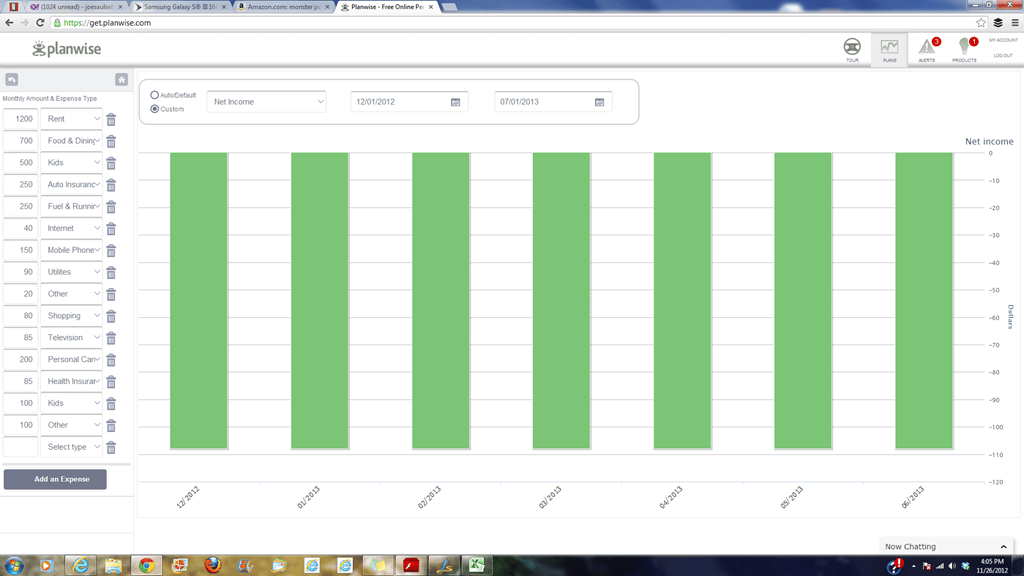
To get an idea of their situation, Steve and Sarah quickly jumped on the Planwise tool on our site. It’s only a matter of minutes to add in expenses and produce a graph like this:


image


As they expected when they said, “We can’t save,” the Planwise graph shows them in the hole just over $100 per month. Now that we know the situation today, let’s start looking for visual clues.

Using my mad Sherlock Holmes skillz (you know AC Doyle was fond of “z”‘s, don’t you?) I’d break Steve & Sarah’s expenses into two types:

  • unlikely suspects
  • likely culprits

Example of an unlikely suspect: I could tell them to cut the $90/mo. utility budget. Realistically for a family of four this could get down to $75/mo., but there are easier wins for $15.

Let’s look at those more likely culprits instead:

– $1,200 Rent. If they can find cheaper digs, this could save them huge dollars. I know….this isn’t popular with people, but it’s the biggest expense on the sheet. It should be thrown into question.

– $150 Mobile Phones. If we could find a way to make this $50, we’d quickly save $50.

– $85 Cable TV. Easy win if they disconnect cable.

– $200 Personal Care. When I’d point to this one, someone in the house would always sigh. For some, giving up their relationship with the hair stylist is like telling grandma you won’t be coming to Thanksgiving. That’s huge money, and can be easily cut.

– $80 Gifts (I’ve called it “shopping” in the Planwise tool). If you aren’t reaching your goals, giving gifts should take the back seat.

How did I find these ones? Generally, they’re bigger numbers. Second, I reasoned what the smallest number could possibly be. By just surveying the list for the biggest numbers and eliminating the ones that can’t be reduced quickly, I came up with a strategy to share with my client.

Sometimes experience helped here (you’d see clients get really creative with their budget), but generally it didn’t. I just learned to look more closely at every number and ask “Why?”


What They Decide


In this scenario, they’re happy cutting gifts back to $25 (kids parties are more difficult to cut than you’d imagine) and eliminate cable tv.

That makes the Planwise graph look like this:


image


They now have $30 per month in their hot little pockets and a balanced budget, right?

Wrong.

Without goals, the Steve and Sarah’s of the world always choose to cut just enough to get to even.

Unfortunately, they also need savings and adequate insurance. We’ll have to cut more, but not until we find out how much more.

That’s because there’s not a reason for them to save more than they really need. Why continue saving money if there are things they’re cutting now that they’ll enjoy?

See how fun it was writing it out?

Another day we’ll use the Planwise tool to check out Steve & Sarah’s ability to save for a house, education and retirement.

What planning tools do you use to project your savings needs? When looking for money, what you you bitches found by writing it out?

Photo: shining.darkness

Enhanced by Zemanta
Photo of Joe Saul-Sehy
Joe Saul-Sehy

Joe is a former financial advisor and media representative for American Express and Ameriprise. He was the “Money Man” at Detroit television WXYZ-TV, appearing twice weekly. He’s also appeared in Bride, Best Life, and Child magazines, the Los Angeles Times, Chicago Sun-Times, Detroit News and Baltimore Sun newspapers and numerous other media outlets.  Joe holds B.A Degrees from The Citadel and Michigan State University.

joesaulsehy.com/

Filed Under: budget tips, Planning Tagged With: can't save, easy savings tips, Entourage, make saving easy, Sherlock Holmes, Starbucks

A Look Into the Post-Election Crystal Ball

November 8, 2012 by The Other Guy 17 Comments

The votes are in and I’d like to congratulate President Obama on his re-election.

This was a hard-fought campaign on both sides, and since we now know who will occupy the White House for the next four years and the Senate and House for the next two years, some of the uncertainty we’ve been experiencing in the stock market should finally begin to dissipate.

Many of you are wondering what the future holds for stocks and the market – and while no one knows for sure – including me, I do have a couple of themes that I think will emerge (or continue) over the next few years.

Theme #1 – Corporate Cash on balance sheets

There are trillions of dollars sitting on corporation’s balance sheets that were awaiting the outcome of the election.  Many were anticipating a Romney election which would’ve brought with it likely corporate easing, but now these large multi-national companies have to do something else with the cash sitting overseas.  If they repatriate it, they’ll be subject to double taxation, much like they are when they issue dividends, and at the highest corporate tax rate in the world.  What I expect in the near term is an increase in company stock buy-backs, which have the immediate impact of lowering supply of that company’s corporate stock.

Immediate effect: Stocks with large cash positions might be worthy investment positions and short term winners.

Theme #2 – CNBC’s Fiscal Cliff

The producers at CNBC can’t help themselves. The phrase “Fiscal Cliff” sells heaps of advertising, so you’ll hear this over and over in the upcoming weeks.  Since the House controls the country’s purse strings, and the President and the House have very different ideas on how to spend money, I expect continued gridlock up to and through the so-called “fiscal cliff.”  Obviously, this will be resolved at some point, but it will provide uneasiness in the markets until it’s behind us.

Immediate effect: Lots of waves in the financial markets. Probably higher VIX (volatility) index.

Theme #2 ½  – Budgetary Issues Related to the Above

I don’t know if it will be a retaliatory-type reaction, or just purely out of ideology, but I expect the continued gridlock in Washington to impact all of the sun setting provisions that have been put in different tax-law extension bills over the last several years.  For example, I think the severe defense cuts will take effect at the beginning of the year and the entitlement spending to continue.

Immediate effect: See Theme #2.

Theme #3 – Weak Dollar and Quantitative Easing

The U.S.’s credit has been downgraded twice already, and it appears headed for another downgrade as we reach our self-imposed borrowing limit of $16 trillion.  Obviously, the Congress and the President will just kick that down the road a bit, but that means continued weakness of the dollar compared to other currencies worldwide.  This is bad news if you’re travelling to Japan or Europe for vacation, because our weak dollar buys less Euros and Yen, but the large, multi-national companies we discussed earlier will benefit from a weak U.S. dollar since they make money in all currencies.  Secondly, our fearless economic leader, Big Ben, has promised to continue to print vast amounts of dollars as long as the government continues to run deficits.  Looks like Ben’s printing money for a long, long time…which could lead to inflation

Potential Headwinds

If there are any market headwinds, it will be the short-term issues relating to the pending fiscal cliff and their respective tax increases.  Undoubtedly, the 3.8% tax on interest, dividends and capital gains that takes effect in 2013 will have an impact as well as the continued implementation of Obamacare.  Since healthcare is mandatory for those employees who work over 30 hours per week, expect to see companies continue to reduce their workforce’s hours to 29,as the CEO of Darden Restaurants (Olive Garden, Red Lobster, etc.) has already announced.

So What Does That Mean for Me?

I think the best bet for many investors is to continue to chase yield.  With bank accounts earning nearly 0% and no rate increase on the horizon, the fact that the S&P 500 averages 2.2% will provide some base level of market support over the coming years.  As confidence comes back, the market should also bounce back accordingly.  It’s sad, but President Obama is probably a “lame duck” president, at least over the next two years, as the House will continue to block all attempts he makes at advancing his agenda.

Ultimately, it’s more of the same.  The uncertainty should be ending, the weak dollar means good things for the large multi-national companies.  I know many were surprised by the outcome, but we are a country that comes together.  Let’s focus on the future and not on the past.

Filed Under: investing news, Planning, successful investing

How Much Did This Election Really Matter?

November 6, 2012 by Joe Saul-Sehy 40 Comments

We just experienced a big day for the United States. Throughout the country people cast votes for new laws and elected officials, including the president. Common people electing officials….it brings up a question: does this mean anything to your overall plan?

For my friends Tim and Kathy, you wonder. They have two young children and make $85k per year. According to them, they have credit card debt of around $6,000. They don’t save, although they could. When we piece together their financial picture, there’s a clear pattern:


Credit Cards:


They love high end restaurants.

“Why?” I asked when we were playing games together one night. Kathy asked me if I could find her a lower rate credit card and handed me their latest bill.

“We eat dinners out because we work hard all day. We’re both absolutely fried when it comes time to make dinner,” Kathy replies. “It doesn’t make sense to be tired all night so we’re tired the next day at our job. Everybody’s had enough, so we head for a nice meal out. We’re happy sharing our day together instead of slaving over prepping a meal.”

That sounds nice, until you read the bottom lines: $48, $53, $79.

“We try to stay away from alcohol during those meals,” Tim quips. “That helps keep the price down.”

Down?

Further down the bill, I see department store shopping.

“It makes it so much easier to get the stuff at one place. Saves us time,” Tim explains.

“I hate shopping,” Kathy says defensively.


Utilities


Tim has an addiction: sports. They have the MLB network package that allows them to see every game in the league each night.

Cost? $120.

Each weekend during the fall, he’s watching several games, courtesy of NFL Sunday ticket.

“It’s for my league,” he says. “I’m in this fantasy football thing. $100 to get in. If I finish in the top three I at least get my money back. Then he points to the television remote. “If I win, it pays for about three years of this.”

Cost? $140.

Has he ever won?

“This is the year!” he smiles.


House/Lawn Work


When I drive by their house, a team of high school age kids is cleaning their lawn. I asked Tim about it at a party we were both attending. “The kids needed the work. It was nice. They came to the house and asked. It’s only $20 a week. Saves me all that time….and gas.”

Speaking of gas….they live in the country. “No high city taxes.” Both Tim and Kathy commute over 20 miles to work. They must spend a couple hundred dollars in gasoline a week.

On my personal Facebook account, Tim made his politics known leading up to the big vote. “We’ve gotta get the President out of office. He’s costing this country dearly. We can’t afford four more years.”

I think there’s a bigger question: Can Tim and Kathy last four more years whether the President won or not?

Photo of Joe Saul-Sehy
Joe Saul-Sehy

Joe is a former financial advisor and media representative for American Express and Ameriprise. He was the “Money Man” at Detroit television WXYZ-TV, appearing twice weekly. He’s also appeared in Bride, Best Life, and Child magazines, the Los Angeles Times, Chicago Sun-Times, Detroit News and Baltimore Sun newspapers and numerous other media outlets.  Joe holds B.A Degrees from The Citadel and Michigan State University.

joesaulsehy.com/

Filed Under: money management, Planning

Five Money-Saving Tasks That’ll Help You Cha-Ching! in the 4th Quarter

October 4, 2012 by Joe Saul-Sehy 28 Comments

I love the sound of the cash register ringing, don’t you?

If you’re going to be successful in your financial life, treat it as if it’s a business and you’re trying to hear that awesome cash register sound. If you don’t, you’ll always prioritize yourself behind more “important” activities like your job (nevermind that the job is there to help your net worth…that’s probably the subject of another post).

Every business has a mandatory list of activities that can’t be ignored. So does your financial life.

Here are five items that MUST be on that list this quarter:

1) Mutual fund capital gains. Even if you don’t have mutual funds outside of an IRA now, you should learn how these rules work. When the manager (or system, for an index fund) trades stocks or bonds inside of the fund a capital gain is generated. Someone has to pay it, and there’s no real fair method, so the mutual fund company declares a date and divides the gain among shareholders of record. Even if you didn’t sell the fund, you’re responsible for your portion of the manager’s buying and selling.

With results so far in 2012 looking up, there’s a good chance you might get hit with a tax bill this year. Avoiding this tax is legal and easy. Find the dates the fund declares capital gains and transfer your money to a different fund in the same family. This avoids fees for switching and the manager’s capital gains tax.

Grab a calculator before you move any money. You’ll still be on the hook for capital gains taxes you generate by selling as well. The cost of switching might outweigh the savings you’ll realize from avoiding any taxes created by the fund manager.

2) The lemon drop. Hoping to skim off some of that skyrocketing Apple stock? Cover a portion of your capital gain by also selling your brother in law’s “can’t lose” loser. There’s no time like now to weed your portfolio of positions that aren’t going anywhere. Although you’re only allowed to show $3k in net capital losses each year, leftovers can be carried over to deduct in future years.

3) Charitable giving. Hopefully you’ve given to your favorite community non-profits throughout the year, but if not (and especially if you itemize), you’ll want to make cash and in-kind donations in before December 31. Keep receipts for your gifts. The IRS has tightened charitable giving laws in recent years.

4) Estimate your taxes and decide when to pay property taxes. If you own a home winter taxes are deductible either in December or January, your choice. Did you receive a big bonus this year? Take the extra deduction now to help lower your tax due. If you make too much, it might be a better idea to wait until next year. High income earners aren’t allowed to claim all of their itemized deductions (ask your accountant about whether you’re subject to phaseouts).

5) Goal evaluation and setting. The 4th quarter is the perfect time to begin thinking about your short and long term goals. Did you hit your benchmark in 2012? If not, what are you going to change in 2013?

While people generally talk a good game about benchmarking, most of my clients were surprised when I pulled the actual number out of their plan to see if they’d hit the mark during a year. By sticking with actual data and avoiding the “Yeah, it feels like I had a good year” you’ll be able to make the necessary course corrections to save the right amount of money in the upcoming year.

I’ll be addressing each of these areas in more detail during the course of the quarter, but do yourself a favor and schedule these tasks now. These are five activities that you don’t want to miss!

What other events are on your 4th quarter financial calendar?

Enhanced by Zemanta
Photo of Joe Saul-Sehy
Joe Saul-Sehy

Joe is a former financial advisor and media representative for American Express and Ameriprise. He was the “Money Man” at Detroit television WXYZ-TV, appearing twice weekly. He’s also appeared in Bride, Best Life, and Child magazines, the Los Angeles Times, Chicago Sun-Times, Detroit News and Baltimore Sun newspapers and numerous other media outlets.  Joe holds B.A Degrees from The Citadel and Michigan State University.

joesaulsehy.com/

Filed Under: money management, Planning, Retirement, successful investing, Tax Planning, tax tips Tagged With: Business, Capital gain, Internal Revenue Service, investing, IRS, Mutual fund, mutual fund capital gains, Tax

A Two Letter Key To Financial Success

September 27, 2012 by The Other Guy 16 Comments

**Today is Cheryl’s birthday so I’m taking the day off to spend with my sweetie and theOtherGuy is in the driver’s seat. Take it away OG!


“No, thanks, nothing for me.”

How many times have you said that when being offered the double-chocolate-ice cream-sundae-float-combo dessert at your favorite restaurant?  It’s almost a foregone conclusion, nearly as automatic as the “I’m just looking” comments we all say when shopping at the mall.  But, how many times do we say that when we’re with our friends?  It’s very easy to say “No, thanks” when we’re with strangers – but what about peer pressure?

In my practice, most of the money problems I help clients deal with stem from their inability to utter a simple two-letter word – “No.”.  Some people have a hard time saying to their kids (“but I REALLY NEED that new video game…”) others have a hard time saying it to their friends.  Still others simply just can’t say it to themselves.  You want to excel at your financial life?  Practice saying “No” as many times as you can each day.

I see so many missed opportunities in business that I also practice sales and marketing training for a well-known speaker and life coach’s firm. One of the primary ways we help people uncover more committed and focused time to growing their sales and their organizations is by saying “No” to as many non-critical things as possible.  If you’re struggling or juggling with too many things – try saying “No.” there, too.

Financial success in the long-run is all about saying “No”  to things today, in exchange for a greater future later.  Here are a couple ideas to gain some “No” traction in your life:

1)  Write out your financial plan of attack – and stick to it.  The human mind can’t tell the difference between vivid imagination and reality, so writing out your financial life can physiologically help you succeed. Most important to our discussion today, if something isn’t part of your plan, it provides a written backbone from which you can just say “No.”

2)  Have a casual money conversation before it’s awkward.  Clue your friends and family into the fact that you’re serious about making changes with your money.  You can say things like, “It’s sure going to be different this year at Christmas time.  We’re finally focusing on getting our financial house in order and we’ve promised each other we’re not going to overspend like we usually do.”  In all likelihood you’ll be your friend’s hero.  They only wish they had your fortitude.

3)  Lead by example in your household.  When you’re struggling with a purchase that you really, really, want, speak your mind out loud.  Your kids will hear, see, and hopefully emulate your behavior.  You can flip through a Best Buy ad and say things like “Boy, I sure like that new TV.  It sure is sharp!  One day, I’ll save enough money and then we can get that TV for our house, wouldn’t that be great?”  Kids need to hear how you handle the day-to-day issues that come up, not just see how you handle them.  Think out loud.

4)  Pick someone else to blame.  Use us.  Use Dave Ramsey.  Use Suze Orman.  We shift blame our whole lives (trust me, I just saw my 3-yr-old blame the cat for coloring on the wall…with a marker.  Everyone knows cats can use markers!) so shift blame to our site.  Say “Hey, I’d really like to join you guys for drinks and dinner tonight, but OG and Joe say that’s a bad use of my money.  I’m dumping it like crazy into my Roth IRA.  A tax-free steak and bottle of wine tastes a lot better than one at 19.99% interest amortized over 15 years.” OK, that last part was a little over-the-top, but you get the idea.

It’s OK to say “No.”  Trust me and try it out.  Where and how can you say “No” today?  Let us “No” below in the comments…(get it?  No = know! Ha! I’m hysterical! Gettin’ crazy with the homophones.)


Filed Under: Planning

  • « Previous Page
  • 1
  • …
  • 7
  • 8
  • 9
  • 10
  • 11
  • …
  • 14
  • Next Page »

FOLLOW US

Search this site:

Recent Posts

  • Can My Savings Account Affect My Financial Aid? by Tamila McDonald
  • 12 Ways Gen X’s Views Clash with Millennials… by Tamila McDonald
  • What Advantages and Disadvantages Are There To… by Jacob Sensiba
  • Call 911: Go To the Emergency Room Immediately If… by Stephen Kanaval
  • 10 Tactics for Building an Emergency Fund from Scratch by Vanessa Bermudez
  • 7 Weird Things You Can Sell Online by Tamila McDonald
  • 10 Scary Facts About DriveTime by Tamila McDonald

Copyright © 2026 · News Pro Theme on Genesis Framework