
• Home
  • About Us
  • Toolkit
  • Getting Finances Done
    • Hiring Advisors
    • Debt Management
    • Spending Plan
  • Insurance
    • Life Insurance
    • Health Insurance
    • Disability Insurance
    • Homeowners/Renters Insurance
  • Contact Us
  • Privacy Policy
  • Risk Tolerance Quiz

The Free Financial Advisor

You are here: Home / Archives for Investor

4 Indispensable Tools for Backtesting Investment Theories Swiftly

December 9, 2025 by Brandon Marcus Leave a Comment

There Are Several Indispensable Tools for Backtesting Investment Theories Swiftly

Image Source: Shutterstock.com

Every investor has a moment when a brilliant idea pops into their head and they’re suddenly convinced they’ve cracked the market’s secret code.

But ideas are cheap, and markets are not, so the real question becomes: Does this theory actually hold up when you run it through real historical data? That’s where backtesting comes in, transforming hunches into measurable results and separating sharp strategy from wishful thinking.

The best part is that backtesting doesn’t have to be a tedious, all-day chore bogged down by confusing code or endless spreadsheets. With the right tools, you can stress-test almost any investment hypothesis quickly, confidently, and with a surprising amount of fun.

1. Quantconnect: Institutional Power Without The Intimidation

QuantConnect takes algorithmic investing from mysterious to magnetic by giving you access to a massive library of historical data and the same testing environment used by professional quants. The interface feels sleek without being overwhelming, allowing curious investors to explore strategies with real-world conditions in mind. It supports multiple asset classes, meaning your theories about stocks, crypto, futures, or forex all get equal treatment under its analytical spotlight.

Even better, the platform allows you to experiment with coding ideas easily, and the atmosphere feels more like an innovation lab than a math exam. Whether you’re a hobbyist or a budding quant, QuantConnect delivers the speed and precision that make backtesting addictive in the best way.

2. Tradingview Strategy Tester: Simple, Visual, And Seriously Effective

TradingView’s Strategy Tester is a dream for anyone who prefers charts over code and clarity over complexity. Backtesting becomes incredibly intuitive here because everything is visualized in real time. This lets you watch your strategy play out candle by candle. You can adjust parameters instantly and see immediately how those tweaks would have changed performance across different market cycles. The built-in scripting language, Pine Script, is surprisingly accessible, making it easy to translate your ideas into testable logic even if you’re not a coder. It’s the perfect middle ground between power and simplicity, offering fast results that help you refine theories without drowning in data.

3. MetaTrader Backtester: A Classic Workhorse with Serious Depth

MetaTrader’s backtesting engine has earned its reputation as a reliable platform for traders who want precise simulations of market behavior. It lets you test everything from automated trading robots to nuanced manual strategies with impressive accuracy. Because the platform is so widely used, you get access to a huge community, endless tutorials, and countless strategy templates to experiment with.

The depth of customization is remarkable, allowing you to fine-tune execution conditions and explore how your theory behaves in fast-moving markets. For anyone who wants a combination of trusted stability and deep flexibility, MetaTrader’s backtester remains a top-tier contender.

There Are Several Indispensable Tools for Backtesting Investment Theories Swiftly

Image Source: Shutterstock.com

4. Portfolio Visualizer: Big-Picture Analysis For Long-Term Thinkers

Portfolio Visualizer stands out because it takes a more long-range, portfolio-based approach to backtesting. You can simulate entire strategies over decades. You can evaluate asset allocation and rebalance schedules, and risk-adjusted returns with surprising detail and speed. The interface is polished and beginner-friendly, but the analytical output feels advanced, making it ideal for investors who want to understand the story behind the numbers.

It’s especially useful for anyone testing theories around diversification, factor investing, or retirement planning. In a world full of tools for rapid, tactical testing, Portfolio Visualizer is a refreshing option for strategic thinkers with long-term vision.

Turn Ideas Into Data-Driven Confidence

Every great investment theory needs to prove itself under the weight of real historical evidence. These tools make that process faster, smoother, and infinitely more enjoyable. Whether you’re exploring short-term trading strategies or long-term portfolio concepts, backtesting gives you the clarity that separates solid insight from risky speculation. When you can see how an idea would have behaved, you gain confidence that spreadsheets alone can’t provide.

Have you tried any of these tools, or do you have a favorite backtesting platform of your own? Share your thoughts, stories, or strategy wins in the comments for others to learn.

You May Also Like…

8 Bold Strategies for Investing During Periods of High Inflation

8 Essential Items Boomers Should Invest In If They’ll Be Living Alone

7 Risky Investment Trends Only Experts Understand Fully

7 Genius Kitchen Tools That Instantly Make Cooking Easier

4 Quick Methods to Verify Advisor Backgrounds Using Public Tools


Brandon Marcus
Brandon Marcus

Brandon Marcus is a writer who has been sharing the written word since a very young age. His interests include sports, history, pop culture, and so much more. When he isn’t writing, he spends his time jogging, drinking coffee, or attempting to read a long book he may never complete.

Filed Under: Investing Tagged With: backtesting investments, bad investing advice, invest, investing, investing advice, Investing Tips, investment theories, investment tools, Investor

What It Take To Be A Successful Investor

July 31, 2019 by Jacob Sensiba

What makes a successful investor? Is it your ability to beat the market or to beat your competition?

In my opinion, being a successful investor doesn’t have to do with out-earning your peers or leaving the S&P in the dust. No, my definition is very simple.

Develop an investment plan using a variety of factors, and be able to execute and follow that plan indefinitely.

Suitability

This is step 1. You need to figure out what your “suitability” is. Your suitability will lay a very good foundation upon which you build your investment plan. Suitability involves three things:

  • Risk tolerance – This is your ability to handle drawdowns in your portfolio. If you crumble with fear every time you lose 5 percent, then you’ll probably want a fairly conservative portfolio*. On the other hand, if you have no problem seeing your portfolio drop 50 percent, then you’re ready for a more aggressive allocation.
  • Time horizon – Probably the most important factor of the three. Your time horizon is basically when you’ll need the money. A long time horizon allows an investor to take on more risk because there’s more time for them to recover from drawdowns. The inverse is true for short time horizons. You’ll want to be conservative because you have little time to earn back what’d you lost.
    • Long time horizon – 10+ years
    • Medium time horizon – 2-5 years
    • Short time horizon – Less than 2 years
  • Goals – What’s your plan? Is this savings going to be used as a down payment for a house? If so, there’s probably a minimum dollar amount you have in mind and you’ll want to tip the odds in your favor that you don’t go below that. Similarly, if this is for retirement and you have 30 years to invest, you have the green light for risk assets.

Keep in mind that all three of these things, plus one other, need to be used together when determining your asset allocation. If you are tolerant of risk, but need the money in 5 years, somewhere in the middle between aggressive and conservative is probably better. That one other thing is your behavior as an investor.

Investor behavior

The finance/investment world is coming around to this, but your psychology is a HUGE factor as an investor.

Obtaining a high return on assets is one of your goals, but it should not be the primary goal. When you create an investment plan you have to make sure it’s something you can actually stick with.

I wrote about it previously, here.

You could be tolerant to risk and you could have a long time horizon, but if you lay awake at night every time the market drops, then you need to rethink your approach.

That kind of fear and anxiety hinders your ability to follow your plan. What normally happens, is someone sets an unrealistic investment plan, one where they take on too much risk.

Thereafter, volatility picks up. They check their portfolio and it’s declined 15 percent. They wait a day and check the next.

Another 2 percent drop. Then the thought of 2008 creeps into their heads and the panic sell.

You can set up a great investment plan, but your behavior will ultimately make the decisions. Keep that in mind.

Asset allocation

Using your suitability and behavior, you can then determine your asset allocation. The types of assets you use in your allocation can vary. If you wanted to invest a small percentage of your portfolio in gold, for instance.

The three most common assets are stocks, bonds, and cash. With risks ranging from high risk to virtually (there’s always some risk) no risk.

Speaking very generally, people with long time horizons and are more tolerant of risk, have a more aggressive portfolio. The inverse is true for people with short time horizons and a low-risk tolerance.

That said, the ultimate goal is to develop a plan that meets your goals in the smoothest fashion possible.

Ignore the noise

Throughout your investment “career” you’ll run into people, friends, family, or even random people on the street that will tell you the sky is falling or that the newest IPO will go gang-busters and you need to get in now!

Put your blinders on. There are two things that hurt investors. Their own behavior and their ability, or lack thereof, to tune out what’s happening around them.

This is extremely difficult because we, as humans, have evolved to use our peers to compare or judge, our standing in society.

Stay in your lane and focus on your goals.

Never stop learning

Every single experience in your life is a learning opportunity, especially the bad one. I recommend journaling daily, recount your day, and dig little nuggets of knowledge from your experiences.

Additionally, take in some form of content every day that improves your understanding in your line of work, or in an industry that you’re interested in.

With regard to your finances, give our Toolkit page a look. There you’ll find a number of books and resources to enhance your financial know-how.

Please be advised: Everything written in this article is for informational purposes only and should not be taken as investment advice. Opinions are my own and do not reflect the opinions of this publisher or my employer.

Further reading:

The Psychology Of Money


Jacob Sensiba
Jacob Sensiba

Jacob Sensible is a financial advisor with decades of experience in the financial planning industry.  His journey into finance began out of necessity, stepping up to support his grandfather during a health crisis. This period not only grounded him in the essentials of stock analysis, investment strategies, and the critical roles of insurance and trusts in asset preservation but also instilled a comprehensive understanding of financial markets and wealth management.  Jacob can be reached at: jake.sensiba@mygfpartner.com.

mygfpartner.com/jacob-sensiba-wisconsin-financial-advisor/

Filed Under: conservative investments, Investing, investment types, money management, Personal Finance, risk management, successful investing Tagged With: Asset, behavior, Investor

Investors Beware: What the 3 Biggest Brokerages Really Do With Investor Money

October 28, 2012 by Joe Saul-Sehy 17 Comments

Today’s guest post comes from Susan Lyon, financial analyst with NerdWallet. Thanks, Susan!

What do E-trade, Schwab, and TD Ameritrade all have in common?  Aside from being the three largest online brokerages and some of the biggest brand names in investing, they also all charge investors upwards of $7.99 or more on the typical stock trade.


Think this doesn’t sound so bad?  Think again.  A recent study by NerdWallet found that over 17 million investors are overpaying $1.8 billion every year on unnecessary (and sometimes very complicated or hidden) fees with the largest brokerages.


In light of the ongoing ETF price wars, you’d think a little of this competitive spirit would trickle down into the trading sphere – but this remains to be seen.


Where Is My Money Really Going?

Brokerages all make money by charging commission: that much is plain and simple.  But how much is too much, and is the peace of mind that comes from trading with a brand name broker worth it, NerdWallet asks?  The data says otherwise.


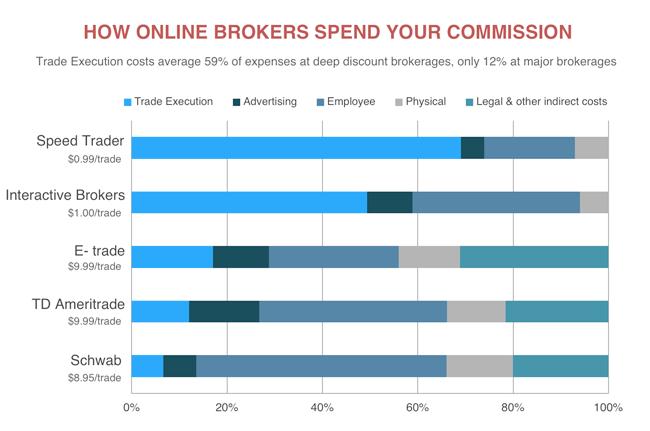
It’s easy to assume that a brand name brokerage is giving you top-notch treatment and the best money can buy, but NerdWallet’s study breaks down the top 3 brokerages’ financial statements to question this assumption.  The key findings:


  • The big 3 online brokers spend a smaller percentage of their money on trade execution – what benefits the investor – compared to the little guys.
  • The big 3 spend far more on advertising and overhead expenses.


This data breaks down expenses at major brokerages by trade execution (what matters to the investor the most) versus advertising, employees, physical, legal and indirect costs:


Lesson learned: active traders can meet their needs just as well by bringing their business to a new firm.  The average investor doesn’t need most of the “extras” offered by the big 3 anyways.  Why pay for something you aren’t even using?


Investors Can Avoid Fees By Shopping Around

The typical investor with these companies makes between 1 and 2 trades per month, so while a one off expense might not seem like a lot, we did the math and it really adds up.  If the typical investor makes only one stock trade per month, of approximately 100 shares, their annual fees at the largest 3 brokers come out to be:


  • E-trade $119.88
  • TD Ameritrade $119.88
  • Schwab $107.40


To make shopping around for better deals quicker and easier, NerdWallet’s new brokerage comparison tool allows investors to compare their many options side-by-side to find the right fit for them.


How Do I Decide on the Best Fit for Me?

NerdWallet’s new tool allows users to do their research before they invest, so they are made aware of all hidden and unpublished fees upfront to avoid unpleasant surprises later on.  Investors can search among the 74 brokerage accounts in the search tool by price, research, or data tools – whichever matters most to them personally.


The takeaway: just like in all personal finance situations, make sure to explore all your options before transferring your money.

Photo credit: Joybot

Enhanced by Zemanta
Photo of Joe Saul-Sehy
Joe Saul-Sehy

Joe is a former financial advisor and media representative for American Express and Ameriprise. He was the “Money Man” at Detroit television WXYZ-TV, appearing twice weekly. He’s also appeared in Bride, Best Life, and Child magazines, the Los Angeles Times, Chicago Sun-Times, Detroit News and Baltimore Sun newspapers and numerous other media outlets.  Joe holds B.A Degrees from The Citadel and Michigan State University.

joesaulsehy.com/

Filed Under: investing news, investment websites, low cost investing Tagged With: Exchange-traded fund, Fee (remuneration), Financial analyst, Investor, NerdWallet, Stock broker, TD Ameritrade

A Shaky Earnings Season Might Be Your Wallet’s Best Friend

July 10, 2012 by Joe Saul-Sehy 11 Comments

There’s baseball season, football season, the holiday season and, of course, earnings season. While the first three may fill you with happiness and (in the holiday case) good cheer, earnings season fills new investors with confusion.

Why do I bring this up?

I woke yesterday morning to a nerve-wracking CNBC.com headline: Investors Brace for Shaky U.S. Earnings Season.


What is Earnings Season? Is It Contagious?


The good news: earnings season affects you directly, but not in the harmful way you may think.

Earnings season is the time (quarterly) when the majority of companies that move financial markets with their results declare how well they’ve performed recently. This news is for the prior quarter.

It’s important, when listening to reports about earnings, to listen for any future forecasting and to also determine what might have been the culprit behind a great or lousy prior quarter. If it’s increased sales on the same-old widget the company’s always sold, fantastic! If the company had a one-time mistake, things might still be looking up. If products just aren’t selling or management is quitting, it might spell bad news.


What Do I Need to Know?


Corporate earnings reports drive the stock market. Sure, financial markets respond to other pressures, but over time the stock market is simply a reflection of the economy. So, if you reread the headline above, Investors Brace for Shaky U.S. Earnings Season, what does that really mean?

Based on the information I told you above, it means this: companies didn’t have stellar profits last quarter.

That’s not nearly as shocking a headline, is it? In fact, I’ll bet you already knew that.


Move On, Nothing to See Here…..


Many investors read the CNBC headline above and think: I’ve gotta sell right now! If you’ve read my ramblings before, you’ll know that I think the opposite. I’m looking to buy when prices are low and sell when they’re high.

Here’s what I recommend instead of having a panic attack:

1) Rebalance your portfolio. Here’s how it works: if you’ve determined how much stock and bond exposure you want (among other asset classes), skim off the areas that have done well to fill in non-performing areas. Low markets are ideal times to rebalance because you’ll reaffirm your long term strategy, take gains from performing spots and redeploy in assets you already own that are low today. Smart move. Then, schedule another rebalance six months from now on your calendar.

2) Look for buying opportunities. If you’re interested in investing, shaky markets are a great place to place your first buys. Make your list of stocks to watch. Wait for earnings reports. Read what companies report, and make your move! Don’t make a common mistake and go whole-hog on a “can’t lose” investment. I’ve been involved with too many “can’t lose” things. I also told my dad I couldn’t lose my hair like he did. Glad I didn’t bet on that….

Not excited to make your own stock picks? Read our pieces on how to evaluate mutual funds and how Exchange-Traded Funds work.

3) If you’re nervous, put defensive measures in place. Use stop losses on individual stocks and exchange traded funds. Monitor fund results more frequently and establish a “worst case scenario” strategy. Remember this: never buy or sell everything on one day or at one time. It’s safer to march in slowly and march out slowly. An orderly walk toward the exit beats a panicked race to the door. Often, down markets rebound quickly.

CNBC, like other publications, is in the business of selling advertising. If the elevator is labeled “Up” or “Down” it’ll be a smooth and steady ride, but I’m sure CNBC knows that “Soar” and “Plummet” garner readers…and then advertiser dollars.

Enhanced by Zemanta
Photo of Joe Saul-Sehy
Joe Saul-Sehy

Joe is a former financial advisor and media representative for American Express and Ameriprise. He was the “Money Man” at Detroit television WXYZ-TV, appearing twice weekly. He’s also appeared in Bride, Best Life, and Child magazines, the Los Angeles Times, Chicago Sun-Times, Detroit News and Baltimore Sun newspapers and numerous other media outlets.  Joe holds B.A Degrees from The Citadel and Michigan State University.

joesaulsehy.com/

Filed Under: investing news, successful investing Tagged With: earning season, Exchange-traded fund, Financial market, Investor, Mutual fund, rebalancing portfolio, shaky earnings season, stock market, when to make stock changes

  • « Previous Page
  • 1
  • 2

FOLLOW US

Search this site:

Recent Posts

  • Can My Savings Account Affect My Financial Aid? by Tamila McDonald
  • 12 Ways Gen X’s Views Clash with Millennials… by Tamila McDonald
  • What Advantages and Disadvantages Are There To… by Jacob Sensiba
  • Call 911: Go To the Emergency Room Immediately If… by Stephen Kanaval
  • 10 Tactics for Building an Emergency Fund from Scratch by Vanessa Bermudez
  • 7 Weird Things You Can Sell Online by Tamila McDonald
  • 10 Scary Facts About DriveTime by Tamila McDonald

Copyright © 2026 · News Pro Theme on Genesis Framework