• Home
  • About Us
  • Toolkit
  • Getting Finances Done
    • Hiring Advisors
    • Debt Management
    • Spending Plan
  • Insurance
    • Life Insurance
    • Health Insurance
    • Disability Insurance
    • Homeowners/Renters Insurance
  • Contact Us
  • Privacy Policy
  • Risk Tolerance Quiz

The Free Financial Advisor

You are here: Home / Archives for diversification

10 Gold vs Stocks Lessons You Shouldn’t Ignore

June 4, 2025 by Travis Campbell Leave a Comment

gold

Image Source: pexels.com

When it comes to building wealth, the gold vs stocks debate is as old as investing itself. Whether you’re a seasoned investor or just starting out, understanding the differences between these two popular assets can make a world of difference in your financial journey. Both gold and stocks have their unique strengths and weaknesses, and knowing when—and how—to use each can help you weather market storms, grow your nest egg, and sleep better at night. If you’ve ever wondered whether you should buy more gold, stick with stocks, or find the right balance, you’re in the right place. Let’s break down the 10 gold vs stocks lessons you shouldn’t ignore, so you can make smarter, more confident decisions with your money.

1. Gold Shines in Uncertain Times

One of the biggest lessons in the gold vs stocks conversation is that gold often acts as a safe haven during economic uncertainty. When markets get rocky, investors tend to flock to gold because it’s seen as a store of value. Unlike stocks, which can swing wildly with market sentiment, gold’s price often rises when fear takes over. This makes gold a valuable tool for protecting your portfolio during recessions, geopolitical tensions, or inflation scares. For example, during the 2008 financial crisis, gold prices surged while stocks plummeted, highlighting gold’s role as a financial safety net.

2. Stocks Offer Long-Term Growth

While gold is great for stability, stocks are the go-to for long-term growth. Over the decades, the stock market has consistently outperformed gold in terms of returns. Companies grow, pay dividends, and innovate, which can lead to significant wealth accumulation for patient investors. If your goal is to build wealth over the long haul, stocks should play a central role in your portfolio. Just remember, the ride can be bumpy, but history shows that time in the market beats trying to time the market.

3. Diversification Is Your Best Friend

The gold vs stocks debate isn’t about picking one over the other—it’s about balance. Diversifying your investments across different asset classes, including both gold and stocks, can help reduce risk and smooth out returns. When stocks are down, gold might be up, and vice versa. This balancing act can help you avoid big losses and keep your financial plan on track, no matter what the market throws your way.

4. Gold Doesn’t Pay Dividends

Here’s a practical lesson: gold doesn’t generate income. Unlike stocks, which can pay dividends and grow your wealth through compounding, gold just sits there. It may appreciate in value, but you won’t get any cash flow from holding it. If you’re looking for passive income, stocks have a clear advantage. This is an important consideration for retirees or anyone who wants their investments to provide regular payouts.

5. Stocks Are More Accessible

Investing in stocks has never been easier. With just a few clicks, you can buy your favorite companies’ shares or invest in index funds through online brokers. Gold, on the other hand, can be a bit trickier. You can buy physical gold, but then you have to worry about storage and security. Alternatively, you can invest in gold ETFs, which adds another complexity layer. For most people, stocks are simply more accessible and convenient.

6. Inflation Impacts Both—But Differently

Inflation is a key factor in the gold vs stocks discussion. Gold is often touted as a hedge against inflation because its value tends to rise when the purchasing power of money falls. Stocks, however, can also outpace inflation over time, especially if you’re invested in companies that can raise prices and grow profits. The trick is understanding how each asset responds to inflation and using that knowledge to protect your wealth.

7. Volatility Isn’t Always Bad

Stocks are known for their volatility, but that’s not necessarily a bad thing. Volatility creates opportunities for savvy investors to buy low and sell high. Gold, while generally less volatile, can still experience sharp price swings, especially during times of crisis. The key is to embrace volatility as part of the investing process and not let short-term swings derail your long-term plan.

8. Gold’s Value Is Largely Psychological

Much of gold’s value comes from perception. People have trusted gold for thousands of years, and that trust gives it staying power. But gold doesn’t produce anything, unlike stocks, which represent ownership in real businesses. Its price is driven by supply, demand, and investor sentiment. Understanding this psychological aspect can help you avoid getting caught up in gold hype and make more rational decisions.

9. Stocks Benefit from Economic Growth

When the economy is booming, stocks usually do well. Companies make more money, hire more workers, and expand their operations. This growth translates into higher stock prices and better returns for investors. Gold, on the other hand, doesn’t benefit directly from economic growth. In fact, it sometimes lags when the economy is strong. If you’re optimistic about the future, stocks are likely to reward you more than gold.

10. Both Have a Place in a Smart Portfolio

The final gold vs stocks lesson is that you don’t have to choose one or the other. Both assets have unique roles to play in a well-rounded portfolio. Gold can provide stability and protection, while stocks offer growth and income. By combining the two, you can create a resilient investment strategy that stands the test of time.

Building Your Financial Future with Confidence

The gold vs stocks debate isn’t about picking a winner—it’s about understanding how each asset fits into your unique financial plan. By learning these lessons and applying them to your situation, you can build a ready portfolio for anything. Whether you lean more toward gold, stocks, or a mix of both, the key is staying informed, balanced, and keeping your long-term goals in sight.

What’s your experience with gold vs stocks? Do you have a preference, or do you use both? Share your thoughts in the comments below!

Read More

Federal Reserve Report: Hang On For Rough Ride…

Stop Reading About Last Year’s Top Ten Mutual Funds

Travis Campbell
Travis Campbell

Travis Campbell is a digital marketer/developer with over 10 years of experience and a writer for over 6 years. He holds a degree in E-commerce and likes to share life advice he’s learned over the years. Travis loves spending time on the golf course or at the gym when he’s not working.

Filed Under: Investing Tagged With: diversification, gold, investing, Personal Finance, Planning, portfolio, Risk management, stocks

6 Ways to Prepare for a Market Crash Without Panic

June 3, 2025 by Travis Campbell Leave a Comment

market crash

Image Source: pexels.com

When the stock market starts to wobble, it’s easy to feel your stomach drop. Headlines scream about plunging indexes, and suddenly, every conversation seems to revolve around the next big crash. But here’s the thing: market downturns are a normal part of investing, and they don’t have to spell disaster for your financial future. In fact, with the right mindset and a few smart moves, you can prepare for a market crash without panic—and maybe even come out stronger on the other side. Whether you’re a seasoned investor or just getting started, learning how to weather the storm is one of the most valuable skills you can develop. Let’s explore six practical ways to get ready for the next market crash, so you can keep your cool and protect your portfolio.

1. Build a Solid Emergency Fund

One of the best ways to prepare for a market crash without panic is to have a robust emergency fund. Think of this as your financial safety net. If the market takes a dive and your investments temporarily lose value, you’ll want cash on hand to cover unexpected expenses or even a job loss. Most experts recommend saving three to six months’ worth of living expenses in a high-yield savings account. This cushion means you won’t be forced to sell investments at a loss just to pay the bills. Having an emergency fund in place gives you peace of mind and the flexibility to ride out market volatility without making rash decisions.

2. Diversify Your Investments

Diversification is a classic strategy for a reason—it works. By spreading your money across different asset classes, industries, and even geographic regions, you reduce the risk that any single downturn will wipe out your entire portfolio. For example, if you only own tech stocks and the tech sector crashes, your losses could be severe. But if you also own bonds, real estate, and international stocks, you’re less likely to feel the full impact of a market crash. Diversification doesn’t guarantee profits, but it can help smooth out the bumps and keep your long-term investment plan on track.

3. Revisit Your Asset Allocation

Your asset allocation—the mix of stocks, bonds, and other investments in your portfolio—should reflect your risk tolerance and financial goals. As you get closer to major milestones like retirement, shifting toward a more conservative allocation is wise. This doesn’t mean pulling out of the market entirely but adjusting your balance to reduce risk. Regularly reviewing and rebalancing your portfolio ensures you’re not overexposed to volatile assets when a market crash hits. If you’re unsure about your ideal allocation, consider consulting with a financial advisor who can help tailor a plan to your needs.

4. Avoid Emotional Investing

It’s natural to feel anxious when the market drops, but making investment decisions based on fear or panic rarely ends well. Selling off your holdings during a downturn locks in losses and can derail your long-term strategy. Instead, remind yourself that market crashes are temporary, and history shows that markets tend to recover over time. Staying calm and sticking to your plan is key. If you find yourself tempted to make impulsive moves, take a step back and review your investment goals. Sometimes, doing nothing is the smartest move you can make.

5. Keep Investing Consistently

One of the most effective ways to prepare for a market crash without panic is to keep investing, even when things look bleak. This approach, known as dollar-cost averaging, involves investing a fixed amount of money at regular intervals, regardless of market conditions. When prices are low, your money buys more shares; when prices are high, you buy fewer. Over time, this strategy can help reduce the impact of volatility and lower your average cost per share. Consistent investing also keeps you focused on your long-term goals, rather than short-term market swings.

6. Educate Yourself About Market Cycles

Knowledge is power, especially when it comes to investing. Understanding that market crashes are a normal part of the economic cycle can help you prepare for a market crash without panic. Take time to learn about past downturns and how markets have historically recovered. This perspective can make it easier to stay calm when the next crash inevitably arrives. There are plenty of free resources, podcasts, and books that break down market cycles in simple terms. The more you know, the less likely you are to make decisions you’ll regret later.

Staying Calm and Confident in Uncertain Times

Preparing for a market crash without panic isn’t about predicting the future—it’s about building a resilient financial plan that can weather any storm. By focusing on what you can control, like your emergency fund, diversification, and consistent investing, you set yourself up for long-term success. Remember, market downturns are temporary, but the habits you build now can last a lifetime. Stay informed, stay calm, and trust in your plan.

How do you prepare for a market crash without panic? Share your tips or stories in the comments below!

Read More

Vacation Without Breaking the Bank

2011 Money Lessons

Travis Campbell
Travis Campbell

Travis Campbell is a digital marketer/developer with over 10 years of experience and a writer for over 6 years. He holds a degree in E-commerce and likes to share life advice he’s learned over the years. Travis loves spending time on the golf course or at the gym when he’s not working.

Filed Under: Investing Tagged With: Asset Allocation, diversification, emergency fund, investing, investor tips, market crash, Personal Finance, Planning, stock market

Jemstep Portfolio Manager Review: Finding the Asset Allocation Middle Ground

April 2, 2013 by Joe Saul-Sehy 15 Comments

How do you review your investments? We give Jemstep a test-drive to see if it’s worth your time and money.

As OG bemoaned last week when writing about his broken garage door, at some point, calling a professional is the right move. In the comments, there were some wonderful discussions about finding “experts” without consulting with a person locally by using YouTube videos, better online tools and calling trusted friends.


The Middle Ground in Asset Allocation

There’s plenty of middle ground between wingin’ it and hiring a financial advisor when picking the right basket of investments. One tool I’ve had the opportunity to test drive is Jemstep. After meeting a Jemstep rep at FINCON last year, I was impressed enough with the product to have Simon Roy, the firm’s president, on our 2 Guys & Your Money podcast. He informed me that they were upgrading the product, and now it’s available.

The “New” Jemstep Portfolio Manager

Jemstep is a program that helps you diversify your investments. You know that dartboard you’ve been throwing at? No longer. Jemstep takes the guesswork out of discovering which investments you should be using and pinpoints suitable replacements for duds (or, surprisingly, good investments in asset classes that really don’t meet your investment needs). During my trial run, JemStep told me some things I’d (shamefully) already knew: I’d let my winners run a little too long, and Jemstep recommended cutting back in those “overgrown” areas where the risks now exceeded the chance for rewards.

How Jemstep Portfolio Manager Works

The Jemstep approach is consistent with that of an advisor. First, JemStep asks you questions about your goals. What do you need your portfolio to do? It asks questions about how far away the goal is, how much you may need to access at a time, and other relevant questions. I found this process fun. The interface is intuitive and the style of the website draws you in.

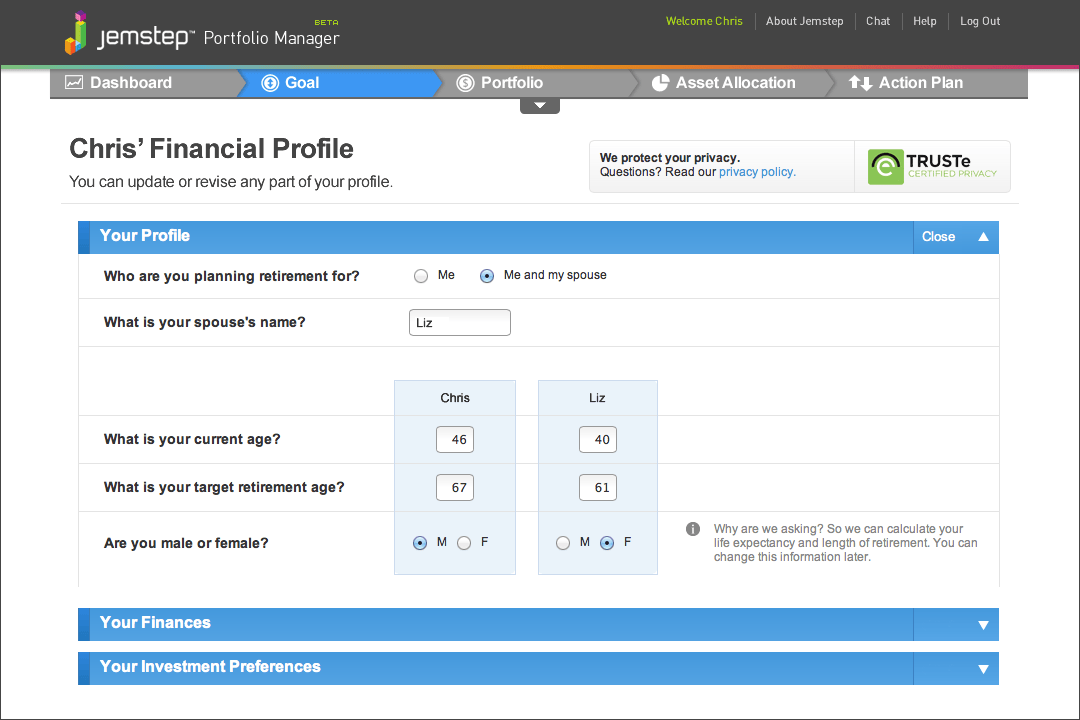
Jemstep Portfolio Manager Review at The Free Financial Advisor

Jemstep asks you for information about your retirement goal, among others. The interface is easy to use, and the blue lines below tell you just how far you still have to go: I have to still fill in information on my finances and investment preferences.

Once you’ve answered goal-related questions, you can upload your portfolio directly from your broker or add in funds manually. Finally, JemStep does it’s work and voila….gives you the correct asset allocation for your goal.

Jemstep Portfolio Manager basic recommendations

Here is the basic recommended portfolio. With these changes, I stand to gain over $9,000 per year in retirement. Yee-haw!

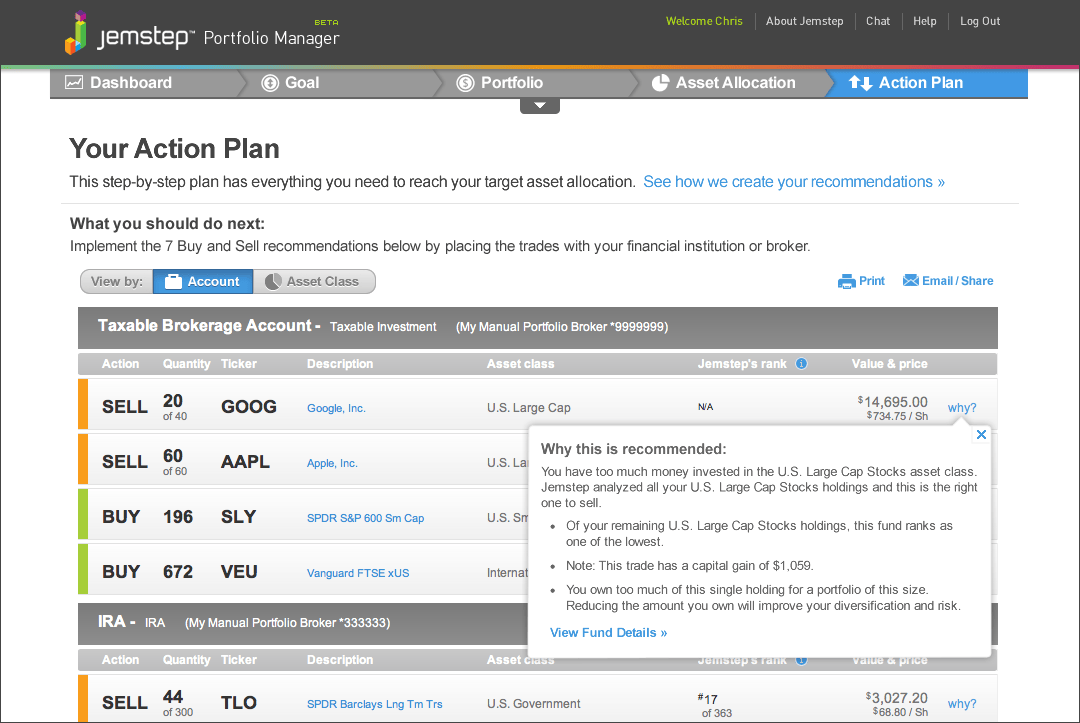
The premium version of Jemstep includes lists of what investments you should sell (in many cases only trim back), which investments you should accumulate, and new suggestions for your portfolio (often in asset classes that don’t exist in your portfolio). Here’s what that looks like:

jAction-Plan

Jemstep not only tells me which investments to sell, but alerts me to potential capital gains taxes. Every sell recommendation is accompanied by a detailed reason why this investment is on the chopping block. In this case: Apple is one of my worst performers and I have too much individual stock for a portfolio of this size.

The Cost

The Jemstep pricing model isn’t surprising. You can access basic advice for free (this includes the asset allocation you should be using, plus the differences between your portfolio and the suggested one). The premium model, which includes continuous tracking, rebalancing advice, a detailed breakdown of recommended sale quantities and investments, is also free for people just starting out. Pricing begins at $17.99 per month for portfolios over $25,000, and increases based on the amount of money Jemstep is helping you manage. While some who are looking for a freebie might be turned off by the price, this is less than the 1% fee often charged by a financial pro. Want professional advice in your corner without having to sit in an office with some team of people? Great. Jemstep won’t call you with hot stock tips and is there when you need it. In exchange, you’ll pay a model comparable to those used by seasoned investors for less than half the cost.

What I Like, What I Don’t

Here’s what I love: this asset allocation is a proven winner that points you toward the low cost, high return investments in a balanced portfolio. If you’ve ever wanted to have a well-managed portfolio but didn’t know where to start, Jemstep is a great place to begin. Different than some generic asset allocation models that I’ve used, JemStep points you toward specific investment options. For the person who wants to make sure they have low cost investments with a proven track record, Jemstep is for you.

Jemstep partnered with Windham Capital Management to create their recommendations. When back-tested against the S&P 500, Jemstep’s recommended portfolio was impressive: all five of their model portfolios outperformed the S&P 500 over the last 14 years with significantly less risk.

Here’s what I don’t like: results. Yes, JemStep provides impressive results, but will you use them? As I’ve stated before, financial advisors exist for one reason: to make sure that the job is finished. When people left my office, the portfolio moves were complete and people could go about their lives, knowing that the important decisions had been made. A JemStep rep was excited to tell me that 12% of JemStep users actually made changes to their portfolio “because it’s so hard to get people to take action.”

She’s right on.

While 12% usage is a great number for an often-free tool used by people on the internet, you should examine yourself. Are you going to follow through and actually take the advice on JemStep? If you don’t trust yourself to do the job, pay more and hire a human being who’ll give you a shove.

Overall Impression

If you’re managing your own money and aren’t sure how to do it well, give Jemstep a shot and follow the recommendations. If you don’t like your advisor or wonder if the recommendations you’re receiving are any good, take the time to use JemStep to give yourself a “second opinion.” The tool is robust enough that you’ll know immediately if your advisor isn’t diversifying your portfolio in a way that makes sense for your goals.

Jemstep can be found at Jemstep.com. I am not an affiliate of Jemstep and was not compensated for this review.

Enhanced by Zemanta
Photo of Joe Saul-Sehy
Joe Saul-Sehy

Joe is a former financial advisor and media representative for American Express and Ameriprise. He was the “Money Man” at Detroit television WXYZ-TV, appearing twice weekly. He’s also appeared in Bride, Best Life, and Child magazines, the Los Angeles Times, Chicago Sun-Times, Detroit News and Baltimore Sun newspapers and numerous other media outlets.  Joe holds B.A Degrees from The Citadel and Michigan State University.

joesaulsehy.com/

Filed Under: low cost investing, Planning Tagged With: Asset Allocation, diversification, Financial adviser, financial advisor, Investment, JemStep

Why You Shouldn’t Invest Like President Obama

September 18, 2012 by Joe Saul-Sehy 25 Comments

Imagine my surprise over the weekend when I discovered President Obama’s portfolio holdings. Although I’m crafty, I didn’t sneak into the West Wing; the President is required to file tax returns and investment documentation. Most investment strategies show up on these forms.

The biggest surprise?

The President can pick fights with Wall Street because he largely doesn’t rely on them for investment returns. Less than 10% of his portfolio is in equity investments, far less than is recommended for most people his age.

After fighting in the trenches as a financial advisor for well over a decade, I can see the method behind his madness. Don’t try to invest like he does. It probably won’t improve your retirement.

Let’s review:

The President’s Portfolio

– Around $500k in cash

– Between $50k and $100k in Vanguard S&P 500 Fund

– Over $1M in Treasury Bills and Notes

– 529 College Savings Plans


Here are the top five take aways:

1) His version of “safety” and yours probably aren’t the same. The President’s massive investment in Treasury Bills suggests that he’s looking to preserve capital, not grow his nest egg. Treasuries are among the lowest risk/lowest reward investments available.

Why he’s different than you:

You probably can’t afford to keep such a large percentage of your portfolio in low-earning investments. A President stands to make millions in the future on book deals, speaking engagements and consulting. His future investment plan can easily include some HUGE assumptions for future cash infusions.

If you’ve calculated your personal returns based on future income, are you sure that your numbers are realistic? I often see plans showing individuals working well into their 70s. Even if you’re healthy enough to work that late in life, do you want to include it in your plan? My clients working in their 70s largely did so because they enjoyed it, not because they needed some benjamins to pay the electric bill.

2) You can tweak your returns without adding much risk. He helps his anemic rate of return by moving some of his huge government bond exposure to Treasury Notes. The difference between treasury bill and treasury note gives him an extra 0.5% in this climate because of the longer duration.

How this applies to you:

For you and I, an extra 0.5% doesn’t help, but we can take similar steps. I wrote this spring about how adding high yield bonds can boost returns while not appreciably increasing risk. Look for investments where the perceived risk is higher than the actual risk and find greater returns. (I’d also put GNMA bonds in this category. They garner a much higher return than Treasuries and the actual risk, while greater than Treasuries, isn’t appreciably higher for the average investor).

3) Watch your fees. The President bets on the US economy by investing in the S&P 500. Instead of relying on investment managers for a return, he uses the Vanguard S&P 500 Index mutual fund.

Here’s a better method than the President uses:

In some cases, an exchange traded fund can lower fees even further. The iShares ETF version of the S&P 500, IVV, features an incredibly low 0.09% cost ratio, while the Vanguard fund the President uses has a still-low internal expense of 0.17%. The only difference? You’ll probably pay trading costs to buy the iShares ETF, while the Vanguard fund is free to purchase in most brokerage accounts. If you’re buying over only a few trades and plan to hold the fund for a long period of time, IVV might be a more cost-effective option.

4) He keeps a large cash reserve. $500k in cash is clearly too large for the average person, but that would be nice, wouldn’t it? Conservative investors should keep enough money to endure a long layoff in money market accounts.

Check out Don’t Be the Emperor With No Emergency Fund for more details on why this is important.

5) Invest in what you know. The President is betting big on future income streams, not on investment returns. As it sits, his portfolio isn’t huge for a man of his office, but I’m sure he knows that it will be in the future. Speaking engagements, consulting and book deals should allow him access to plenty of money without risking his investments in the stock, real estate, or commodities markets.

An example that might be closer to home:

I had clients once who herded cattle. They earned a 10% return year-over-year on their herd, without a ton of variation. We kept that the centerpiece of their portfolio, while creating a diverse mix of other investments to round out their returns. They were surprised I wanted them to continue buying cows. “Investment advisors want you to only use stocks,” Bryan said. I agreed with him. “I’m a fee-based advisor. You paid me money to give you the right direction. I don’t need to make money on convincing you to invest through my firm. If I were you, I’d stick with cattle because it earns a great return and it’s what you know.”

My last takeaway (and I won’t number this one):

The President appears to need a good investment advisor. He either isn’t comfortable with a suitably well-rounded portfolio or just doesn’t have the time. Either way, he’s lost considerable money to either not being educated in investments or to being too busy to care. The right advisor can help him boost returns, tweak his tax strategy and still focus on his “day job” so he doesn’t feel like a Wall Street trader. Investment advisors aren’t for everyone, but in this case, I think it’s warranted and a great idea.

Mr. President, although I’m no longer practicing, I’m ready if you need help. I’m sure the Secret Service can figure out my phone number.


That’s my story, now it’s your turn: What investments could you improve in your portfolio?

Photo of Joe Saul-Sehy
Joe Saul-Sehy

Joe is a former financial advisor and media representative for American Express and Ameriprise. He was the “Money Man” at Detroit television WXYZ-TV, appearing twice weekly. He’s also appeared in Bride, Best Life, and Child magazines, the Los Angeles Times, Chicago Sun-Times, Detroit News and Baltimore Sun newspapers and numerous other media outlets.  Joe holds B.A Degrees from The Citadel and Michigan State University.

joesaulsehy.com/

Filed Under: successful investing Tagged With: diversification, obama investments, president uses treasuries, treasury bills, treasury notes

The Least Funny Financial Joke Ev-Ar

October 17, 2011 by The Other Guy 4 Comments

We used to tell a joke. I know, when you think “financial planner”, all you imagine is a group of suits clowning around, and general hilarity, right?  Me neither.  But, we did have a joke.  Maybe you’ve heard it.

A woman walks into a financial advisor’s office. After leading a good discussion about her goals, the advisor asks what investments she’s using toward her objectives.  She tells him she has CDs at Bank of America, Wachovia, the corner bank, and her credit union.

The advisor says, “why do you have the CDs spread around at so many banks?”

To which she answered proudly, “I’m diversified!”

Yeah, now you know why my wife never wanted to attend our work Christmas parties. We are cray-zee.

There’s a point here, though. Diversification is about much more than spreading your money around. Although there is a certain leap of faith when diversifying, that leap is far beyond where most investors begin to jump. There’s a ton of science you can perform before you throw your dart toward the target.

Many people begin with the dart. Gold sounds like a good idea. The guy at work l.o.v.e.s. small company stocks. Your boss has ridden Apple all the way to the top. Your cousin invests in rental properties and is making a killing.

These may all be fine investments, but none might reach the goal.

Different investments have performed better or worse depending on the time frame. Historically, the stock market has been a horrible place to invest for short term goals. Bonds have been wonderful during most five year periods. Still, both stocks and bonds have performed poorly over short time periods (such as a year).

One tool that advisors used well during my time in the field was an asset allocation tool. Luckily, you can find these all over the internet. With an asset allocation tool, you’ll find out what investments give you the historically least amount of risk with the greatest chance of return. These tools work very well for someone who’s new to investing, because at the least, they help you find a sensible approach to diversifying your money.

Tomorrow, I’ll have a few places for you to look for good asset allocation tools.  For now, if someone would like to be Joe’s guinea pig, how long do you have until your goal? I’d love to have a real-live person to use as an example.

– Joe

Filed Under: Planning, successful investing Tagged With: Asset Allocation, bad jokes, diversification, finance jokes, financial jokes, fun with investments

  • « Previous Page
  • 1
  • 2
  • 3

FOLLOW US

Search this site:

Recent Posts

  • Can My Savings Account Affect My Financial Aid? by Tamila McDonald
  • 12 Ways Gen X’s Views Clash with Millennials… by Tamila McDonald
  • What Advantages and Disadvantages Are There To… by Jacob Sensiba
  • 10 Tactics for Building an Emergency Fund from Scratch by Vanessa Bermudez
  • Call 911: Go To the Emergency Room Immediately If… by Stephen Kanaval
  • 7 Weird Things You Can Sell Online by Tamila McDonald
  • 10 Scary Facts About DriveTime by Tamila McDonald

Copyright © 2026 · News Pro Theme on Genesis Framework