• Home
  • About Us
  • Getting Finances Done
    • Hiring Advisors
    • Debt Management
    • Spending Plan
  • Insurance
    • Life Insurance
    • Health Insurance
    • Disability Insurance
    • Homeowners/Renters Insurance
  • Contact Us
  • Our Editorial Commitment

The Free Financial Advisor

You are here: Home / Archives for financial advisor

Top 12 Reasons You Should Fire Your Financial Advisor

May 1, 2024 by Teri Monroe Leave a Comment

firing financial advisor

Hiring a financial advisor is a significant decision that can greatly impact your financial future. One in three Americans have sought advice from a professional financial advisor. However, not all financial advisors are created equal. There may come a time when it’s necessary to part ways with your current advisor. Here are the top 12 reasons why you should fire your financial advisor.

1. Lack of Communication

lack of communication

If your financial advisor is unresponsive or fails to keep you updated on your investments and financial plan, it may be time to move on. Open communication is crucial in any client-advisor relationship. As a rule of thumb, you should talk to your financial advisor at least once or twice a year.

2. Poor Performance

poor performance

Consistently poor performance in your investment portfolio compared to market benchmarks or your financial goals is a clear sign that your advisor may not be effectively managing your assets. If your portfolio is underperforming in both good and bad markets to a risk-adjusted benchmark, then there may be an issue. It’s best to not look at your investments over a few months or a year to gauge performance.  However, if over 5 years you haven’t made progress this could be a red flag, and it may be time to fire your financial advisor.

3. Conflicts of Interest

conflict of interest

If your advisor’s recommendations seem to be influenced more by their own interests or incentives rather than your financial well-being, it’s a red flag that shouldn’t be ignored. Also, it’s important to ask your advisor if they are a fiduciary. Fiduciaries are legally or ethically bound to put their client’s best interests ahead of their own.

4. High Fees

high fees

Excessive or hidden fees can eat into your investment returns over time. Fees should always be clear and presented upfront. If you feel like you’re paying too much for the services provided by your financial advisor, it’s worth exploring more cost-effective alternatives.

5. Lack of Expertise

lack of expertise

Financial advisors should have the knowledge and expertise to guide you through various financial situations. If your advisor lacks expertise in areas relevant to your needs, it could be detrimental to your financial health.

6. Inappropriate Risk Tolerance

risk

Sometimes, you and your advisor may have a mismatched investment philosophy. If your advisor consistently pushes you into investments that are too risky or too conservative for your comfort level, it’s a sign that they’re not considering your risk tolerance and investment objectives.

7. Overtrading

overtrading

Excessive trading in your investment accounts can lead to unnecessary transaction costs and tax consequences. If your advisor seems to be excessively trading without a clear strategy, it could be detrimental to your long-term financial goals.

8. Lack of Personalization

lack of personalization

Of course, your financial advice should be tailored to your specific financial situation, goals, and preferences. If your advisor provides generic advice or fails to consider your individual circumstances, it may be time to find someone who will provide more personalized guidance.

9. Ethical Concerns

ethics

Any unethical behavior or breaches of trust should not be tolerated. If you suspect your advisor of engaging in unethical practices, such as unauthorized trading or misrepresentation of investment opportunities, it’s crucial to take action.

10. Inability to Explain Strategies

financial advisor

Your advisor should be able to clearly explain the strategies behind their recommendations and how they align with your financial goals. If you find yourself confused or uncertain about the reasoning behind their advice, it may be a sign of incompetence or lack of transparency.

11. No Clear Financial Plan

no clear financial plan

A comprehensive financial plan is essential for long-term financial success. If your advisor fails to provide you with a clear and actionable plan to achieve your goals, it’s time to find someone who will help you map out your financial future.

12. Loss of Trust

firing financial advisor

Ultimately, trust is the foundation of any successful client-advisor relationship. If you no longer trust your advisor to act in your best interests, it may be time to seek a new advisor who can rebuild that trust.

Making The Decision

fired financial advisor

Firing your financial advisor is not a decision to be taken lightly, but there are certain warning signs that should not be ignored. If you find yourself experiencing any of the above issues with your current financial advisor, it may be time to fire them. Remember, your financial future is too important to leave in the hands of someone who isn’t meeting your needs and expectations.

Read More

Furry Best Friend: 10 Most Loyal Dog Breeds For Lonely Retirees

12 Crucial Money Lessons Baby Boomers Passed Down to Their Millennial Kids

Photograph of Teri Monroe
Teri Monroe
Teri Monroe started her career in communications working for local government and nonprofits. Today, she is a freelance finance and lifestyle writer and small business owner. Teri holds a B.A. From Elon University.  In her spare time, she loves golfing with her husband, taking her dog Milo on long walks, and playing pickleball with friends.

Filed Under: Investing, Personal Finance Tagged With: financial advisor, financial advisor mistakes

Which Is Better For A Small Business: Financial Advisor vs. Accountant

August 8, 2022 by Tamila McDonald Leave a Comment

financial advisor vs accountant

When you run a small business, having a strong financial team by your side is a difference maker. However, you may need to choose between different types of financial professionals. Financial advisor vs. accountant is a common debate among small business owners. If you’re wondering which option is best for you. Here’s what you need to know.

Financial Advisor vs. Accountant: What’s the Difference?

While financial advisors and accounts may have similar knowledge in some cases. They represent two different specialties, each with unique areas of expertise.

In many cases, an accountant focuses on the basics of your financial picture. Thus, ensuring that your ledger remains balanced. Additionally, they typically help with finding tax-saving strategies that align with your situation. That could involve how assets are managed from a tax perspective, recommending specific types of retirement accounts, ensuring you capture every deduction, or similar steps.

Financial advisors are a bit different. While they may also recommend strategies that are beneficial to your taxes, their main goal is to assist you with seizing financial growth opportunities. Along with financial planning, investment advice is commonly a part of what a financial advisor offers.

The unique perspective each of these professionals provides means they can work together to ensure your entire financial picture is well managed. However, not all small businesses can afford to hire both.

Pros and Cons of a Financial Advisor

Financial advisors are adept at planning and recommending paths that can lead to financial growth. Often, they focus heavily on the investment side of the equation, though many will also examine other areas to seek out opportunities. For a small business, financial growth can be a priority, particularly if they’re in a startup phase and are dealing with financial uncertainty or there are plans for various kinds of expansion.

Another area financial advisors focus on is insurance. They can assist with choosing the correct coverage for your business, ensuring any assets are adequately covered and that all critical scenarios are addressed in that coverage.

However, financial advisors don’t typically handle the more transactional side of the equation. Handling ledgers, tracking payments and expenses on a daily basis, and similar services aren’t commonly what a financial advisor offers. This leaves those tasks to someone else, which may not be ideal if you don’t have time to handle them personally and don’t have other financial professionals on board.

Pros and Cons of an Accountant

In many ways, accountants are more transactional. They track and log the flow of money in and out of a business, and make recommendations that often feel more logistical. For small businesses with complex financial activities, this can be a boon. It ensures someone is solely focused on the company’s earnings, expenses, taxes, and reporting, reducing the odds of errors and increasing your chances of securing tax savings.

Accountants can also assess the financial impact of various moves. For example, if you’re considering an acquisition, an accountant can help analyze the situation and produce estimates that give you a clearer picture regarding how proceeding may impact you financially.

When it comes to drawbacks, accountants aren’t as growth-oriented. While they may recommend investment accounts, they usually limit that to options that result in a tax benefit, as that results in a savings for the company. In some cases, this can make the level of financial guidance feel incomplete, suggesting you were looking for advice in the growth arena.

Financial Advisor vs. Accountant: Which Is Better for a Small Business?

Neither financial advisors nor accountants are inherently better for small businesses. Instead, you need to factor in your financial needs, allowing you to select the best option for your unique situation.

If you’re concerned about balance sheets, financial reports, transaction tracking, and tax preparation, an accountant is typically the way to go. Accountants specialize in that type of financial tracking, and they’re particularly adept at identifying tax-saving strategies that allow you to reduce what you owe legally.

For guidance about investments, insurance, and long-term financial plans, a financial advisor could be a better fit, as much of their focus is on financial growth and preservation strategies. They’re also skilled at asset management, which can be beneficial in some scenarios.

Consider what you need from a financial professional, and use that to guide your decision. That ensures you bring the right one on board. However, you can also consider hiring both. Financial advisors and accountants can work together to manage the entire financial picture. That ensures that every base is covered, which could be the better choice in the long run.

When it comes to financial advisor vs. accountant for small businesses, do you agree with the points above? Did you choose one over the other and would like to discuss your reasoning? Did you choose one only to discover that it either wasn’t the right fit or was the perfect match? Share your thoughts in the comments below.

Read More:

  • Taking Your Small Business to the Next Level
  • What’s Needed to Start a Small Business 401(k) Plan
  • Tax Tips for Small Business Owners


Tamila McDonald
Tamila McDonald

Tamila McDonald is a U.S. Army veteran with 20 years of service, including five years as a military financial advisor. After retiring from the Army, she spent eight years as an AFCPE-certified personal financial advisor for wounded warriors and their families. Now she writes about personal finance and benefits programs for numerous financial websites.

Filed Under: Small business Tagged With: accountant, financial advisor, Small business

The Pros and Cons of Being a Financial Advisor

November 4, 2020 by Jacob Sensiba 1 Comment

If you’ve ever considered a career as a financial advisor, there are some things you’ll want to consider before jumping in headfirst. There are definitely some perks like being your own boss and earning what you’re really worth, but there are some pitfalls too. Here’s a look at some of the pros and cons of being a financial advisor to help you make your decision.

The UpSide

You can be self-employed

While working for a firm, either public or private, is an option, so is working for yourself. You can set up an office at home to save money on office rental and even set your own schedule in a way that works with your lifestyle. If you don’t want clients coming to your home office, you can set appointments at their home or office and go to them.

There’s no salary limit

Working in another field usually comes with a salary based on your experience and the company’s pay schedule. As a financial advisor, you set your own fees for the services you provide and can even earn commissions on the products you sell. Your earning potential is up to you.

Start-up costs can be low

If you’d like to be self-employed, this is definitely a plus. Of course, you’ll have to pay licensing and other business fees, which can be a little costly but are usually a one-time or annual expense. As far as your monthly expenses, you can keep these to a minimum, especially if you work from home. Monthly website fees and a little online advertising can cost about $300 – $500 a month. Be mindful of Errors and Omissions Insurance (E&O). You must be cognizant of fees assessed by your firm, if you decide not to work for yourself.


You get to help others

Whether you’re working with individuals or small families, you can help them reach their goals of buying a home, saving for their child’s college education, or putting money away for retirement instead of living paycheck to paycheck. A job where you get to do something useful and help others is a great way to spend your days.

Get your own finances in order

As you’re developing your practice, as well as going through the licensing process, you’ll have to learn a lot about finance. Every part of the “financial journey” needs to be an area of expertise. When you’re helping others meet their goals, you’ll be able to get your own finances in order using the knowledge you acquired.

The Down Side

There’s a lot of stress

In order to be successful, you have to be great with numbers and a pro at multitasking as you’ll be switching from one thought to another all day long. The only way to make more money is to take on more clients, which leads to more stress. You have to learn how to manage your day instead of letting your day manage you.

It’s a lot of work

Depending on where you live, your state and even your county will have licensing and certification requirements that you will have to meet. You may need a college degree or special training. And in most cases, you will need to be sponsored by a brokerage firm which means you’ll need to work for one for a bit. You’ll need to acquire a lot of knowledge about finances, as well as sales, marketing, and psychology. Continuous prospecting and licensing are needed to propel your business forward.

You have to be a people person

While you’ll begin receiving referrals at some point, finding clients of your own will be difficult in the beginning. You have to be committed to going to networking events, calling people, asking for referrals, and marketing your services. This can mean working a lot of hours when you’re just starting out.

There are certainly some great perks to being a financial advisor, but there are some challenges to consider before deciding to make this your career choice.

Related Reading:

Hiring a Financial Advisor

5 Questions You Should Ask Your Financial Advisor

Different Ways Financial Advisors Charge

Jacob Sensiba
Jacob Sensiba

Jacob Sensible is a financial advisor with decades of experience in the financial planning industry.  His journey into finance began out of necessity, stepping up to support his grandfather during a health crisis. This period not only grounded him in the essentials of stock analysis, investment strategies, and the critical roles of insurance and trusts in asset preservation but also instilled a comprehensive understanding of financial markets and wealth management.  Jacob can be reached at: jake.sensiba@mygfpartner.com.

mygfpartner.com/jacob-sensiba-wisconsin-financial-advisor/

Filed Under: Hiring Advisors Tagged With: advantages, disadvantages, financial advisor, financial advisors

Jemstep Portfolio Manager Review: Finding the Asset Allocation Middle Ground

April 2, 2013 by Joe Saul-Sehy 15 Comments

How do you review your investments? We give Jemstep a test-drive to see if it’s worth your time and money.

As OG bemoaned last week when writing about his broken garage door, at some point, calling a professional is the right move. In the comments, there were some wonderful discussions about finding “experts” without consulting with a person locally by using YouTube videos, better online tools and calling trusted friends.


The Middle Ground in Asset Allocation

There’s plenty of middle ground between wingin’ it and hiring a financial advisor when picking the right basket of investments. One tool I’ve had the opportunity to test drive is Jemstep. After meeting a Jemstep rep at FINCON last year, I was impressed enough with the product to have Simon Roy, the firm’s president, on our 2 Guys & Your Money podcast. He informed me that they were upgrading the product, and now it’s available.

The “New” Jemstep Portfolio Manager

Jemstep is a program that helps you diversify your investments. You know that dartboard you’ve been throwing at? No longer. Jemstep takes the guesswork out of discovering which investments you should be using and pinpoints suitable replacements for duds (or, surprisingly, good investments in asset classes that really don’t meet your investment needs). During my trial run, JemStep told me some things I’d (shamefully) already knew: I’d let my winners run a little too long, and Jemstep recommended cutting back in those “overgrown” areas where the risks now exceeded the chance for rewards.

How Jemstep Portfolio Manager Works

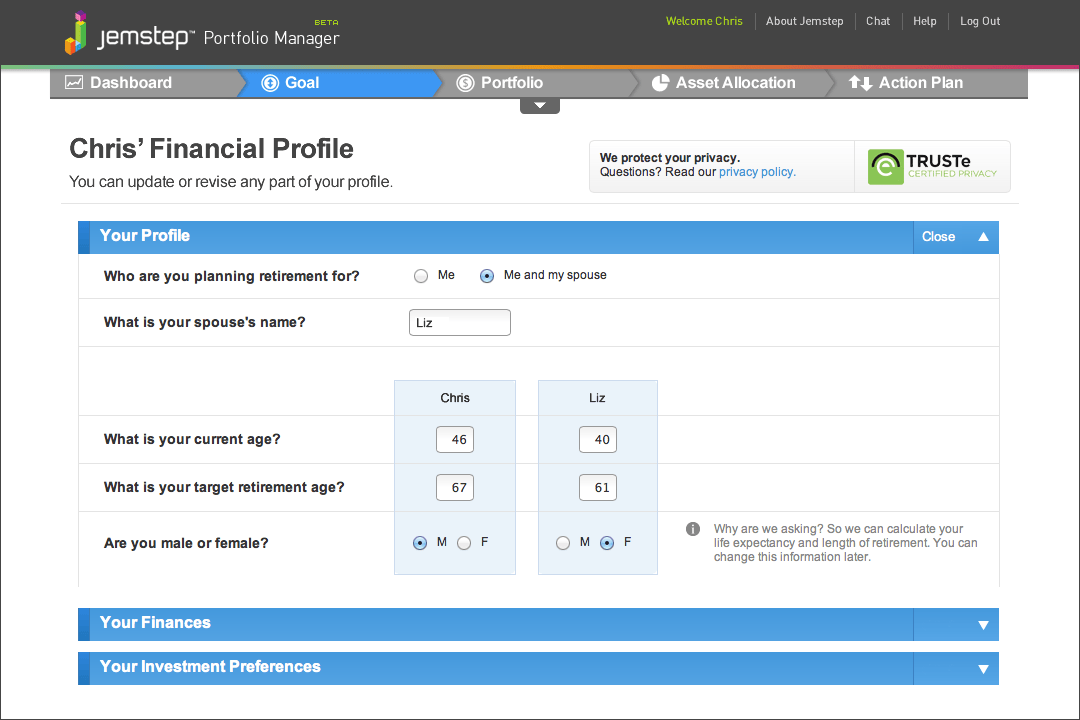
The Jemstep approach is consistent with that of an advisor. First, JemStep asks you questions about your goals. What do you need your portfolio to do? It asks questions about how far away the goal is, how much you may need to access at a time, and other relevant questions. I found this process fun. The interface is intuitive and the style of the website draws you in.

Jemstep Portfolio Manager Review at The Free Financial Advisor
Jemstep asks you for information about your retirement goal, among others. The interface is easy to use, and the blue lines below tell you just how far you still have to go: I have to still fill in information on my finances and investment preferences.

Once you’ve answered goal-related questions, you can upload your portfolio directly from your broker or add in funds manually. Finally, JemStep does it’s work and voila….gives you the correct asset allocation for your goal.

Jemstep Portfolio Manager basic recommendations
Here is the basic recommended portfolio. With these changes, I stand to gain over $9,000 per year in retirement. Yee-haw!

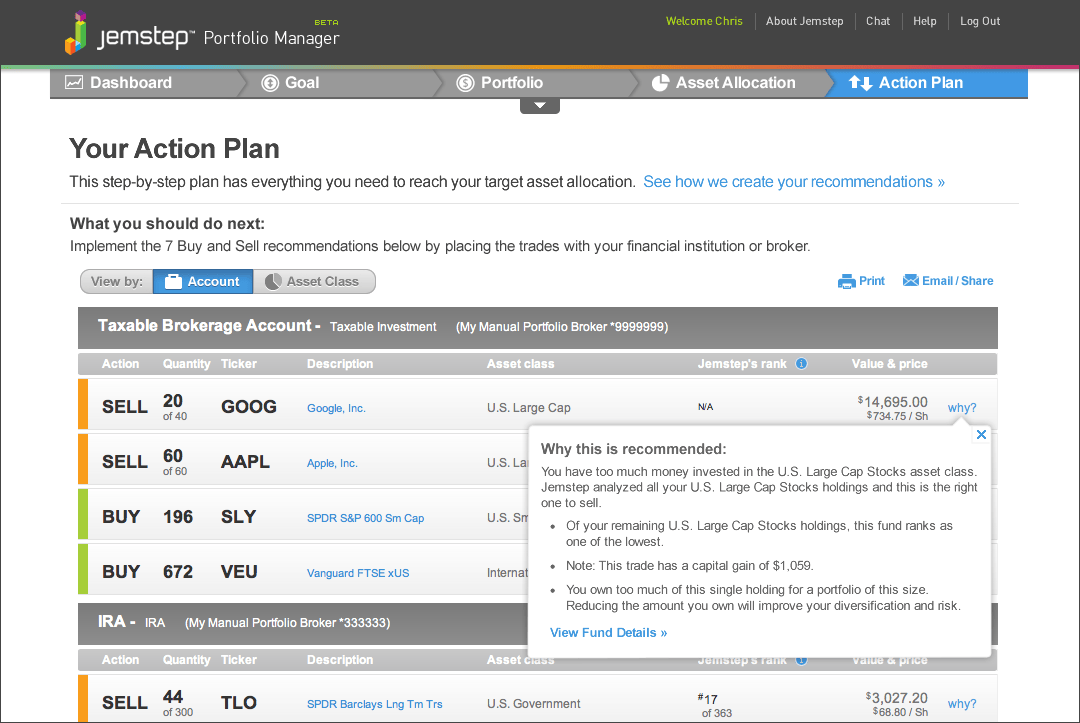
The premium version of Jemstep includes lists of what investments you should sell (in many cases only trim back), which investments you should accumulate, and new suggestions for your portfolio (often in asset classes that don’t exist in your portfolio). Here’s what that looks like:

jAction-Plan
Jemstep not only tells me which investments to sell, but alerts me to potential capital gains taxes. Every sell recommendation is accompanied by a detailed reason why this investment is on the chopping block. In this case: Apple is one of my worst performers and I have too much individual stock for a portfolio of this size.

The Cost

The Jemstep pricing model isn’t surprising. You can access basic advice for free (this includes the asset allocation you should be using, plus the differences between your portfolio and the suggested one). The premium model, which includes continuous tracking, rebalancing advice, a detailed breakdown of recommended sale quantities and investments, is also free for people just starting out. Pricing begins at $17.99 per month for portfolios over $25,000, and increases based on the amount of money Jemstep is helping you manage. While some who are looking for a freebie might be turned off by the price, this is less than the 1% fee often charged by a financial pro. Want professional advice in your corner without having to sit in an office with some team of people? Great. Jemstep won’t call you with hot stock tips and is there when you need it. In exchange, you’ll pay a model comparable to those used by seasoned investors for less than half the cost.

What I Like, What I Don’t

Here’s what I love: this asset allocation is a proven winner that points you toward the low cost, high return investments in a balanced portfolio. If you’ve ever wanted to have a well-managed portfolio but didn’t know where to start, Jemstep is a great place to begin. Different than some generic asset allocation models that I’ve used, JemStep points you toward specific investment options. For the person who wants to make sure they have low cost investments with a proven track record, Jemstep is for you.

Jemstep partnered with Windham Capital Management to create their recommendations. When back-tested against the S&P 500, Jemstep’s recommended portfolio was impressive: all five of their model portfolios outperformed the S&P 500 over the last 14 years with significantly less risk.

Here’s what I don’t like: results. Yes, JemStep provides impressive results, but will you use them? As I’ve stated before, financial advisors exist for one reason: to make sure that the job is finished. When people left my office, the portfolio moves were complete and people could go about their lives, knowing that the important decisions had been made. A JemStep rep was excited to tell me that 12% of JemStep users actually made changes to their portfolio “because it’s so hard to get people to take action.”

She’s right on.

While 12% usage is a great number for an often-free tool used by people on the internet, you should examine yourself. Are you going to follow through and actually take the advice on JemStep? If you don’t trust yourself to do the job, pay more and hire a human being who’ll give you a shove.

Overall Impression

If you’re managing your own money and aren’t sure how to do it well, give Jemstep a shot and follow the recommendations. If you don’t like your advisor or wonder if the recommendations you’re receiving are any good, take the time to use JemStep to give yourself a “second opinion.” The tool is robust enough that you’ll know immediately if your advisor isn’t diversifying your portfolio in a way that makes sense for your goals.

Jemstep can be found at Jemstep.com. I am not an affiliate of Jemstep and was not compensated for this review.

Enhanced by Zemanta
Photo of Joe Saul-Sehy
Joe Saul-Sehy

Joe is a former financial advisor and media representative for American Express and Ameriprise. He was the “Money Man” at Detroit television WXYZ-TV, appearing twice weekly. He’s also appeared in Bride, Best Life, and Child magazines, the Los Angeles Times, Chicago Sun-Times, Detroit News and Baltimore Sun newspapers and numerous other media outlets.  Joe holds B.A Degrees from The Citadel and Michigan State University.

joesaulsehy.com/

Filed Under: low cost investing, Planning Tagged With: Asset Allocation, diversification, Financial adviser, financial advisor, Investment, JemStep

What Do You Do When Things Go Wrong? – 2 Guys and Your Money

March 4, 2013 by Joe Saul-Sehy 12 Comments

Have shows come automatically to your iPod! Use the 2 Guys iTunes page here.

Listen to shows on your smartphone! Try the Stitcher app here.

30 episodes and going strong! To celebrate, we’re bringing our best show yet.

OG lost a computer last week, forcing him to take a week off from the podcast (thanks to Doug for filling in!). That means that it’s a good week to talk about risk management… What can go wrong? What should you do about it? Joe & OG tackle some lessons gleaned from Hollywood stars who’ve lost fortunes, PK discusses credit, Lance from Money, Life & More and Greg from Club Thrifty join Joe to discuss covering your bases with insurance, and finally, we give you our Top 5 Ways to Protect Your Portfolio.

As usual, show notes will fill in throughout the day Monday

2 Guys & Your Money Show 30: Notes

<> Open

<1:50> H&R Block offer: Save 15% on your tax prep!

<4:56> Lessons learned from stars who’ve run into money trouble

<15:58> PK’s Fractional Sense: Credit

1 in 20 have a catastrophic error on their credit report

Link in PK’s segment: annualcreditreport.com

<23:54> Shortwave: Lance from Money, Life & More and Greg from Club Thrifty join us to discuss contingency planning.

Don’t want to sit at your computer and listen to the show? Take it with you! Use either iTunes or Stitcher to listen to the show on the go.

Link to the 2 Guys iTunes page here. Listen on the Stitcher app here.

<40:11> Let’s Give Something Away

Our March Giveaway is Here! This month win one of Laura Vanderkam’s eBooks.

Link to our Giveaway

<> Top 5 Ways to Protect Your Portfolio

OG Top 5

5) Create a system to monitor your portfolio

4) Options (writing covered calls)

3) Stop loss

2) Diversification. Proper asset allocation

1) Nothing. We are our own worst enemy.

Joe Top 5

5) Dollar Cost Averaging

4) Rebalance

3) Scheduled meetings

2) Options (buying puts)

1) Stop loss


<> End: Films

– OG – Flight

– Joe – House of Cards

Enhanced by Zemanta
Photo of Joe Saul-Sehy
Joe Saul-Sehy

Joe is a former financial advisor and media representative for American Express and Ameriprise. He was the “Money Man” at Detroit television WXYZ-TV, appearing twice weekly. He’s also appeared in Bride, Best Life, and Child magazines, the Los Angeles Times, Chicago Sun-Times, Detroit News and Baltimore Sun newspapers and numerous other media outlets.  Joe holds B.A Degrees from The Citadel and Michigan State University.

joesaulsehy.com/

Filed Under: Podcast Tagged With: financial advice, financial advisor, financial radio, fun financial podcast, H&R Block, iTunes, podcast, radio, Risk management

Two Guys & Your Money #14 – The Worst 5 Ways to Hire a Financial Advisor

October 15, 2012 by Joe Saul-Sehy 7 Comments

Have shows come automatically to your iPod! Use the 2 Guys iTunes page here.

Listen to shows on your smartphone! Try the Stitcher app here.


“Top 5” is SO last week….this time we took a different approach.

With OG at Mickey’s house, my mom’s neighbor Doug co-hosts (even though he THINKS he’s just coming to the basement to help with the furnace….).

PK tells us how your vote ISN’T wasted, even if you live in an overwhelmingly blue or red state.

The roundtable gives us their best advice from the past month.

We’re giving away the classic The E-Myth, Why Most Small Businesses Fail and What To Do About It

(You have several ways to win: 5 entries to tweet about the show, 5 to like us on Facebook and 25 if you guess the voice on the podcast.)

Click Here For Our October Giveaway Page!


Show Notes

<> Open

<> Yahoo’s Top 13 Wastes of Money. Are you guilty of any of these? Joe and Doug weigh in on our favorites, and the ones we think might not really be a waste.

<> PK from DQYDJ.net: 3rd Party voting.

<> Let’s Give Something Away: Our October book giveaway is in full swing. You don’t even have to listen to the show! Click here for the three ways to win.

<> On the Shortwave: Our best advice from the last month

<> Worst 5 Ways to Hire an Advisor

<> Show End

Doug: Black Book (German film about the Dutch resistance. Rated R. Thumb up, but not for kids)

Joe: 6 Days to Air (Documentary about the making of South Park. Thumb up, but not for kids)

Photo of Joe Saul-Sehy
Joe Saul-Sehy

Joe is a former financial advisor and media representative for American Express and Ameriprise. He was the “Money Man” at Detroit television WXYZ-TV, appearing twice weekly. He’s also appeared in Bride, Best Life, and Child magazines, the Los Angeles Times, Chicago Sun-Times, Detroit News and Baltimore Sun newspapers and numerous other media outlets.  Joe holds B.A Degrees from The Citadel and Michigan State University.

joesaulsehy.com/

Filed Under: Podcast Tagged With: financial advisor, worst ways to hire advisor

  • « Previous Page
  • 1
  • …
  • 6
  • 7
  • 8

Follow Us

Search this site:

Recent Posts

  • Can My Savings Account Affect My Financial Aid? by Tamila McDonald
  • 12 Ways Gen X’s Views Clash with Millennials… by Tamila McDonald
  • What Advantages and Disadvantages Are There To… by Jacob Sensiba
  • 10 Tactics for Building an Emergency Fund from Scratch by Vanessa Bermudez
  • Call 911: Go To the Emergency Room Immediately If… by Stephen Kanaval
  • 7 Weird Things You Can Sell Online by Tamila McDonald
  • 10 Scary Facts About DriveTime by Tamila McDonald

Copyright © 2026 · News Pro Theme on Genesis Framework