• Home
  • About Us
  • Getting Finances Done
    • Hiring Advisors
    • Debt Management
    • Spending Plan
  • Insurance
    • Life Insurance
    • Health Insurance
    • Disability Insurance
    • Homeowners/Renters Insurance
  • Contact Us
  • Our Editorial Commitment

The Free Financial Advisor

You are here: Home / Archives for Susan Paige

Key Factors To Consider In Your Retirement Timeline

July 8, 2024 by Susan Paige Leave a Comment

Retirement. It conjures images of balmy beaches, leisurely travel, and finally having the time to pursue your passions. But before you pack your bags and trade in your suit for swim trunks, there’s some planning to be done when it comes to your retirement plans.

Senior couple walking on the beach holding hands at sunrise, plan life insurance at retirement concept.

Here’s a breakdown of key factors to consider as you map out your ideal retirement timeline.

How Much Do You Need?

This might seem obvious, but it’s crucial—your retirement income needs. Here’s a breakdown to help you get a realistic picture for your retirement plan:

  • Essential expenses: Factor in housing, food, utilities, transportation, and basic necessities.
  • Healthcare costs: These tend to rise with age. Consider potential out-of-pocket costs and supplemental insurance options.
  • Lifestyle desires: Do you dream of travel, hobbies, or supporting loved ones? Factor in these costs.
  • Debt obligations: Will you have any outstanding debts at your retirement age? Factor in monthly payments if applicable.

Your retirement needs are unique. This is just a starting point to guide your retirement process.

Professional Guidance

A retirement strategists and advisors can provide invaluable guidance as you plan for retirement. They can help you assess your needs, create a personalized plan, and make informed investment decisions, especially regarding life insurance which can play a role in your overall retirement security.

Compound Interest

Compound interest is like a snowball fight. The earlier you start, the bigger and faster your snowball grows.

Here’s how it works for you:

  • Start small, but start early: Even a modest amount invested early on can reap significant rewards by your retirement age.
  • Time is your friend: The longer your money stays invested, the more time it has to grow through compound interest.
  • Reinvest your earnings: Don’t spend your interest! Let it join the party and grow alongside your principal amount.

Compound interest is a powerful tool that can significantly boost your retirement preparation. Even small contributions early in your career can be substantial by retirement, putting you on track to achieve your retirement goals.

Retirement Income Sources

Social Security retirement benefits are a piece of the pie, but they likely won’t cover all your expenses. Factor in any employer-sponsored pensions, personal investments, and potential income from side hustles during retirement. Consider consulting with your benefits office to get a clearer picture of your options.

Debt-Free Retirement

Debt payments can significantly impact your retirement budget. Prioritize paying off high-interest debts like credit cards before you retire. A debt-free retirement provides greater financial security and peace of mind.

Hand putting Coins in glass jar with retro alarm clock , retirement

Retirement Budget

Creating a retirement budget is more than just about numbers. It’s about charting a course for your future freedom. Here’s how to get started:

  • Gather your income sources: List your expected income streams in retirement, including health benefits, pension payments, and any planned withdrawals from your retirement savings.
  • Tally your expenses: Be honest! Include housing costs, groceries, utilities, healthcare, transportation, and any planned travel or hobbies. Don’t forget to factor in inflation.
  • Compare income vs. expenses: Do your numbers add up? If there’s a gap, consider ways to adjust your retirement goals. This might involve saving more now, working a few extra years, or exploring ways to reduce expenses in retirement.
  • Set realistic goals: Be honest with yourself. Do you crave an early retirement with a lower budget, or a more luxurious lifestyle at a later retirement age?

A well-crafted retirement budget is a roadmap to your dream retirement, whether it’s an early retirement filled with adventure or a more traditional retirement age filled with financial security.

Investing in Health

Your health is your greatest asset. Taking care of yourself now translates into a healthier, happier retirement. Here’s how you can invest in your well-being:

  • Move it or lose it: Regular exercise strengthens your body and boosts your mood. Aim for at least 30 minutes of moderate-intensity activity most days of the week.
  • Fuel your body: Eat a balanced diet rich in fruits, vegetables, and whole grains. Limit processed foods, sugary drinks, and unhealthy fats.
  • Befriend sleep: Aim for 7-8 hours of quality sleep each night. Adequate sleep improves focus, memory, and overall well-being.

You’ll have the energy to pursue your passions, travel the world, and make the most of your golden years.

Where Do You Want to Live

Think about where you want to live in retirement. Will you stay put, downsize, or relocate to a new city or state? Consider factors like cost of living, proximity to family, and access to desired amenities.

Social Security Retirement Benefits

You can start claiming Social Security retirement benefits as early as 62, but the longer you wait (up to age 70), the higher your monthly benefit. Consider your financial situation and desired retirement date when making this retirement election. The Social Security Administration provides resources and a benefit calculator to help you estimate your monthly benefit payment.

Professional Guidance

A financial advisor can provide invaluable guidance as you navigate your retirement planning process. They can help you assess your needs, create a personalized plan, and make informed investment decisions, especially regarding life insurance which can play a role in your overall retirement security.

Final Thoughts

Don’t let retirement planning stress you any further. Imagine yourself, on that beach, with a drink in hand. Take the first step today! Explore your options, crunch the numbers, and chart your course to a dream retirement. You deserve it!


Filed Under: Personal Finance

Top Tips For Buying A House With Children Or Grandchildren

July 5, 2024 by Susan Paige Leave a Comment

Being able to own one’s own house is a dream that most people share. However, for many, it is a dream that is out of reach. Property prices continue to rise while an entire generation of people are stuck renting other people’s properties. The spiralling cost of living crisis is certainly contributing to this, as inflation makes it very difficult to save up for a deposit on a home. If you’re a parent or grandparent watching your kids or grandkids struggle to get into the housing market, you might be wondering what you can do.

If you’re in a position to do so, you could help them out by either becoming a guarantor on their fixed-rate home loan or pooling your funds together to buy a house with them. But what’s the best way to approach this? This article will share some helpful tips for buying a house with your kids or grandkids. Keep reading to learn more.

Choose The Right Home Loan

Even if you have a substantial deposit or the majority of the funds required to purchase a home, you may still need to apply for a home loan. There are a variety of fixed-rate home loans and variable-rate home loans available on the market. The advantage of a fixed-rate loan is that if the cash rate is raised by the central bank, your home loan will remain at a lower fixed rate until it expires. This can be a significant advantage when inflation rises, as often happens the central bank needs to respond to increasing costs of living. A variable rate, on the other hand, can be advantageous when the central interest rate is lower, as banks will lower the rate accordingly. 

When researching home loan options, consider a range of factors, including the interest rate, as well as the other associated terms, fees and conditions of the loan. Ensure that your kids or grandkids also understand the implications of getting a home loan. For many people, this is the most debt you’ll ever incur, and debt needs to be managed well to stop it from becoming too much of a financial burden. 

Practical Design Considerations

Next comes the practical aspect of your decision to buy a house with your family. Are you simply pitching in so they can afford their own home? In this case, you may be listed on the title and have some responsibility for the mortgage, alongside your children or grandchildren, but you’ll continue living in your own home. 

On the other hand, you might plan to move in with them. If you all buy a larger home with extra bedrooms, you could all co-inhabit the property, which could be excellent for family bonding and connection, and a great money-saver. If you value alone time, you could consider a home with a self-sustained granny flat or a separate dwelling in the backyard, so you have some distance from your kids/grandkids and can retain some independence. This allows you to live in close proximity with those who matter most to you, without everyone having to crowd into the same property. 

The Benefits Of Professional Advice

Before you enter into a co-ownership agreement with your immediate family, such as your children or grandchildren, make sure that you seek professional advice from either a solicitor, conveyancer or both. They can assist you in completing the relevant legal paperwork for the arrangement, as well as provide advice on what can happen if things go south. 

This means you’ll be fully informed of all the potential legal risks, and what everyone can do to protect themselves. You may feel this is superfluous, especially if you haven’t had any problems with your family thus far, but relatives can and do fall out sometimes, especially when large amounts of money are involved. By seeking professional advice, you’re doing the correct due diligence that everyone ought to do in this situation, even if you never end up needing it. 

Property and Pest Inspections

Before buying a home, you’ll want to know everything you can about it and its sellers. This is a crucial tip for anyone looking to purchase a home, let alone those buying with their family. A building and pest inspection involves a qualified professional going over the home you’re considering buying with a fine tooth comb to look for defects and vermin infestation. 

The last thing you want is to buy a home that will require significant structural or foundation work to make it habitable or one that has a termite or other pest inspection. A certified building and pest inspector can go over the property and provide a report on its condition. When buying a home via a private sale, you can even make your offer contingent on the inspection, thus protecting you as the buyer. 

If the report turns up anything concerning, you can safely rescind your offer. You may also want to conduct an inspection before bidding on a home at auction, as you don’t want to buy a house needing a million repairs without knowing what you’re getting into. 

~

In this article, we’ve gone over our top tips for buying a house with your children or grandchildren. From home loan structures to legal advice to other practical considerations, we’ve covered everything you need to know about this critical topic. 

If you’re planning to buy a home together with your children or grandchildren, the most important thing is communication. Go over your goals and finances together before making any big decisions. Once all of you are agreed and once you’ve determined that your finances are in order, you’re ready to start shopping around for a home. 

Filed Under: Personal Finance

A Visual Approach to Wealth Management

July 4, 2024 by Susan Paige Leave a Comment

In today’s fast-paced and technology-driven world, managing personal finances has become increasingly complex. With multiple income streams, diverse investments, and varied expenses, it’s essential to have a comprehensive understanding of one’s financial landscape. Enter financial mapping software—a revolutionary tool that brings a visual approach to wealth management. This article delves into the intricacies of financial mapping software, exploring how it can transform the way we manage our finances.

Traditional financial management often involved spreadsheets, bank statements, and manual calculations. While these methods provided a basic overview, they lacked the ability to present data in an intuitive and dynamic way. Financial mapping software changes the game by offering a visual representation of one’s financial status. This evolution from static numbers to interactive visuals is akin to moving from a black-and-white photograph to a full-color, high-definition video.

What is Financial Mapping Software?

Financial mapping software is a digital tool designed to create a visual representation of an individual’s or family’s financial situation. It integrates various financial data points, such as income, expenses, assets, liabilities, and investments, into a cohesive and interactive map. This map allows users to see their entire financial picture at a glance, making it easier to identify trends, track progress, and make informed decisions. Some of the key features include:

  1. Comprehensive Data Integration

One of the standout features of financial mapping software is its ability to integrate data from multiple sources. Whether it’s bank accounts, credit cards, investment portfolios, or real estate holdings, the software consolidates all information into a single platform. This integration ensures that users have a holistic view of their finances without needing to switch between different applications or documents.

  1. Interactive Visuals

The software transforms raw data into interactive charts, graphs, and maps. These visuals make it easier to understand complex financial information. For instance, a pie chart can show the distribution of expenses, while a line graph can track investment growth over time. Interactive features allow users to drill down into specific categories for more detailed information.

  1. Goal Tracking

Setting and tracking financial goals is a crucial aspect of wealth management. Financial mapping software enables users to set goals for savings, debt reduction, investment growth, and more. Progress towards these goals is visually represented, providing motivation and clarity on the steps needed to achieve them.

  1. Scenario Analysis

Financial mapping software often includes tools for scenario analysis. Users can input different variables, such as changes in income, expenses, or investment returns, to see how these changes impact their financial future. This feature is invaluable for planning and preparing for various life events and economic conditions.

  1. Real-Time Updates

With real-time data synchronization, financial mapping software provides up-to-date information. This immediacy ensures that users are always working with the latest data, which is essential for accurate decision-making and financial planning.

Benefits of Using Financial Mapping Software

  1. Enhanced Understanding

Visual representations make complex financial data more accessible and understandable. Users can quickly grasp their financial status, identify areas of concern, and recognize opportunities for improvement.

  1. Improved Decision-Making

With a comprehensive and up-to-date view of their finances, users are better equipped to make informed decisions. Whether it’s determining the best time to invest, identifying unnecessary expenses, or planning for retirement, financial mapping software provides the necessary insights.

  1. Time Efficiency

By consolidating data from multiple sources and automating many aspects of financial tracking, financial mapping software saves users time. Instead of manually updating spreadsheets or calculating figures, users can focus on analyzing data and making strategic decisions.

  1. Goal Achievement

The goal tracking feature of financial mapping software keeps users accountable and motivated. Visual progress indicators provide a clear picture of how close one is to achieving their financial goals, fostering a sense of accomplishment and encouraging continued effort.

  1. Stress Reduction

Managing finances can be stressful, especially when dealing with complex and disorganized data. Financial mapping software brings order and clarity, reducing the anxiety associated with financial management and planning.

Choosing the Right Financial Mapping Software

With numerous options, like Asset-Map financial planning as an example, choosing the right financial mapping software can be daunting. Here are some factors to consider:

  1. User-Friendly Interface

The software should be easy to navigate, even for those who are not tech-savvy. A clean and intuitive interface ensures that users can quickly access the information they need.

  1. Customization Options

Different users have different financial needs. Look for software that allows customization to fit individual preferences and financial situations. This might include customizable dashboards, personalized reports, and adjustable settings.

  1. Security Measures

Given the sensitive nature of financial data, robust security measures are a must. Ensure that the software uses encryption, secure data storage, and other security protocols to protect user information.

  1. Integration Capabilities

The software should seamlessly integrate with various financial institutions and platforms. This integration ensures that all relevant data is accurately captured and reflected in the financial map.

  1. Customer Support

Reliable customer support is essential, especially when dealing with complex financial software. Look for providers that offer comprehensive support options, including tutorials, FAQs, and direct customer service.

Final Thoughts

Financial mapping software represents a significant advancement in personal finance management. By providing a visual and interactive approach to understanding one’s financial situation, it empowers users to make informed decisions, set and achieve goals, and ultimately attain financial well-being. As technology continues to evolve, the tools at our disposal for managing wealth will only become more sophisticated, making it easier than ever to navigate the complexities of personal finance.

Investing in financial mapping software is not just a step towards better financial management; it’s a step towards a more secure and prosperous future. So, take control of your financial journey with the power of visualization and see your wealth grow in ways you never thought possible.

Filed Under: Personal Finance

Streamlining Financial Services With Loan Origination Software

July 4, 2024 by Susan Paige Leave a Comment

The financial services industry is continually evolving, driven by advancements in technology and changing customer expectations. One significant development is the integration of loan origination software (LOS), which plays a crucial role in the lending process. LOS integration helps streamline operations, improve customer experiences, and enhance the overall efficiency of financial institutions. This article explores the importance of integrating loan origination software, the benefits it offers, key features, and best practices for successful implementation.

Loan origination software is a digital solution designed to automate and manage the loan application and approval process. From initial application to loan disbursement, LOS handles various stages of the lending lifecycle, including application processing, credit scoring, underwriting, document verification, and compliance checks. The integration of LOS into a financial institution’s existing systems can significantly enhance the efficiency and accuracy of these processes.

The Importance of LOS Integration

Enhanced Efficiency and Speed

Integrating LOS with other financial systems automates repetitive and time-consuming tasks, reducing the need for manual intervention. This automation speeds up the loan approval process, allowing financial institutions to process a higher volume of applications in less time. Quicker turnaround times can enhance customer satisfaction and give institutions a competitive edge in the market.

Improved Accuracy and Compliance

Manual data entry is prone to errors, which can lead to delays and compliance issues. LOS integration ensures that data is accurately captured and transferred between systems, minimizing the risk of errors. Additionally, LOS is often equipped with compliance features that help institutions adhere to regulatory requirements, reducing the likelihood of legal issues and fines.

Better Customer Experience

Today’s customers expect fast, seamless, and transparent service. LOS integration enables financial institutions to provide a more efficient and user-friendly loan application process. Customers can apply for loans online, track their application status in real-time, and receive quicker decisions, leading to a better overall experience.

Data-Driven Decision Making

LOS integration facilitates the collection and analysis of data from various sources, providing valuable insights into customer behavior, loan performance, and market trends. Financial institutions can leverage this data to make informed decisions, improve risk management, and tailor their products and services to better meet customer needs.

Cost Savings

By automating manual processes and improving operational efficiency, LOS integration can lead to significant cost savings. Financial institutions can reduce labor costs, minimize the need for paper-based processes, and lower the risk of costly errors and compliance breaches.

Key Features of Effective LOS Integration

To maximize the benefits of LOS integration, financial institutions should look for software that offers the following key features:

Automated Workflow Management

Effective LOS should provide automated workflows that streamline the loan origination process. This includes features such as automated credit scoring, document verification, and underwriting, which help reduce manual intervention and speed up decision-making.

Seamless Integration Capabilities

LOS should seamlessly integrate with other core systems used by the financial institution, such as customer relationship management (CRM) systems, core banking systems, and credit bureaus. This ensures smooth data flow and minimizes disruptions to existing operations.

User-Friendly Interface

A user-friendly interface is essential for both customers and employees. The software should offer an intuitive application process for customers and an easy-to-navigate dashboard for loan officers, enabling them to efficiently manage and track loan applications.

Customizable and Scalable

Financial institutions have unique needs and workflows. LOS should be customizable to fit specific requirements and scalable to accommodate growth. This flexibility ensures that the software can adapt to changing business needs and evolving market conditions.

Advanced Security Features

Security is paramount in the financial services industry. LOS should include robust security features such as data encryption, access controls, and secure data storage to protect sensitive customer information and comply with regulatory standards.

Real-Time Reporting and Analytics

Access to real-time data and analytics is crucial for making informed decisions. LOS should provide comprehensive reporting and analytics capabilities, allowing financial institutions to monitor loan performance, identify trends, and optimize their lending strategies.

Best Practices for LOS Integration

Successfully integrating LOS into a financial institution’s operations requires careful planning and execution. Here are some best practices to ensure a smooth and effective integration:

Define Clear Objectives

Before starting the integration process, financial institutions should define clear objectives and goals. This includes identifying the specific pain points the integration aims to address and the desired outcomes, such as improved efficiency, enhanced customer experience, or better compliance.

Involve Key Stakeholders

Successful LOS integration requires collaboration between various departments, including IT, operations, compliance, and customer service. Involving key stakeholders from the outset ensures that all perspectives are considered and that the integration aligns with the institution’s overall strategy.

Conduct a Thorough Needs Assessment

Conducting a thorough needs assessment helps identify the specific features and capabilities required from the LOS. This includes evaluating existing systems, workflows, and processes to ensure that the chosen software can effectively address current challenges and future needs.

Choose the Right Vendor

Selecting the right LOS vendor is crucial for a successful integration. Financial institutions should look for vendors with a proven track record, robust support services, and the ability to customize and scale their solutions. Additionally, the vendor should have experience in the financial services industry and a deep understanding of regulatory requirements.

Plan for Data Migration

Data migration is a critical aspect of LOS integration. Financial institutions should develop a comprehensive data migration plan that ensures accurate and secure transfer of data from existing systems to the new LOS. This includes data mapping, validation, and testing to minimize the risk of data loss or corruption.

Provide Comprehensive Training

Training is essential to ensure that employees can effectively use the new LOS. Financial institutions should provide comprehensive training programs that cover all aspects of the software, from basic functionality to advanced features. Ongoing support and training should also be available to address any issues that arise post-implementation.

Monitor and Evaluate Performance

After integrating the LOS, financial institutions should continuously monitor its performance and evaluate its impact on operations. This includes tracking key metrics, gathering feedback from users, and making necessary adjustments to optimize the software’s effectiveness.

In the End…

Loan origination software integration is a transformative step for financial institutions seeking to enhance their lending processes. By automating workflows, improving accuracy, and providing data-driven insights, LOS integration can significantly boost efficiency, reduce costs, and enhance customer satisfaction. However, successful integration requires careful planning, collaboration, and ongoing evaluation. By following best practices and leveraging the right features, financial institutions can unlock the full potential of LOS and drive sustainable growth in a competitive market.

Filed Under: Personal Finance

The Importance of Filing Your Income Tax Returns on Time

July 3, 2024 by Susan Paige Leave a Comment

It might not sound like the most exciting job to file your income tax returns on time but think of how good it will feel to cross that important task off your list.

Not only does reporting on time help you stay on the right side of the law, but it also keeps you from having to deal with extra stress and possible fines.

There’s also always the chance of getting a tax return, which is always a nice treat! Let’s look at the many reasons why you should look forward to this yearly event instead of dreading it.

Avoid Late Filing Penalties

Of course, the most important reason to file your taxes on time is to avoid fines for doing so late.

For late returns, the Internal Revenue Service (IRS) charges large fines and interest, which can make your tax bill much higher. It’s very important to send in your returns by the due date to avoid these fines, even if you’re promised a refund.

Get Your Refund Sooner

Filing your taxes early will get you your money faster if you are qualified for a tax return.

The IRS usually gives refunds within 21 days of getting the tax return, but this time frame can change for several reasons. You can waste that extra money and skip the long wait if you file early.

Plan Your Finances Effectively

Getting your tax planning returns in on time can also help you make good financial plans.

If you know how much tax you have to pay early in the year, you can make changes to your budget and your plans to spend and save. It also gives you a better idea of your general finances, which helps you make smart choices about the future.

Avoid Last-Minute Stress

We’ve all been in a hurry to finish something at the last minute. Putting in tax forms is no different.

You’re setting yourself up for extra stress and possible mistakes in your returns by putting off this important job. Don’t have to rush at the last minute; file your taxes early and give yourself time to look them over and make sure they are correct.

Demonstrate Good Citizenship

Not only is it the law, but paying taxes is also a good thing to do as a person. Your tax payment strategies help pay for important government services like roads, schools, hospitals, and more.

When you file your taxes on time, you do your social job and help make the world a better place.

Manage Estimated Tax Payments

Mastering estimated tax payments is essential, especially if you’re self-employed or have other sources of income that aren’t subject to withholding.

Making quarterly time-estimated tax payments throughout the year can help you avoid underpayment penalties and ensure you’re not caught off guard with a large tax bill when it’s time to file your returns.

Embrace the Annual Ritual of Income Tax

On-time filing of your income tax forms is more than just a job; it’s a chance to take charge of your finances, avoid fines, and maybe even get a refund.

If you approach this yearly task with a positive attitude, you can turn what many people see as a boring job into a useful habit that helps your general financial health and the community.

So, mark your calendar, get your papers together, and get ready to do your tax forms with confidence and excitement!

Does this article help you? Explore our website to find more helpful and interesting ideas.

Filed Under: Personal Finance

Power to Choose: Exploring Wind Energy Options in Texas Electricity Market

July 3, 2024 by Susan Paige Leave a Comment

In Texas, the power to choose your electricity provider offers residents a unique opportunity to select energy sources that align with their values and needs. With increasing awareness about environmental sustainability, many Texans are turning to wind energy as a viable option. 

Companies like Utility Bidder are making it easier for consumers to compare and choose the best energy plans available. This article will explore wind power’s benefits, environmental and economic advantages, and how Texans can navigate their power options to make sustainable and cost-effective decisions. 

Picture background

The Power to Choose in the Texas Electricity Market

The power to choose your electricity provider in Texas is a significant advantage for residents. This deregulated market allows consumers to select from various energy providers, enabling them to pick plans that suit their preferences and budgets. Texans can compare rates, contract terms, and electricity sources, such as wind power.

The availability of wind energy options through the power to choose Texas power system means that residents can actively participate in the transition to renewable energy. With numerous providers offering power plans, Texans have the opportunity to select energy that is both eco-friendly and cost-effective. 

Benefits of Choosing Wind Power

Wind power offers several benefits for Texans looking to make sustainable choices. One of the primary advantages is its environmental impact. Wind turbines generate electricity without emitting greenhouse gases, making them a clean energy source. This helps reduce air pollution and mitigate climate change effects. 

Economically, power can be very attractive. The cost of wind energy has decreased significantly over the past decade, making it one of the most affordable energy sources available. 

Lower maintenance costs and technological advancements in wind turbines have contributed to this trend. Furthermore, choosing power can stabilize electricity prices, as it is less susceptible to the volatility of fossil fuel markets.

Environmental Advantages of Wind Energy

Wind energy’s environmental benefits are profound. Wind turbines convert kinetic energy from the wind into electrical energy without burning fossil fuels or emitting harmful pollutants. 

This process results in significantly lower carbon emissions compared to traditional energy sources, helping to combat global warming and reduce the overall carbon footprint. In addition to reducing air pollution, wind energy supports biodiversity. 

Economic Impact of Wind Power in Texas

The economic impact of Texas power is substantial. The state has invested heavily in energy infrastructure, creating numerous job opportunities in the construction, maintenance, and operations of wind farms. These jobs range from technical positions, such as wind turbine technicians, to roles in project management and logistics.

Moreover, wind power projects generate significant revenue for local communities through land lease payments to landowners and tax contributions to local governments. These financial benefits help support public services, such as schools and emergency services, boosting the overall economy. 

The Global Wind Energy Council highlights that Texas leads the nation in wind power capacity, reflecting the state’s commitment to harnessing this renewable resource for economic growth.

Offshore Wind Power Potential

While onshore wind power dominates Texas’s wind energy landscape, offshore wind power holds significant potential for the future. 

Offshore wind farms can harness stronger and more consistent wind speeds found over the ocean, leading to higher capacity factors and increased electricity generation. 

Offshore power also presents unique opportunities for innovation and economic development. The construction and maintenance of offshore wind farms require specialized skills and equipment, potentially creating new industries and job opportunities in coastal regions. 

Picture background

Best Practices for Selecting Wind Energy

When choosing wind energy options in Texas, there are several best practices to consider. 

  1. First, consumers should compare different electricity plans to find the best rates and contract terms. 
  2. Using resources like Utility Bidder can help streamline this process, allowing for easy comparison of wind energy options available in the market.
  3. Additionally, it is essential to evaluate the reputation and reliability of energy providers. 
  4. Reading customer reviews and checking provider ratings can offer insights into the quality of service and support provided. 

Understanding Wind Power Generation

Wind generation involves converting kinetic energy from the wind into electrical energy using wind turbines. When the wind blows, it turns the turbine’s rotor blades, which spin a shaft connected to a generator. 

The efficiency of power generation depends on several factors, including wind speed doubles, turbine design, and site location. Higher wind speeds generally result in more electricity generated, making regions with consistent and strong winds ideal for wind farms. 

Maintenance and Costs of Wind Turbines

Maintenance costs for wind turbines vary greatly but are generally lower than those for traditional power plants. Regular maintenance is essential to ensure the optimal performance and longevity of wind turbines. This includes routine inspections, lubrication of moving parts, and repairs as needed.

The initial investment in wind power infrastructure can be high, but the long-term savings and environmental benefits often outweigh the costs. 

Advances in technology and increased demand for renewable have driven down the cost of wind power, making it a competitive option in the Texas electricity market. 

Future of Wind Energy in Texas

The future of wind energy in Texas looks promising, with continued growth and development on the horizon. As technology advances and costs decrease, wind power will likely play an even larger role in the state’s energy mix. 

The expansion of both onshore and offshore wind farms will enhance Texas’s renewable capacity and contribute to a more sustainable and resilient electrical grid.

Picture background

Conclusion

Choosing wind energy in Texas offers a multitude of benefits, from environmental advantages to economic growth. The power to choose your electricity provider empowers Texans to make informed decisions about their energy consumption, supporting renewable and reducing their carbon footprint. 

With robust wind power capacity and ongoing technological advancements, Texas is well-positioned to continue leading the renewable energy sector. 

Filed Under: Personal Finance

Search as a Service Best Practices

July 2, 2024 by Susan Paige Leave a Comment

Finding information quickly might mean the difference between success and stagnation in the digital world. SaaS, or search as a service, provides a sophisticated way to improve search capabilities without putting undue strain on systems resources. SaaS, which prioritizes scalability and efficiency, is quickly becoming a vital resource for companies of all kinds. To achieve optimal performance and customer happiness, it is imperative to comprehend and put into practice best practices for search as a service. Continue reading to learn the fundamentals of effective SaaS usage.

Understanding Search as a Service: A Comprehensive Overview

img

Alt text: An iMac setup on a white desk.

Search as a Service offers businesses a hosted and managed search facility, streamlining the integration of advanced search functionalities into digital platforms. With rapid indexing and retrieval capabilities, it ensures instant and accurate access to vast amounts of data while handling complex query requirements through advanced algorithms. Scalability accommodates growing data influxes without additional infrastructure investments, making it cost-effective for startups and enterprises. Additionally, providers offer comprehensive analytics for tracking search effectiveness, aiding in continuous refinement following search as a service best practices.

Selecting the Right Search as a Service Provider

When choosing a SaaS provider, compatibility with existing systems is key, ensuring seamless integration for a smooth implementation of search functionality. Prioritize providers that emphasize security and data privacy to safeguard sensitive information and comply with industry regulations. Reliability is crucial, so opt for providers with dependable uptime and clear SLAs for uninterrupted service. Lastly, assess the quality of customer support offered, considering accessibility, responsiveness, and technical expertise to swiftly address any issues that may arise.

Integrating and Implementing Search as a Service Effectively

Selecting the right SaaS provider is crucial, and once chosen, close collaboration with their technical team during integration is key. Establish a clear plan with milestones to monitor progress and address any issues promptly. Customization of search algorithms, relevance settings, and interface design can greatly enhance user experience. Ensure your development team is well-trained in utilizing the tools provided by the SaaS platform, taking advantage of any training resources available. Implementing an iterative approach to integration with phased launches allows for testing, feedback, and iterative improvements, ultimately leading to a more refined search experience over time.

Optimizing Search Functionality for User Experience

img

Alt text: A group of people discussing optimization for user experience and search as a service best practices while writing on colorful sticky notes on a table.

Enhancing the search feature on digital platforms is crucial for improving user experience. User testing and feedback collection are essential for making the search functionality more intuitive and responsive to user needs. Employing techniques like machine learning and natural language processing can enhance search relevance by understanding user behavior patterns. Ensuring mobile responsiveness is vital, given the increasing number of users accessing services via smartphones, requiring both functional and visual optimization. Exploring search as a service best practices, such as refining the indexing process, ensures up-to-date content availability and prevents irrelevant results.

Monitoring and Maintaining Search Performance Metrics

Maintaining peak performance of your SaaS involves diligent monitoring of various metrics such as search query logs, response time, accuracy, relevance of search results, and system uptime. Regularly reviewing search query logs provides insights into user needs and challenges, allowing for ongoing adjustments to search parameters. Monitoring response time sheds light on user experience, prompting efficiency improvements if delays occur. Assessing the accuracy and relevance of search results through feedback mechanisms ensures they meet user expectations. Lastly, monitoring system uptime guarantees availability when users need it, fostering trust and reliance on your platform’s search capabilities.

Altogether, whether you’re a burgeoning startup or an established enterprise, embracing search as a service and its best practices can revolutionize how you manage information retrieval. Overall, a well-selected SaaS provider, effective integration, relentless optimization, and continuous performance monitoring are the bedrock of a successful search ecosystem.

Filed Under: Personal Finance

Form 990-N vs. Form 990-EZ: Understanding the Key Differences

July 1, 2024 by Susan Paige Leave a Comment

Nonprofit organizations often face confusion while deciding on the appropriate 990 forms for their organizations. When it comes to small nonprofits, the confusion intensifies as there is a subtle difference between the forms they are required to file, such as Form 990-N and Form 990-EZ. So, It’s important to understand the key differences between them. 

In this blog, we aim to aid those small nonprofits by breaking down the key differences between Form 990-N and Form 990-EZ.

Understanding Form 990-N and 990-EZ

Form 990-N (e-Postcard) is an IRS tax form used by most small nonprofit and tax-exempt organizations to meet their tax obligations. 

Form 990-EZ (Short Form Return of Organization Exempt from Income Tax) is a shortened version of the standard Form 990, designed to satisfy the annual filing requirements of small to mid-ranged organizations.

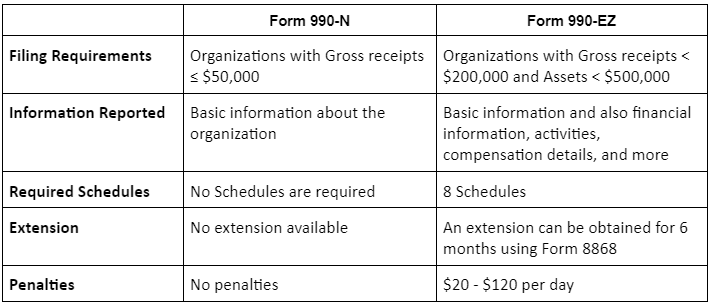
Form 990-N vs Form 990-EZ — A Comprehensive Breakdown

The purpose of both forms 990-N and 990-EZ might seem similar, but the distinction lies in the specific types of organizations that are required to file each form. Here are the key differences between the forms

  • Eligibility Requirements

Form 990-N:

Small nonprofit organizations can file Form 990-N if their gross profit is generally equal to or less than $50,000. If,

  • It has been in existence for 1 year or less and received or vowed $75,000 or less during its first tax year
  • It has been in existence for 1 to 3 years and has an average gross receipt of $60,000 or less during its first two tax years.
  • It has been in existence for 3 years and has an average gross receipt of $50,000 or less for the immediately preceding 3 tax years.

Form 990-EZ:

Nonprofit organizations can file Form 990-EZ if their gross receipt is less than $200,000 and total assets are less than $500,000 at the end of their tax year.

Organizations eligible to file Form 990-EZ include those that are 

  • Exempt from income tax under section 501(a) 
  • Political organizations under section 527
  • Nonexempt charitable trusts

Note: Non-profit organizations eligible to file Form 990-N may optionally choose to file Forms 990-EZ or 990. Those required to file Form 990-EZ can file Form 990, but vice versa is not possible.

  • Information Required

Form 990-N requires less information compared to Form 990-EZ. Form 990-N only requires basic information about the organization, whereas Form 990-EZ includes detailed financial data, activities, compensation specifics, and additional details.

  • Schedules

Form 990-EZ filers have 8 different types of schedules based on requirements. In contrast, Form 990-N filers are not required to submit any additional filings.

  • Penalties

Late filing of Form 990-EZ can result in penalties ranging from $20 to $120 for each day the return is late, depending on the organization’s size. Form 990-N typically does not carry any penalties for late filing. 

  • Extensions

The deadline for filing 990-EZ can be extended by using Form 8868. On the other hand, 990-N does not have any extensions.

A Quick Run-Down of the Key Differences

Similarities Between 990-N and 990-EZ

While we’ve discussed the major differences between 990-EZ and 990-N, here are some of the aspects that lie in common for both these forms.

  • Deadlines

All 990 forms, including 990-N and 990-EZ, share a common deadline that is the 15th day of the 5th month following the end of their tax year.

  • Automatic Revocation

Failure to file any of these forms for three consecutive years could lead to the automatic revocation of their tax-exempt status.

  • E-file Mandate

Both Form 990-N and Form 990-EZ must be submitted only through electronic filing as mandated by the IRS. This can be accomplished by using an IRS-authorized e-file provider. 

  • Public Disclosure

Like every other 990 form, once Form 990-N and Form 990-EZ are approved, they will be made available for public review.

Conclusion

Understanding the key significance of both forms allows nonprofits to navigate their tax obligations efficiently, minimizing ambiguity. To streamline this daunting process, opting for an ideal e-file provider is advised, which could significantly reduce these obscurities and, in turn, lessen the administrative burdens. 

Filed Under: Personal Finance

Traditional Banking vs. Digital Solutions: What is the Future of Overseas Payments?

June 28, 2024 by Susan Paige Leave a Comment

For businesses, sending money abroad can often feel like navigating a maze, with the constant fluctuation of forex rates and the overwhelming number of transfer options. Traditional banks, while seemingly reliable, often charge large fees and obscure the true cost of international transfers. SWiM PAY offers an alternative, providing a seamless and cost-effective solution for those needing to send money overseas. Here’s how SWiM PAY manages to surpass the major banks and deliver superior FX rates and services.

Understanding Forex Rates

Forex rates, or ‘FX rates’, fluctuate constantly and are crucial when transferring money to a country with a different currency. This is especially significant for businesses that often handle much larger sums than individuals. Given the dynamic nature of global finance, ensuring one gets the best deal on forex rates is essential.

The Drawbacks of Traditional Banking

Traditional banking involves physical branches with all their associated costs, including tellers, vaults, and ATMs. This old-school approach falls short in modern finance for several reasons:

  • High Overheads: Maintaining physical branches is expensive, and these costs are passed on to customers when sending money overseas.
  • Broad Focus: Traditional banks deal with a wide range of services, from home loans to insurance, which means they don’t need to offer competitive forex rates.
  • Reputation Trading: Big banks rely on their brand recognition, allowing them to maintain complex fee structures and higher exchange rates.

While big banks have their advantages, their size makes adopting new financial technologies cumbersome. As a result, they often lag in providing competitive forex rates.

The Advantages of Fintech

Fintech, or financial technology, is revolutionizing banking, particularly in real-time forex rate comparisons and online services. SWiM PAY leverages fintech to offer superior services in several ways:

  • Lower Overheads: Without physical locations, SWiM PAY reduces costs and passes those savings to customers.
  • Automation and Focus: SWiM PAY uses cutting-edge global payment technology, providing a streamlined platform dedicated to international money transfers.
  • Digital Focus: Unlike traditional banks, SWiM PAY is fully invested in digital and online payments, crucial for cross-border transactions.
  • Digital Wallets: Digital wallets are the preferred choice for online transactions across borders. SWiM PAY’s digital wallets support multiple currencies, offer instant global transfers, and ensure top-notch security.

The Bottom Line: Fintech’s Impact on Forex Rates

SWiM PAY’s competitive forex rates are transparent and free from confusing financial jargon. Specializing in digital payments and business forex, SWiM PAY offers better rates than big banks. This specialization in global payments is the key advantage.

One can easily compare FX rates on the SWiM PAY website, check the rates from the world’s largest banks, and see for themselves that SWiM PAY’s forex rates truly stand out.

Filed Under: Personal Finance

Top Digital Marketing Agencies: Leaders in Innovation and Results

June 28, 2024 by Susan Paige Leave a Comment

In the era of digitalization, where our lifestyles are driven by online technologies, the importance of a robust digital strategy cannot be underestimated. Businesses opting for a quality digital strategy are blossoming, standing out from the competition with higher brand recognition and customer engagement. A significant part of propelling this burgeoning wave is the assistance of a reputable digital marketing company.

From social media marketing to search engine optimization, affiliated marketing, and content marketing, the top digital marketing agencies are reshaping the business landscape with their innovative digital solutions. Here, we delve into some of the top agencies that have proven to be leaders in innovation and results. 

Leaders in Innovation and Results

Several marketing agencies globally perfectly blend technology with creativity and strategic thinking, helping businesses to thrive in digital platforms. Here are some internationally recognised, leaders in the field of digital marketing.

Karmarama

As part of Accenture Interactive, Karmarama is known for its innovative approach to digital marketing. Renowned for its creative designs, data-driven solutions, and personalised strategies, Karmarama has a global reputation for delivering stellar results to its clients.

Starcom

With a global presence in 100+ countries, Starcom excels at combining data insights and brand-building strategies to deliver effective digital marketing campaigns. Striving for agile innovations, Starcom has surpassed the expectations of businesses across various sectors.

Digitas

Belonging to the Publicis Groupe, Digitas focuses on creating connective experiences that can transform businesses. It employs its data-driven strategies, creativity, and in-depth technological knowledge, to assist its clients in building meaningful customer relationships.

Wunderman Thompson

Wunderman Thompson merges creativity, data, technology, and business consultancy to provide end-to-end marketing solutions. Its innovative strategies and goal-oriented approach have denoted Wunderman Thompson as a frontrunner in growing meaningful brand experiences.

Conclusion

Undoubtedly, today’s digital marketing landscape is diverse and complex. However, various agencies are striving to simplify this complexity with their innovative digital marketing solutions. The ability to translate contemporary technological advancements into accessible and effective marketing strategies is what marks out an agency as a leader amidst the global competition. 

By choosing to partner with a leading digital marketing agency, businesses can seize unique opportunities that will propel them into the future, fostering enhanced customer relationships and higher brand recognition along the way.

Author Bio: Ben Austin is the founder and CEO of multi-award-winning digital marketing agency Absolute Digital Media. Ben loves to write and share exclusive insights into the world of digital marketing from his own eyes.

Filed Under: Personal Finance

  • « Previous Page
  • 1
  • …
  • 4
  • 5
  • 6
  • 7
  • 8
  • …
  • 63
  • Next Page »

Follow Us

Search this site:

Recent Posts

  • Can My Savings Account Affect My Financial Aid? by Tamila McDonald
  • 12 Ways Gen X’s Views Clash with Millennials… by Tamila McDonald
  • What Advantages and Disadvantages Are There To… by Jacob Sensiba
  • 10 Tactics for Building an Emergency Fund from Scratch by Vanessa Bermudez
  • Call 911: Go To the Emergency Room Immediately If… by Stephen Kanaval
  • 7 Weird Things You Can Sell Online by Tamila McDonald
  • 10 Scary Facts About DriveTime by Tamila McDonald

Copyright © 2026 · News Pro Theme on Genesis Framework